
AI for Nonprofits: Smart Ways to Strengthen Your Impact


Table of Content
Download Paymattic – it’s Free!

Subscribe To Get
WordPress Guides, Tips, and Tutorials
We will never spam you. We will only send you product updates and tips.
Nonprofit organizers often have to wear multiple hats at the same time to keep their organizations running. On any given day, they act as fundraisers, communicators, program managers, and accountants, often juggling all these roles with limited resources.
They operate activities on tight budgets, which means balancing mission-driven work with everyday operations is a constant challenge. However, technology continues to evolve rapidly, and nonprofits that adopt new technologies report noticeable increased efficiency in their operations.
Almost 60% of nonprofits are already using AI for their organizational work. With the right use of AI, these organizations manage their repetitive tasks, organize information, and support operations without spending twice the time or effort.
In this article, we’ll show you how to use AI for nonprofits to strengthen their impact and make day-to-day work more manageable without adding unnecessary complexity.
The role of AI in nonprofit work
Nonprofits deal with a wide range of tasks every day, often with limited staff and time. This is where AI for nonprofits can play a supportive role. It helps teams handle routine work more efficiently while staying focused on their mission.
70% nonprofits agreed that AI assist to reduce workload and boosting the efficiency of their organizational activities.
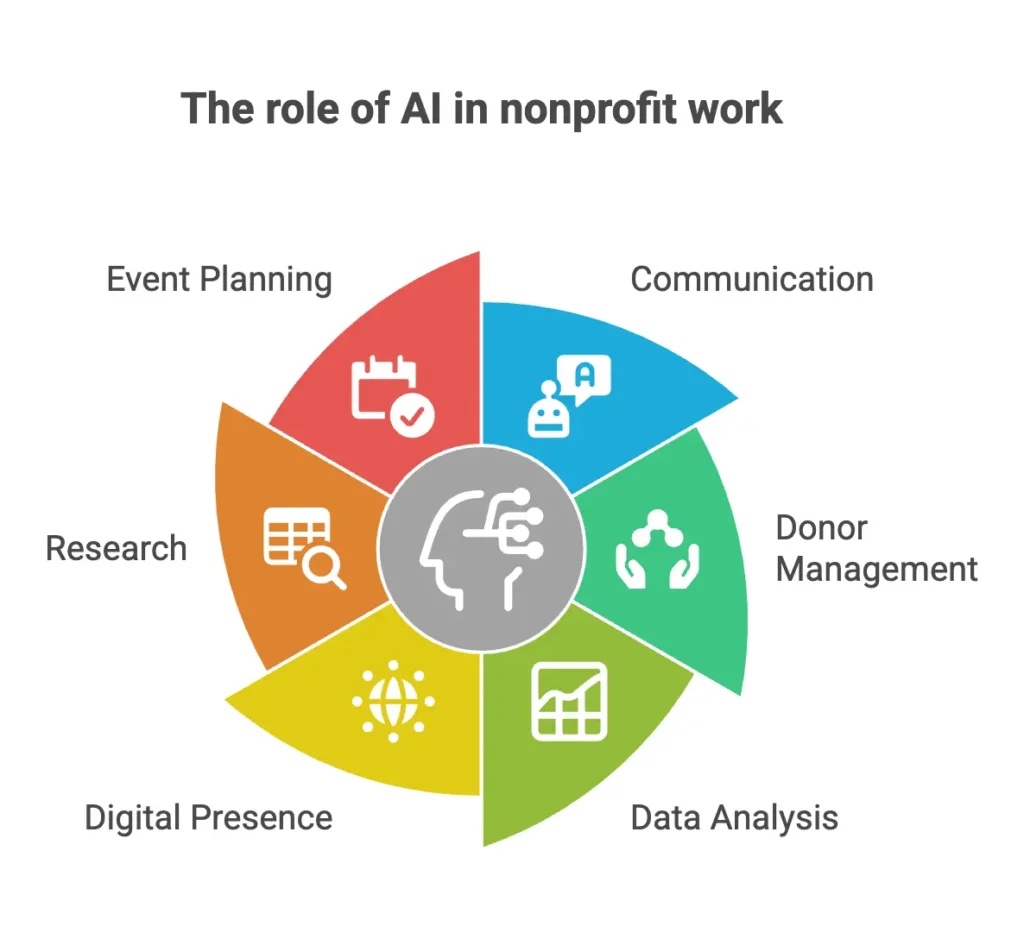
Below are some of the key areas where AI can help nonprofit organizations.
Communication
Clear communication is essential for nonprofits, whether it’s writing emails, grant proposals, blog posts, or donor updates. AI can help draft initial content, refine messaging, and maintain consistency across communication channels. This reduces the time spent starting from scratch and allows teams to focus on storytelling and relationship-building.
Donor management
Managing donor communication can be time-consuming for small teams. With AI, nonprofits can organize donor data, personalize messages, track engagement, and plan timely follow-ups. This makes it easier to nurture long-term relationships, improve donor retention, and stay connected without adding extra administrative workload.
Data analysis and reporting
Nonprofits collect data from donations, campaigns, and programs, but often struggle to turn it into insights. AI helps summarize information, spot trends, and create clear reports. This allows teams to share results confidently with stakeholders, board members, and funders without spending hours on manual analysis.
Digital presence
A nonprofit’s digital presence is often the first impression for donors, volunteers, and supporters. AI can help improve website content, keep information organized, and ensure pages stay updated. This makes it easier for visitors to understand your mission, find key information, and feel confident supporting your work.
Research and information gathering
Nonprofits often need to research grant opportunities, community needs, or policy updates. AI for nonprofits can help by summarizing large amounts of information and highlighting key points. This saves valuable time, reduces manual effort, and helps teams make informed decisions faster without getting overwhelmed.
Event planning
Nonprofits have to plan multiple events to raise funds. Planning an event can be a complex and time-consuming task. AI can assist with scheduling, task management, and attendee communication, ensuring important details are organized and deadlines are met.
All of these benefits are possible with the support of AI for nonprofits, but they don’t happen without your involvement. The results depend entirely on how thoughtfully you use these tools and how clearly you guide them. The more context, direction, and intention you provide, the better the outcomes will be.
How AI is changing fundraising
Fundraising has always been about relationships, timing, and personalization. The challenge is maintaining that human connection at scale when a small team is managing thousands of donors.
According to the 2025 Online Donor Feedback Survey, 67% of fundraisers now agree that nonprofits should use these technologies to assist in fundraising and administrative tasks. More importantly, those who do are seeing a measurable “productivity boom.”
For example, with the help of AI, writing personalized thank-you notes for 500 donors now takes minutes instead of days.
Traditional fundraising often relies on “RFM” (Recency, Frequency, Monetary) data, such as examining who gave last and how much they gave. AI for nonprofits takes this further by using predictive modeling to answer three vital questions: Who should we contact, when is the perfect time, and how much should we ask for?
Research shows that 30% of nonprofits have already boosted their fundraising revenue in the last 12 months by using smarter AI engagement tools.
So, it’s already clear that AI can be your great partner. The key is to guide it with your voice and tone, especially when communicating with donors, so that they feel a connection to your mission.
Subscribe Newsletter
Subscribe to our newsletter for updates, exclusive offers, and news you won’t miss!

How to use AI for your nonprofit
Today, AI is helping nonprofits in many ways, from building a strong online presence to handling administrative work. From the journey of thinking to implementation, you can use AI as your supporting partner.
But one thing to remember, AI works best when you provide it with clear instructions.
Here are the key areas where technology transforms daily operations:
Website creation
The appearance of your nonprofit websites matters most, as donors make most of the giving decisions here. So, it needs to be perfect, organized, and meaningful.
Building a website used to mean hiring a developer or spending weeks with complicated platforms. However, with AI website building tools like Wix AI, 10Web, and Durable, now possible to build professional sites in minutes. You just answer questions about your organization, upload your logo and photos, and get a complete site with donation buttons and contact forms.
These AI website builders are a great choice for nonprofits that want to save time and ignore the complicated website-building process.
Design visual content
Visual communication is essential for nonprofits to convey their mission, but not every organization has a dedicated design team. AI can support teams in creating visuals for social media, presentations, and marketing materials, helping maintain a consistent style across platforms.
Several AI tools generate interactive wireframes and layouts from text prompts that can be published directly. Tools like Farmar AI, Figma AI, and Relume.io allow you to describe your preference in natural language and deliver designs based on your prompt instantly.
Content generation
Good content immediately touches donors’ emotions. The content you delivered is very important as it brings the story of your mission. With the help of AI tools, content writing become faster than ever.
Feed a tool your program updates and impact stories, and get a draft in your organization’s voice. Before publishing it on your website, edit and add personal touches where you feel necessary. There are many tools, such as ChatGPT, Claude, and Jasper, that can produce SEO friendly content within two minutes.
Administrative task
Nonprofit organizers have to handle multiple administrative responsibilities like scheduling meetings, organizing files, tracking deadlines, managing volunteer databases, and responding to routine inquiries. This is where AI can make a meaningful difference. It can handle this task efficiently for you.
Many nonprofits already use these tools to manage their administrative task, so they can focus on their mission completely. For example, you can use a tool like Otter.ai for taking notes, instead of skipping yourself from actively participating in important meetings.
Social media promotion
Social media is the best way to reach a wider audience. Many nonprofits actively post on social media their daily activities to engage their supporters. It’s proven that almost 59% people who engage with non-profit social media donated to their cause.
To create social media post requires two things: engaging visuals and content that delivers emotions. AI for nonprofits can help you save time and effort to do that. We already mentioned AI tools that can help you create visuals and content for social media promotion.
Email marketing
48% donors like to get updates about fundraising campaigns through emails. That means email marketing plays a huge role to retainting your existing supporters.
AI for nonprofits helps simplify email marketing by making communication more timely and relevant. It can assist in organizing contact lists, personalizing email content based on donor or subscriber behavior, and scheduling emails at the right time. This ensures messages feel more thoughtful and engaging, while reducing the manual effort required to manage ongoing email campaigns.
Donor research
Donor research is a critical part of successful fundraising, but it can be time-consuming and complex. AI helps simplify this process by analyzing large amounts of donor data, segmenting the donor types and identifying patterns that may be difficult to spot manually.
Tools like DonorSearch AI are designed specifically for nonprofit donor research. DonorSearch AI helps organizations identify high-potential donors by analyzing wealth indicators, philanthropic history, and engagement data. This enables fundraising teams to focus their efforts on donors who are more likely to support their mission, saving time while improving the quality of donor outreach.
Leverage AI to amplify your nonprofit’s impact
As we move into 2026, technology adoption is expected. What truly matters is how nonprofits use it to create meaningful impact and advance their mission.
How AI helps nonprofits work smarter is already visible in everyday tasks. AI reduces manual effort by assisting with admin work, donor data management, research, and communication, giving nonprofit teams more time to focus on impact rather than operations.
To turn these efforts into real results, nonprofits need the right tools alongside AI. If you’re running your website on WordPress, a donation solution like Paymattic can help you launch and manage fundraising campaigns smoothly.
If you’re already using Paymattic, then you must have a good experience of online fundraising. And, if you have not tried Paymattic yet, give it a try, you’ll definitly loved it.
Join the thousands already enjoying Paymattic Pro!
Frequently asked questions
Here are some frequently asked questions about uses of AI for nonprofits.
1. What does AI actually mean for nonprofits?
AI for nonprofits refers to using artificial intelligence tools to support everyday work, such as fundraising, communication, donor research, reporting, and administrative tasks. It helps small teams do more with limited time and resources without replacing human decision-making.
2. Is AI expensive or difficult for nonprofits to adopt?
Many AI tools are affordable or even free at entry levels, and some are already built into platforms nonprofits use daily. The key is choosing tools that solve specific problems instead of adopting AI just for the sake of it.
3. Can AI help nonprofits raise more donations?
Yes, AI can support fundraising by analyzing donor data, predicting giving behavior, personalizing outreach, and improving campaign timing. While AI doesn’t replace relationships, it helps nonprofits make smarter, data-driven fundraising decisions.
4. Is it safe to use AI with donor data?
AI can be used safely if nonprofits choose tools that follow strong data privacy and compliance standards. It’s important to understand how data is stored, processed, and protected, and to use AI as a support system, not as an unchecked decision-maker.
5. Will AI replace nonprofit staff or volunteers?
No. AI is designed to assist, not replace, nonprofit teams. It handles repetitive and time-consuming tasks so staff and volunteers can focus more on strategy, relationships, and mission-driven work. The final work must be done under the guidance of the nonprofit staff.

Madhobi
This is Madhobi, a content writer at WPManageNinja with expertise in technical writing and email marketing. Outside of work, she likes traveling and exploring new places.

Leave a Reply