
How To Keep Your Donors For Life Using The Donor Engagement Cycle?


Table of Content
Download Paymattic – it’s Free!

Subscribe To Get
WordPress Guides, Tips, and Tutorials
We will never spam you. We will only send you product updates and tips.
Too Long; Didn’t Read?
The donor engagement cycle is a repeatable process that helps nonprofits turn one-time donors into long-term supporters. It has 5 stages: Identification, Qualification, Cultivation, Solicitation, and Stewardship.
- Follow the full cycle to improve donor retention, lifetime value, and predictable revenue.
- Avoid common mistakes like only reaching out when you need money, weak thank-you follow-ups, and treating every donor the same.
- Use the 30-day engagement plan in this guide to build a simple system you can run every month.
Most nonprofits don’t have a fundraising problem. They have a donor engagement problem.
I’ve seen nonprofits work harder every year, send more emails, and run more campaigns; yet still lose donors after the first gift.
That’s why I rely on a clear donor engagement cycle: a simple, repeatable path to move people from first-time giver to long-term supporter.
In this blog, I’ll show you how to use that cycle, avoid the mistakes that quietly kill your results, and turn the donors you already have into a stronger, more reliable source of revenue.
You’ll learn the 5 core stages: Identification, Qualification, Cultivation, Solicitation, and Stewardship, along with practical examples, questions to ask, and mistakes to avoid.
You’ll also get a 30-day donor engagement plan you can copy, plus a shortlist of tools to manage the full donor cycle and improve retention, donor value, and steady fundraising revenue.
So, let’s get started.
What is the Donor Engagement Cycle?
The Donor Engagement Cycle is a continuous, strategic process used by nonprofits to identify, cultivate, solicit, and steward donors, nurturing them from initial awareness into lifelong supporters.
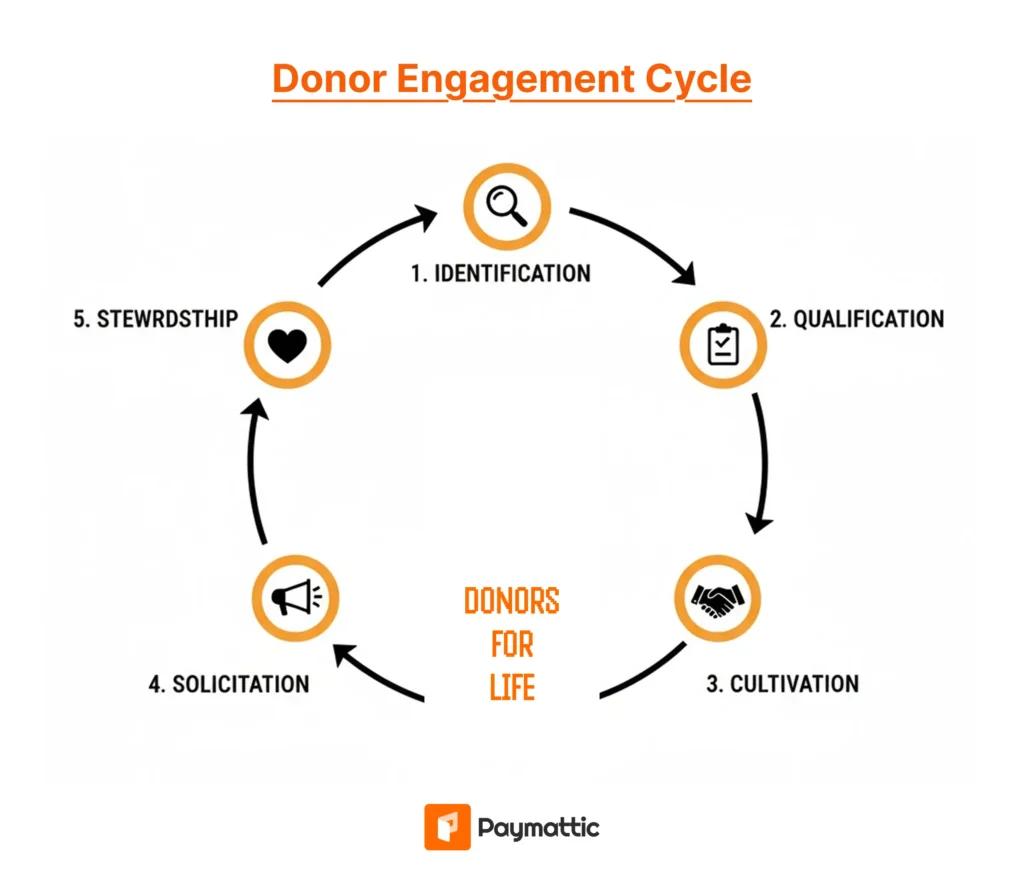
It moves away from one-off donations, focusing on relationship-building (Ask, Thank, Report, Repeat) to increase donor retention rates and maximize lifetime value.
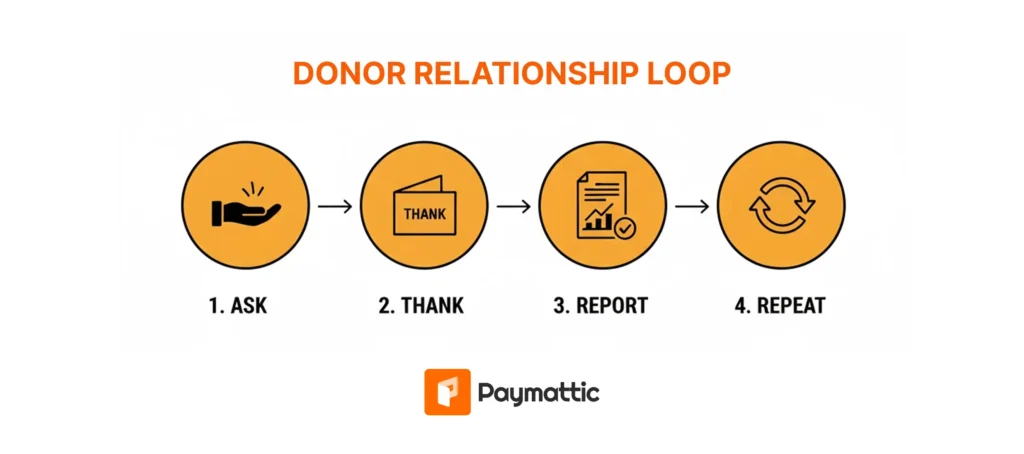
Instead of treating each donation as a one-off gift, the donor engagement cycle helps you see every interaction as part of a bigger donor journey.
I use it as a practical checklist to make sure no stage is skipped, and no good prospect is left drifting in your database.
The 5-core stages of the Donor Engagement Cycle
The donor engagement cycle is a simple and structured way to move people from interested to invested. When you follow all five stages, you spend less time chasing new donors and more time growing the donor life cycle value of the donors you already have.
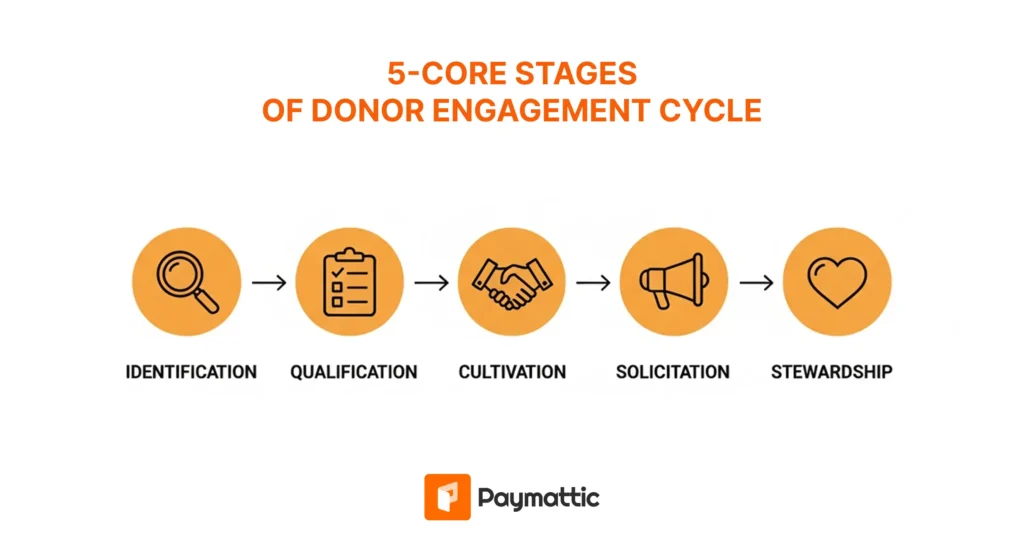
Let’s walk through each stage and see how it fits into your donor pipeline stages and overall donor relations plan.
1: Identification
The identification stage is about finding the right donors and who you should focus on. In this fundraising cycle, you actively look for people who care about your cause and can realistically give.
In identification, you aren’t asking for money. You’re building a focused list so you don’t waste time on the wrong people. This foundation sets up every other part of the donor relations strategy.
Good identification is the first step in any donor engagement strategy template.
If you skip or rush identification, you end up with a noisy donor list that consists of lots of names, few real partners, and low ROI on your donation campaigns.
Example of the identification stage
Let’s say you run a local education nonprofit. To identify prospective donors, you:
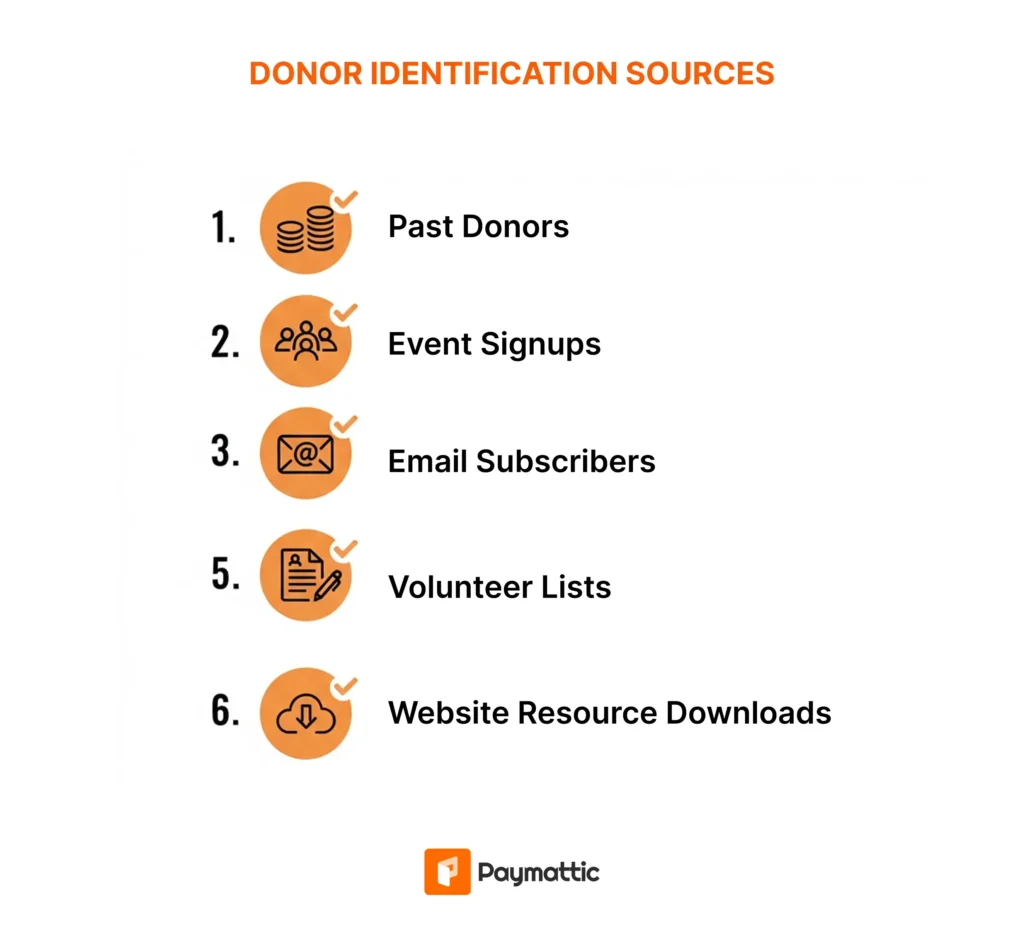
- Pull a list of people who have:
- Donated in the last 24 months
- Attended an event
- Downloaded a resource from your website
- Cross-check that list with:
- People who live in your city
- Parents of school-aged children
- People who already give to education causes
From there, you focus your time on those who are engaged and aligned with your mission. This is how you build a realistic donor pipeline you can later use to cultivate donors and invite them into cultivation in fundraising.
Things to consider in donor identification
- Look for the three basics
- Past giving (to you or similar causes)
- Ability to give (income, wealth indicators, job role, business ownership, etc.)
- Connection to your mission (location, lived experience, values, affiliations)
- Use the data you already have
- Your CRM or even a spreadsheet
- Event signups and email subscribers
- Volunteer lists and petition signers
- Start broad, then narrow
- Begin with a wider list of “possible” donors
- Narrow it down to a smaller group who are likely to give again or upgrade
- Don’t ignore small donors
- Regular small givers often have a high affinity for your cause, and you can turn them into long-term supporters
2: Qualification
Qualification is about assessing the donor’s interest and capacity while deciding who is worth deeper effort right now. After the qualification stage, you move from “maybe” to “yes, we should invest in this relationship.”
In qualification, you validate two things. One, do they care enough about this cause? Two, can they give at the level that makes sense for your strategy?
In many donor strategy templates, qualification sits early in the 6 stages of the fundraising cycle, because it shapes how you will be cultivating donors later.
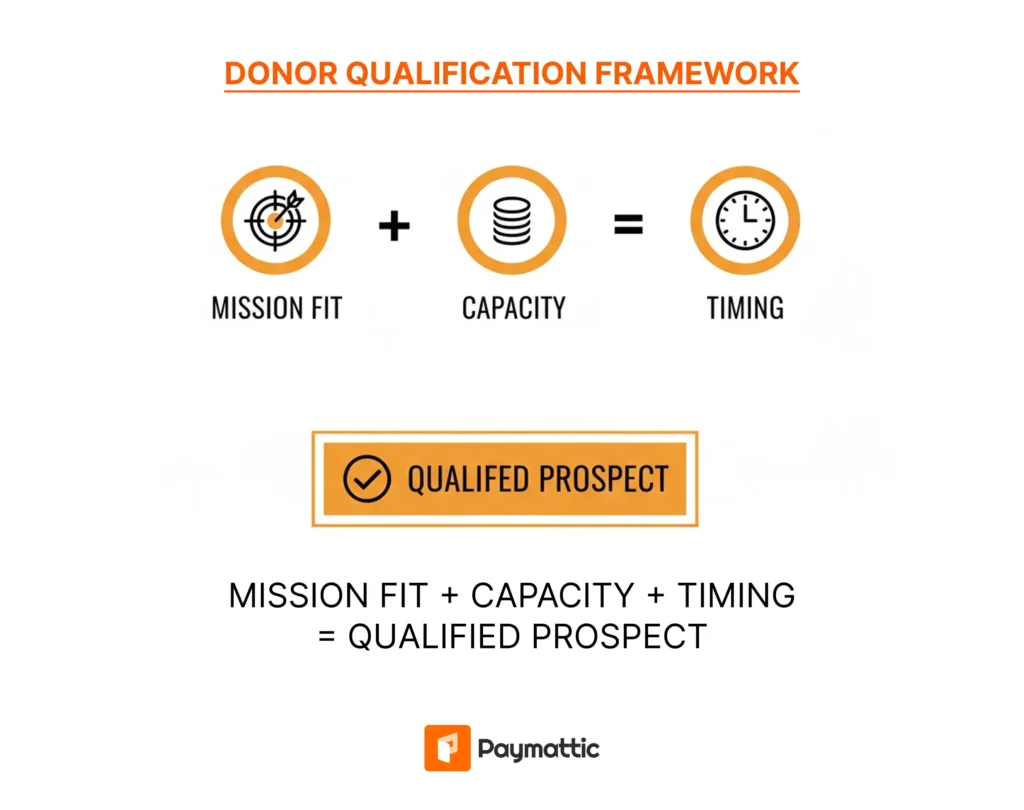
If you skip qualification, you treat every name on your list the same. That leads to weak portfolios, slow pipelines, and lots of nice conversations that never go anywhere.
Questions to ask in donor qualification stage
You can ask these in conversations, surveys, or casual check-ins –
- To assess your mission fitness:
- What first drew you to our organization?
- Which part of our work matters most to you?
- Which other causes or nonprofits do you support?
- To assess priority and timing:
- Where do we sit among your charitable priorities right now?
- Are there any big commitments or changes this year that affect your giving?
- To check the donor’s engagement level:
- How would you like to be involved with our work?
- What kind of updates or invitations are most useful for you?
- To assess the donor’s giving comfort:
- When you think about making a meaningful gift, what does that look like for you?
- Would you be open to talking about a larger impact in the future?
It might sound overwhelming to the donors, but you are not hard-selling. You are listening and taking notes so you can build a realistic donor relations plan around each engaged donor.
Signs a prospect is qualified
Let’s look at some signals that scream your prospective donor is qualified for your fundraising mission.
The donor –
- Has given recently, or increased their gift size over time
- Engages with your content (opens emails, replies, attends events, volunteers)
- Talks about your mission using “we” language, not just “you” language
- Has clear capacity markers (role, business, property, prior large gifts elsewhere)
- Is open to meeting, sharing their story, and exploring impact
- Signals that your cause is a top priority, not just a nice-to-have
These are the people you want to move forward through your donor pipeline stages and invest more time in engaging donors in a structured way.
3: Cultivation
Cultivation is the relationship-building phase.
You help the donor understand your work, see their impact, and feel personally connected before you ask for more or ask for a bigger gift. This is the heart of cultivation in fundraising.
At this point in the fundraising cycle, your focus is to cultivate donors with consistent, meaningful touchpoints that turn a casual giver into an engaged donor.
If you skip cultivation, your asks feel sudden and transactional. Donors may give once, but they rarely stick around or upgrade.
Practical touchpoint for the cultivation stage
Use a mix of low effort and high touch, depending on the donor:
- Education and access
- Short impact emails with one clear story
- Invite them to a site visit, tour, or behind the scenes call
- Share a simple day-in-the-life of someone they are helping
- Involvement and voice
- Ask them for feedback on a campaign idea or message
- Invite them to join a small roundtable or Q&A with your program staff
- Offer volunteer roles that align with their skills
- Recognition and relationship
- Personal thank you calls from staff, board, or beneficiaries
- Handwritten notes after events or milestones
- Introductions to other supporters with similar interests
Well designed donor cultivation events can sit in this stage. They give donors access, recognition, and a stronger sense of belonging without being a hard sell.
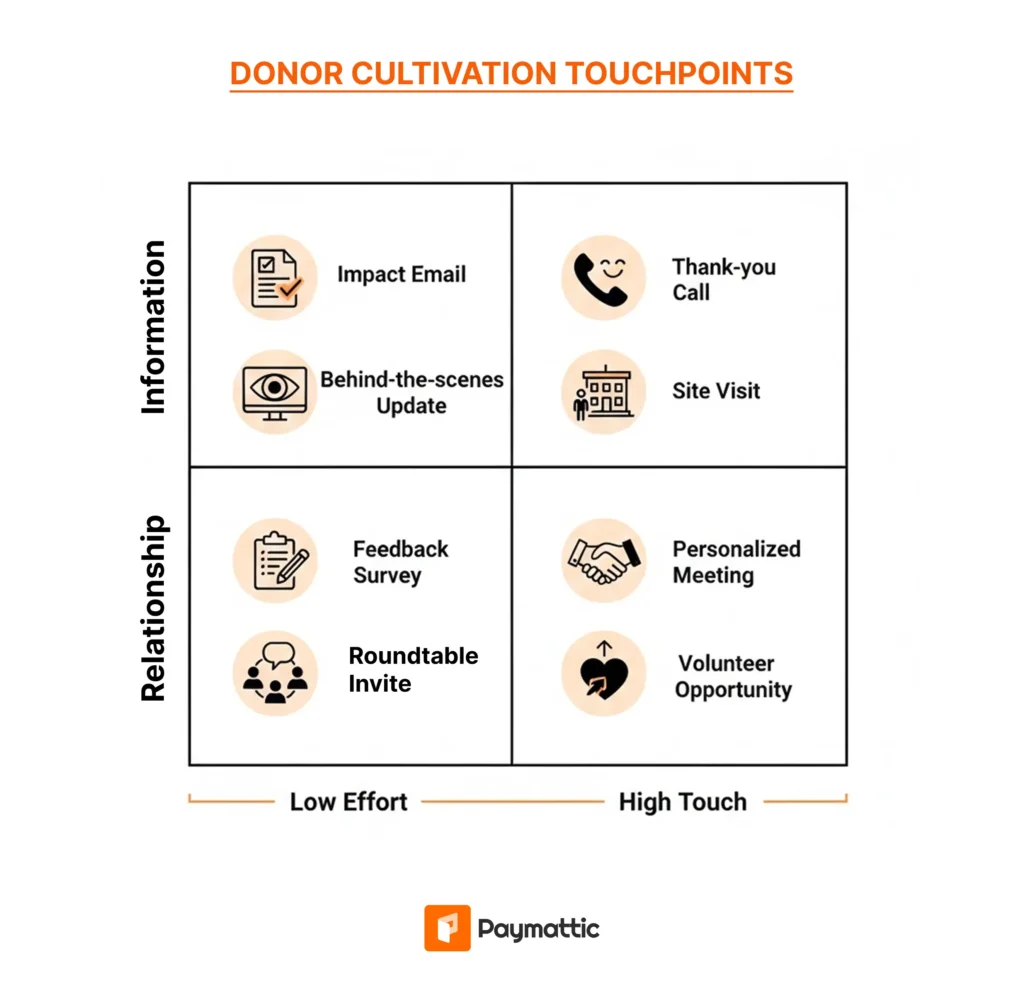
Every touchpoint should either build trust, deepen understanding, or show impact.
How often to follow up
There is no single perfect cadence, but as a baseline:
- For mid and major prospects:
- Aim for 1 meaningful touchpoint every 4 to 6 weeks
- Increase frequency around key campaigns or events
- For general donors:
- Regular email updates (monthly or bi-monthly)
- A few higher touch moments across the year (thank you calls, surveys, invites)
You should cover some basics before contacting a donor.
For example, plan your touchpoints so they don’t feel like constant asks. Also, track activity in your CRM so donors don’t get duplicate or conflicting outreach. And adjust your follow-up messages based on their response.
This rhythm becomes part of your donor engagement strategy template and helps you stay consistent when cultivating donors at scale.
4: Solicitation
Solicitation is where you clearly ask for support.
By this point, the donor understands your work and sees where they fit. Your job is to make the ask direct, specific, and easy to say yes to.
If you handle this stage well, the solicitation stage converts an engaged donor into a committed partner and turns your earlier donor relations strategy into actual revenue. If you mishandle this stage, you either ask too small, ask too soon, or never ask at all.
How to make a clear, compelling ask
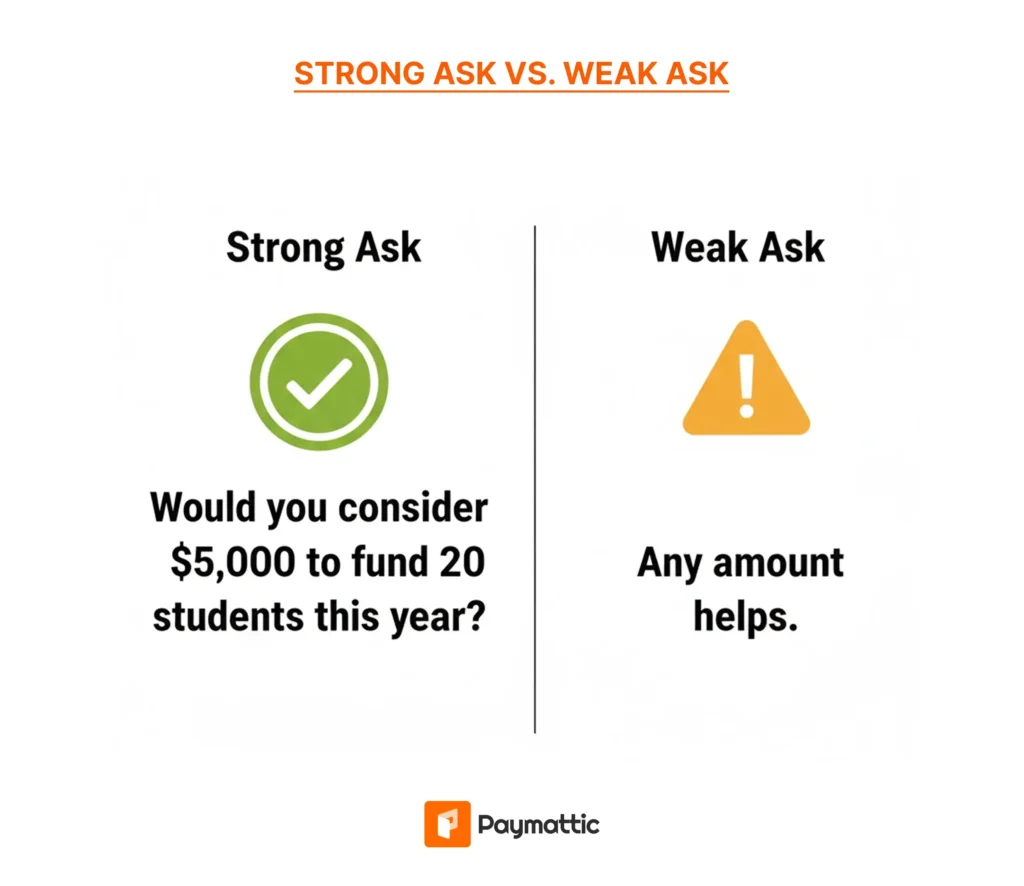
- Be specific
- Ask “Would you consider a gift of $5,000 to fund 20 students’ full tuition this year?”
- Not: “Any amount helps.”
- Tie the gift to a concrete outcome
- Show what their gift will change, not just what it will “support”
- Acknowledge their history
- Ask “You have been with us for three years and helped launch X. We’d love to talk about a larger impact.”
- Offer options, but have a lead ask
- Ask “We are asking some donors to consider $5,000. For you, that could look like $2,500 now and $2,500 later in the year.”
- Make the next step obvious
- A short reply, a calendar link, a pledge form, or a donate button that works on mobile
These practices fit neatly inside any donor strategy template or donor engagement strategy template because they are simple and repeatable.
Mistakes to avoid in the solicitation stage
There are some mistakes you should avoid in this stage. Like –
- Apologizing for the ask: Over qualifying (“I know times are hard, you can say no…”) weakens your message
- Asking too vaguely: Donors can’t decide if they don’t know the number, the purpose, or the timing
- Overloading with information: The ask moment is not the time for a long slide deck or wall of stats
- Ignoring the donor’s signals: If they have already said they need time, don’t push for an on-the-spot decision
- Ending without a clear close: You should always end with either a direct ask or a firm next step
5: Stewardship
Stewardship starts the moment a donor gives. It is how you thank them, report back, and keep the relationship going so their first gift becomes one of many.
Strong stewardship is what turns a transaction into a long term donor relations plan. It is also a key part of engaging donors in the later donor pipeline stages and closing the loop on the 6 stages of the fundraising cycle.
If you treat stewardship as an afterthought, your donor file leaks. You work hard to win donors, then lose them quietly because they never feel seen or informed.
How to properly thank donors
I follow a donor thank you framework that I call FPS (Fast, Personal, Specific). Aim for fast, personal, and specific responses.
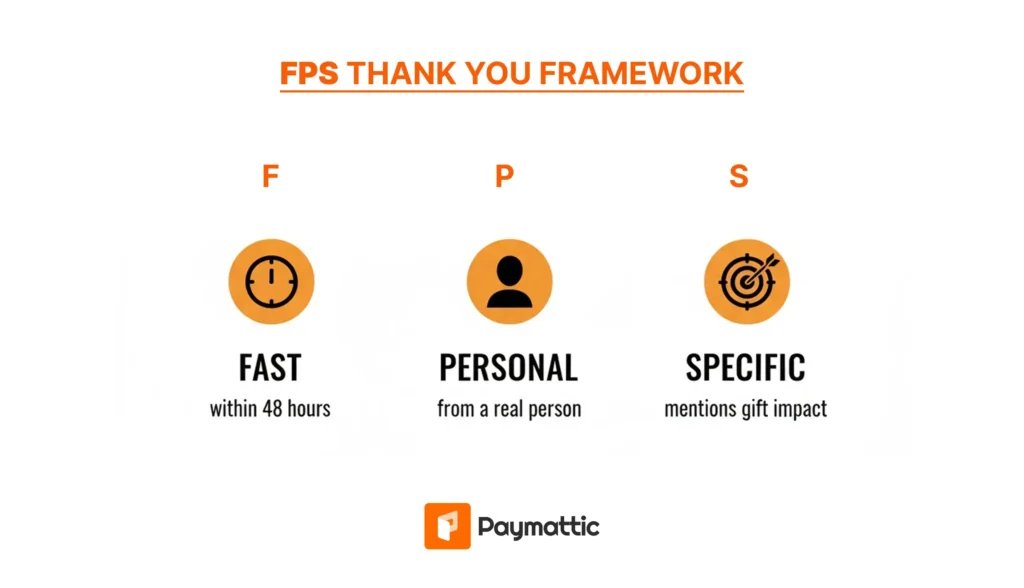
- Fast
- Automatic receipt within minutes
- Personal thank you (email, call, or note) within 48 hours for higher value gifts
- Personal
- Use their name, reference the specific gift, and avoid generic templates
- Where possible, thank them from a real person, not from “The Campaign Team”
- Specific
- Say “Your gift of $250 will cover school supplies for 5 students this semester. Thank you.”
Stewardship is more than a thank you message. It is an ongoing loop of thank, show impact, invite deeper connection, and ask again when it makes sense. Even small improvements here move the needle on retention and help you cultivate donors for the long term.
Practical tips to keep donors on loop
- Short impact updates a few times a year, focused on what you (the donor) made possible
- Annual or semi-annual reports written in plain language with photos and concrete outcomes
- Occasional non-ask touches such as appreciation events, behind-the-scenes videos, or simple “we thought you’d like this” emails
- Targeted invitations to upgrade:
- One-time donors → monthly donors
- Monthly donors → higher amount or special project
- Loyal annual donors → multi-year commitments or legacy discussions
When you put these pieces together, you have a simple donor relations strategy that brings you revenue throughout the year.
Here’s a video I found on YouTube that explains the donor engagement cycle in simple terms.
Over time, this is how you move donors smoothly through the donor pipeline stages and build a healthy base of supporters who stay, grow, and advocate for your cause.
Read: Donor Psychology 101: The Science Behind Why People Donate
Benefits of a strong donor engagement cycle
When your donor engagement cycle is weak or inconsistent, you feel it everywhere. You work harder for the same (or smaller) results, you lose donors after one or two gifts, and your revenue becomes unpredictable from year to year.
A strong cycle does the opposite. It brings structure, better relationships, and a more stable income that you can plan around as part of a clear donor management process.
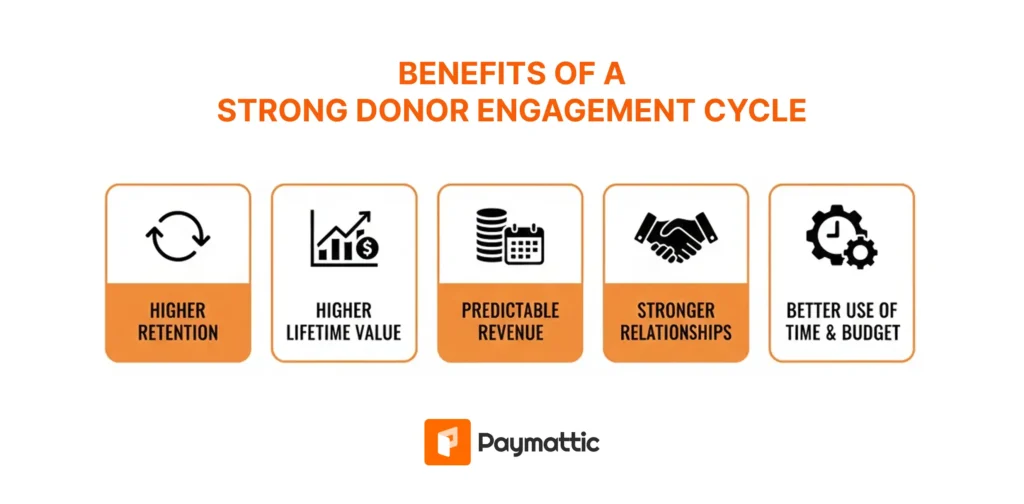
Here are some benefits of a strong donor engagement cycle, plus what each one means, why it matters, and how to improve it.
You can use these ideas to sharpen your nonprofit donor engagement strategies and build a practical donor engagement plan template that fits your organization.
Higher donor retention
Donor retention means how many of your donors come back and give again.
A strong engagement cycle keeps donors informed, appreciated, and connected between campaigns, so they are more likely to renew. Instead of treating each gift like a one-time win, you treat it as the start of a relationship, which is the foundation of cultivating donor relationships over time.
Higher retention helps because it is almost always cheaper to keep a donor than to find a new one. When donors feel seen and understand their impact, they are more likely to stick with you through economic changes and competing asks from other nonprofits.
Over time, this stable base of repeat donors smooths out your revenue and makes it easier to forecast and budget, especially when you understand your donor cycle stages and where people tend to drop off.
To improve retention, map your current touchpoints from first gift to second gift and beyond. Look for gaps where donors hear nothing from you. Add simple, repeatable steps such as fast thank you messages, short impact updates, and occasional surveys or check-ins. Track year-over-year retention as a key metric and use it to judge whether your nonprofit donor engagement efforts are actually paying off.
Higher lifetime donor value
Lifetime value means the total amount a donor gives to your organization over the full course of their relationship with you.
A strong donor engagement cycle increases lifetime value by turning small, occasional gifts into regular, larger, or multi-year support. It gives you a clear path to help donors grow their giving in a way that fits their interests and capacity.
This helps because it reduces your dependence on constant donor acquisition or one-off big wins.
When donors move through a clear journey of identification, cultivation, donor solicitation, and stewardship, they are more likely to upgrade to monthly giving, mid-level gifts, or even major gifts over time. That means more revenue per donor and less pressure to refill your donor file every year with new names.
To improve lifetime value, segment your donors by behavior and stage. Build simple upgrade paths for each segment, like small one-time donors to monthly givers, monthly givers to mid-level donors, and long-term supporters to legacy or campaign donors.
Use your donor engagement cycle at each step: qualify who is ready, use cultivation fundraising tactics with targeted content, then make clear, specific asks that match what you know about them. This is where a simple major donor strategy template can help you stay consistent.
Subscribe Newsletter
Subscribe to our newsletter for updates, exclusive offers, and news you won’t miss!

More predictable and sustainable revenue
Predictable revenue means you can roughly estimate what will come in over the next 6 to 12 months, based on patterns in your donor base.
A strong donor engagement cycle creates those patterns. When you consistently identify, cultivate, solicit, and steward donors, your results become more stable and less dependent on luck or last-minute pushes.
This helps because nonprofits need predictability to plan programs, hire staff, and commit to multi year projects. If your revenue swings wildly, you are forced into short term decisions, reactive cuts, or rushed appeals that can damage donor trust.
A disciplined approach to how to engage donors turns your base into a more reliable source of funding, not a guessing game.
To improve donation predictability, track key engagement metrics alongside money raised. Watch things like repeat gift rate, number of engaged donors at each stage, response rates to campaigns, and attendance at events. Use this data to forecast likely income by segment. Then refine your donor cycles where you see a drop off. For example, by strengthening follow-up with first-time donors so that more of them convert to second gifts.
Stronger donor relationships and advocacy
Stronger relationships mean donors feel emotionally connected to your work, not just aware of it.
In a strong donor engagement cycle, every stage is designed to build trust, show impact, and invite donors into the story. Over time, donors move from casual supporters to true partners who give, volunteer, and advocate for your cause.
This helps because engaged donors do more than give money. They share your campaigns, bring friends, host peer-to-peer fundraisers, and speak well of you in their networks.
In many organizations, the most engaged donors are also the most reliable during tough times and the most open to larger or more creative forms of support. This is what donor cultivation looks like in practice.
To improve relationship strength, audit your communications and touchpoints from the donor’s point of view. Check that you talk about “you” and “we,” not just “we” and “our organization.” Add moments where you ask for feedback, invite stories, and highlight donor voices in your content.
Use your engagement cycle to plan regular non-ask touchpoints such as appreciation notes, behind-the-scenes updates, and simple “here is what you made possible” messages. This is how to cultivate donors in a way that feels natural and keeps nonprofit donor engagement going between asks.
Better use of staff time and budget
A strong donor engagement cycle gives your team a clear process to follow instead of relying on ad hoc outreach.
Each stage has a purpose, clear next steps, and defined actions. This structure lets you prioritize the right donors at the right time, rather than treating everyone the same or chasing whoever is loudest.
This helps because staff time and budget are usually limited. Without a structured cycle, teams often spend too much time on low-potential prospects and too little time on the donors most likely to grow. Clear definitions for cultivation vs stewardship, and where each sits in your donor cycle stages, also make it easier to onboard new staff, hand off relationships, and maintain consistency as you grow.
To improve how you use time and budget, document your engagement stages and what should happen in each one. Turn that into a simple workflow that can be tracked in your CRM or even a spreadsheet. Define which donors get high-touch treatment and which get scaled, automated touchpoints.
And then review this workflow regularly, remove steps that do not add value, and double down on the ones that clearly move donors forward. Over time, this becomes a simple, repeatable framework for how to engage donors without burning out your team.
Common donor engagement mistakes to avoid
In my experience working with nonprofits, I’ve noticed that many of them tend to make some common mistakes when it comes to engaging with donors.
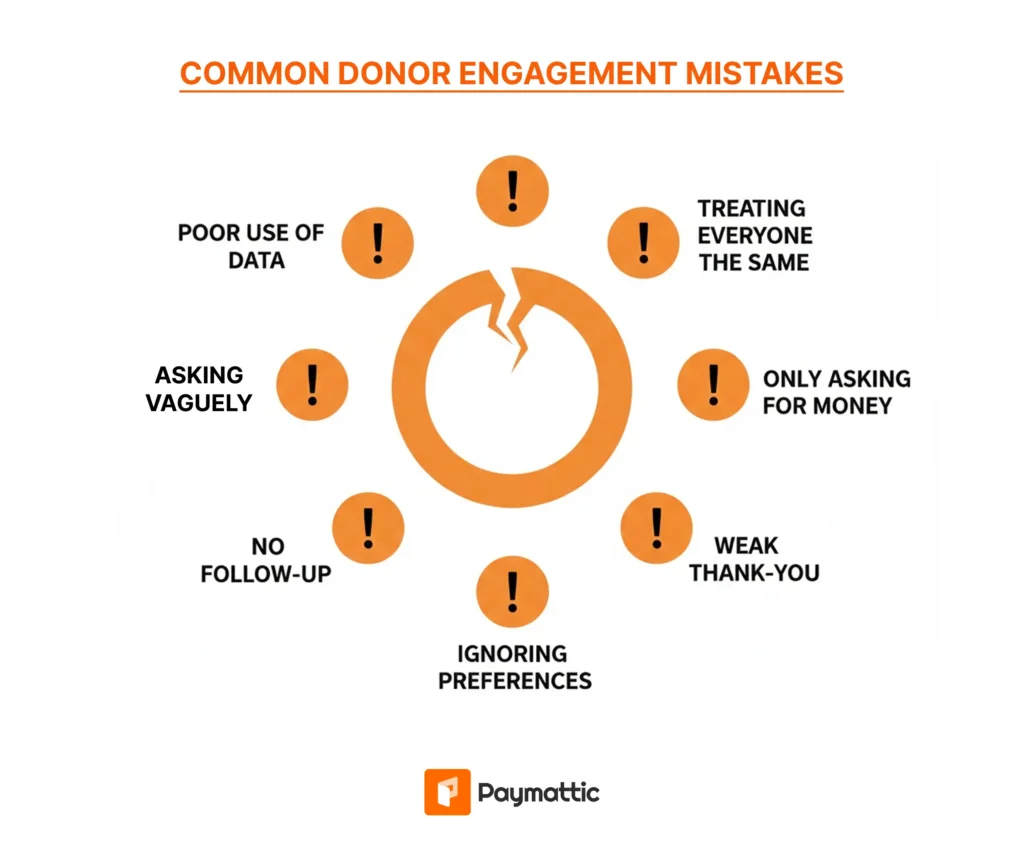
Here are some common mistakes you should be aware of:
Treating every donor the same
This mistake is using one generic approach for all donors, no matter how they give, why they give, or how long they have supported you.
Everyone gets the same emails, the same event invites, and the same asks. There is no real segmentation in your donor cycle beyond “on the list” and “not on the list.”
This hurts because generic communication feels irrelevant and easy to ignore.
High-potential donors do not get the deeper contact they need. Small but loyal donors feel overlooked. New donors do not get a clear next step in their donor journey.
Over time, this leads to low engagement, low response rates, weak retention, and a donor lifecycle that never really matures.
Only reaching out when you need money
In this scenario, donors only hear from you during campaigns or when there’s an urgent need. For the rest of the time, outreach is minimal or nonexistent.
Donors should be treated as partners who should see and feel their impact all year as part of a healthy donor engagement strategy.
This hurts because donors feel used and detached from your mission. If every message is an ask, people start to tune you out. They do not see progress or results between campaigns, so they question whether their support matters.
Over time, this pattern pushes donors away and makes every new appeal in your fundraising cycle harder to land.
Ignoring donor preferences
Here, you do not track or respect how donors want to hear from you.
You send emails to people who prefer phone calls. You call people who asked for emails only. You send too many messages to some donors and too few to others. You also ignore simple requests like do not contact me about events.
This hurts because it signals that you are not listening. Donors feel like names on a list instead of people moving through a thoughtful donor journey.
Some will unsubscribe completely. Others will stop opening messages. A few will complain to staff or online. All of this reduces engagement and makes it harder to rebuild trust and move people forward in the donor cycle.
Weak or late thank-you processes
In this mistake, thank you messages are slow, generic, or both. Receipts may go out, but personal thanks do not. Higher value donors and first-time donors are not acknowledged in a special way. Sometimes gifts are never recognized beyond the automated confirmation.
This hurts because the first hours and days after a gift are critical in the donor engagement cycle. A slow or cold thank you makes the gift feel unnoticed.
Donors are less likely to give again, answer your emails, or talk about you in a positive way. Poor stewardship at this point directly lowers retention, future gift size, and the effectiveness of your wider donor engagement strategies.
No clear follow-up after first gifts
Here you celebrate the first gift, then move on. And there is no specific plan to move first-time donors toward a second gift or deeper engagement. They drop into the same general list as everyone else and receive whatever mass messages go out next.
This hurts because the biggest drop in retention is often between the first and second gift in the donor life cycle. If you do not give new donors a clear path forward, most of them will never give again.
You end up spending budget to acquire donors who never become loyal supporters, which drives up your costs and weakens long-term income from your donor cycle fundraising.
Poor use of donor data
This mistake is having data but not using it well. Records are incomplete, out of date, or spread across different systems.
You do not track key engagement signals like event attendance, email behavior, or volunteer history in a consistent way, so staff rely on guesswork instead of facts.
This is crucial because you cannot see who is most engaged, who is at risk of lapsing, or which efforts are working. You waste time on the wrong prospects and miss donors who are ready for a stronger ask or deeper donor cultivation.
It also becomes hard to measure the real impact of your donor engagement work and refine your donor cultivation cycle over time.
Asking vaguely or without a clear purpose
Here, your appeals talk about your organization in general terms but do not make a specific request. You say every gift helps without naming an amount, a timeline, or a clear outcome.
There is no strong link between what you are asking for and what will change if the donor gives.
This hurts because donors have to do extra work to decide what to give, or whether to give at all. Many will postpone the decision or ignore the appeal.
Even when people give, they may choose lower amounts because they do not see a strong case for a larger gift. Over time, this leads to weaker campaigns, lower average gift sizes, and a donor engagement plan that never reaches its full potential.
Inconsistent follow-up on promises
In this mistake, staff make promises to donors and then do not follow through. You say you will send a report and never do. You promise a meeting and fail to schedule it. You tell a donor you will share an impact story and then forget about it.
Trust is central to donor engagement. When you do not keep your word, donors feel that their time and support are not valued. Even small broken promises add up.
Donors become cautious, less responsive, and less willing to commit to larger or longer term support, which weakens your entire donor cultivation plan.
Overlooking lapsed donors
Here, you let donors drift away without any real attempt to win them back. When someone stops giving or engaging, they disappear from your active plans.
There is no defined re engagement process, and lapsed donors are rarely reviewed or contacted with tailored messages.
Your lapsed donors often know your work and may be open to returning if approached in a thoughtful way. Ignoring them means you keep paying to acquire brand new donors while leaving a warm audience untouched.
It also hides warning signs about problems in your donor engagement cycle that might be pushing people away at specific points in the donor journey.
Working without a clear engagement strategy
In this mistake, your donor engagement is a series of one-off actions instead of a planned process. Different staff do different things with the same donors.
There is no shared calendar. You do not have clear stages or fundraising goals. Success depends on individual effort instead of a repeatable system.
This hurts because the results are inconsistent and hard to scale. When staff leave, relationships and knowledge leave with them. New team members struggle to know what to do next with any given donor.
Without a basic donor cultivation plan and strategy, you cannot improve your donor cultivation cycle or fundraising cycle in a focused way or see which changes actually work.
A 30-day donor engagement plan for nonprofits
Here’s a 30-day donor engagement plan you can implement in your nonprofit right away.
This plan is optimized for fast donor cultivation. You can copy this donor engagement plan template and implement it right away.
| Days | Stage | Focus | Key Actions | Primary Outcome |
| Day 1–2 (Week 1) | Identification | Define target segment | Choose priority group (first time, lapsed, event only, small recurring) and set simple inclusion criteria. | Clear focus for the 30 day sprint. |
| Day 3–4 (Week 1) | Identification | Build and clean list | Export data from CRM/sheets, remove bounces, DNCs, and duplicates; tag as “30 Day Engagement – Identified.” | Clean, usable prospect list. |
| Day 5–7 (Week 1) | Identification | Prioritize prospects | Score contacts (recent gift, event, engagement), group into top, mid, and base tiers. | Tiered list for different levels of effort. |
| Day 8–9 (Week 2) | Qualification | Define qualification signals | Decide what “qualified” means (opens, clicks, replies, meetings, gift level, capacity indicators). | Clear rules for who is worth deeper effort. |
| Day 10–11 (Week 2) | Qualification | Run a quick qualification outreach | Send short check-in emails/surveys or call invites to top and mid tiers with one simple CTA. | See who engages and shows interest. |
| Day 12–14 (Week 2) | Qualification | Sort and tag prospects | Tag as “qualified,” “monitor,” or “low priority” based on responses and engagement. | Shortlist for cultivation and future asks. |
| Day 15–16 (Week 3) | Cultivation | Plan tailored touchpoints | For each tier, define one key touchpoint (call/meeting for top, personalized email for mid, simple impact email for monitor). | Concrete cultivation plan by tier. |
| Day 17–18 (Week 3) | Cultivation | Execute cultivation | Make calls/meetings, send emails, share impact stories, ask interest questions, and log notes. | Stronger relationships and clearer donor interests. |
| Day 19–21 (Week 3) | Cultivation | Prepare for asks | Review responses, flag donors with strong alignment or “what else can I do?” signals. | Priority list for solicitation in Week 4. |
| Day 22–24 (Week 4) | Solicitation | Make tailored asks | For top: direct ask via call/video with amount, purpose, timing; for mid: personal email ask; for light: targeted campaign email. | Clear, specific asks to each engaged segment. |
| Day 25–27 (Week 4) | Stewardship | Thank and acknowledge | Within 24–48 hours, send prompt, specific thanks; add calls/notes for higher value and first time donors; thank non givers for time/feedback. | Donors feel seen and appreciated quickly. |
| Day 28–30 (Week 4) | Stewardship | Close loop and review | Tag all who gave, add them to a simple 90-day stewardship sequence; review metrics from all stages and note what worked. | Ready to repeat with a stronger next 30-day cycle. |
5 donor engagement tools
Here are five tools that can help you manage identification, qualification, cultivation, solicitation, and stewardship in one simple stack.
CharityEngine
CharityEngine is an all-in-one nonprofit CRM that brings fundraising, events, email, and payments into a single system.
Instead of stitching together multiple tools, you can see a full donor record in one place and use that to drive each stage of the donor engagement cycle.
Core features of CharityEngine
- Nonprofit CRM built for fundraising and donor management
- Secure, built-in payment processing
- Custom donation forms and campaign pages
- Email marketing tools tied directly to donor data
- Event and peer-to-peer fundraising management
- Major gift management and pipeline tracking
- Volunteer and sustainer (recurring) gift management
- Reporting and dashboards with 200+ ready-made reports
Salesforce
Salesforce Nonprofit Cloud is a flexible CRM platform that gives you a 360-degree view of donors, volunteers, and program participants.
It is designed for organizations that want strong data, complex workflows, and tight integration between fundraising, programs, and marketing.
If you have a defined donor lifecycle and multiple teams touching the same supporter, this helps everyone work from the same record.
Core features of Salesforce
- Centralized CRM for donors, volunteers, and beneficiaries
- Custom objects and fields to map your donor engagement cycle
- Native tools for fundraising, marketing, and program management
- AI features for summaries, insights, and recommendations
- Strong reporting and dashboard tools
- Large ecosystem of integrations and nonprofit-specific apps
- Discounted pricing and support through the Power of Us program
Donorbox
Donorbox is a fundraising suite focused on making online and on-site giving simple and fast. It is useful if you want to improve donation forms, add more ways to give, and manage donor records without a heavy setup.
For many small to mid-sized organizations, it can act as both an online giving platform and a lightweight donor engagement hub.
Core features of Donorbox
- Optimized donation forms and hosted donation pages
- AI-powered CRM for donor records, segmentation, and activity tracking
- Donor portal with QuickDonate to simplify repeat giving
- Text to give, donate buttons, and kiosks for in-person giving
- Memberships, crowdfunding, and peer-to-peer campaigns
- Event ticketing with automated receipting
- AI assistant for data queries and content drafting
- High uptime, strong security, and fraud protection
DonorPerfect
DonorPerfect is a donor management and fundraising CRM built for small and midsize nonprofits.
It gives you a central place to track gifts, communication history, and basic engagement activity. If you need something that is easier to learn and focused on core donor management, this is a practical option.
Core features of DonorPerfect
- Donor and gift management in a central database
- Campaign, appeal, and event tracking
- Basic automation for receipting and acknowledgments
- Reporting on retention, giving history, and trends
- Integrations with email tools such as Constant Contact
- Web forms and online giving options
- Training and customer support aimed at smaller teams
Anedot
Anedot is an online giving platform used by nonprofits, churches, schools, and campaigns. It is designed to help you create high-converting donation pages, capture donor data, and keep processing simple.
If you already have a CRM or want a focused giving tool with low overhead, Anedot fits well as your main donation front end.
Core features of Anedot
- No code “Action Pages” for donations and lead generation
- Optimized forms with recurring giving and multiple funds
- Text to give and QR code options included
- Built-in payment processing with clear, simple pricing
- Financial reporting and deposit management
- Integrations with tools like Salesforce, HubSpot, Mailchimp, and QuickBooks
- Focus on data privacy and security for donor information
Summing it up
A strong donor engagement cycle is a clear, repeatable way to turn one-time gifts into lasting support.
I have seen that the organizations that win are the ones that treat donor engagement as a system: they know their stages, they avoid the common mistakes, and they keep improving their plan month after month.
You do not need a perfect setup to start. Take the simple 30-day plan from this article, pick one or two tools that fit your size, and begin applying the cycle to a small group of donors. Then review what worked, adjust, and run it again.
If you do that consistently, you will raise more, keep more donors, and feel more in control of your fundraising.
Godspeed.
Join the thousands already enjoying Paymattic Pro!
Frequently Asked Questions (FAQs) about Donor Engagement Cycle
Here are answers to some frequently asked questions regarding the Donor Engagement Cycle and donor engagement.
1) What are the stages of donor engagement?
The stages are Identification, Qualification, Cultivation, Solicitation, and Stewardship. These steps help you move donors from first contact to long-term support through consistent communication, clear asks, and strong follow-up.
2) What are the 5 stages of donor development?
The 5 stages of donor development are the same cycle: identify the right donors, qualify interest, cultivate the relationship, ask for support, and steward them after the gift so they keep giving again.
3) What is the donor funding cycle?
The donor funding cycle is the repeatable process nonprofits use to find donors, build trust, make an ask, and keep donors engaged after they give. It helps you create steady funding instead of relying on one-time gifts.
4) How do you improve donor retention using the donor engagement cycle?
Follow the full cycle and never stop at the donation. Thank donors quickly, show results, and stay in touch between campaigns. When donors feel valued and informed, they are more likely to give again.
5) What is the biggest mistake nonprofits make in donor engagement?
The biggest mistake is only contacting donors when asking for money. Donors stay longer when you build relationships, share impact updates, and thank them properly, not just send fundraising emails.

Mahfuzur Rahman Nafi
Mahfuzur Rahman Nafi is a Marketing Strategist at WPManageNinja. With 4 years of experience in Product Marketing, he has developed marketing strategies, launched products, written content, and published websites for WordPress products. In his free time, he loves to read geeky stuffs.
Leave a Reply