
21 Effective Strategies For Recurring Donations


Table of Content
Download Paymattic – it’s Free!
Subscribe To Get
WordPress Guides, Tips, and Tutorials
We will never spam you. We will only send you product updates and tips.
TL;DR:
Recurring donors give 42% more annually, stay 8 years on average (vs 1.68 for one-time donors), and drive 31% of online nonprofit revenue. This article covers 21 effective strategies for recurring donations across form optimization (default monthly, simplified fields), program design (named programs, welcome sequences), conversion tactics (social proof, matching campaigns, strategic timing), and retention (failed payment recovery, anniversary recognition, easy cancellation). You’ll also learn how to cultivate donors post-signup through consistent communication and pause options
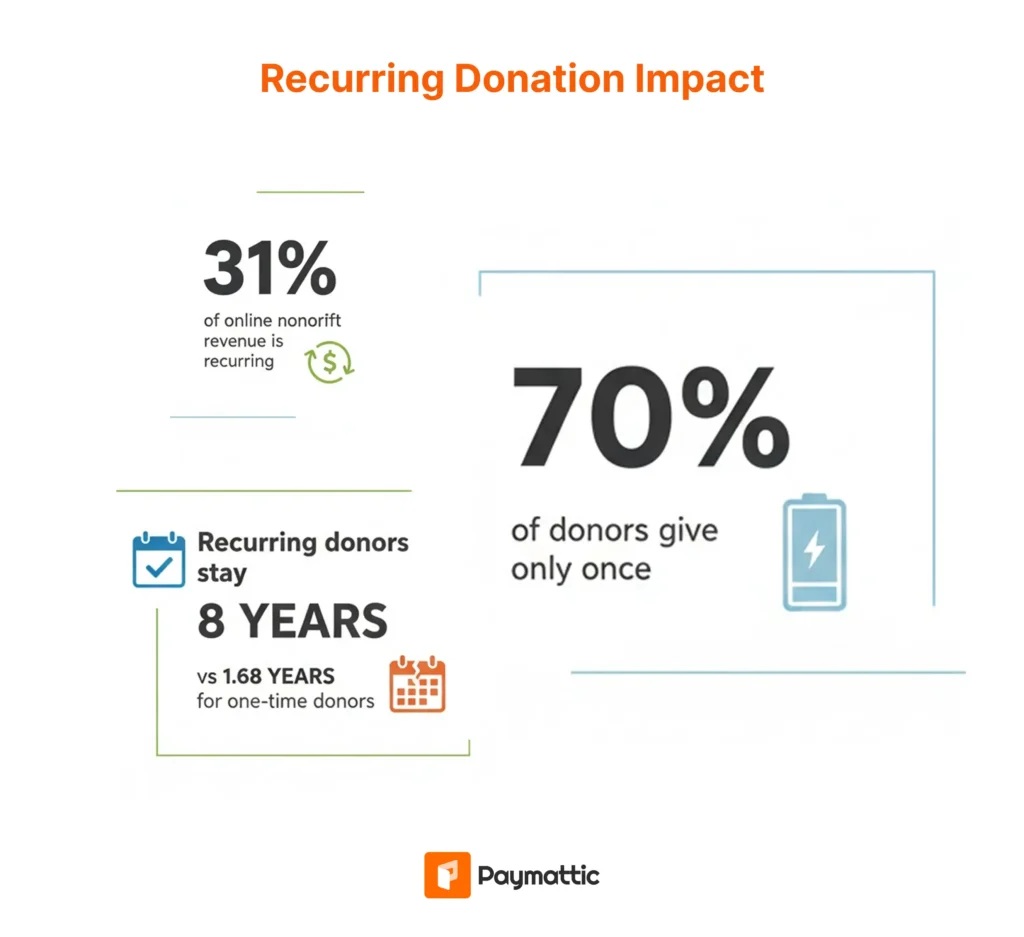
Here’s a number that should make you uncomfortable: 70% of donors give to a nonprofit only once and never return.
Meanwhile, the organizations crushing their fundraising goals have figured something out. Monthly giving now accounts for 31% of all online nonprofit revenue, up from 27% the previous year.
And recurring donors stick around for an average of eight years compared to just 1.68 years for one-time donors.
The math is simple. The execution is where most organizations struggle.
I’ve spent considerable time researching what separates thriving recurring donation programs from the ones that limp along. This article covers 21 effective strategies for recurring donations that you can actually implement without a massive budget or dedicated team.
Let’s get into it.
What are recurring donations?
Recurring donations are automatic, scheduled contributions that donors set up to give on a regular basis, typically monthly, quarterly, or annually. Instead of making a one-time gift and moving on, donors authorize your organization to charge their credit card or bank account at fixed intervals.
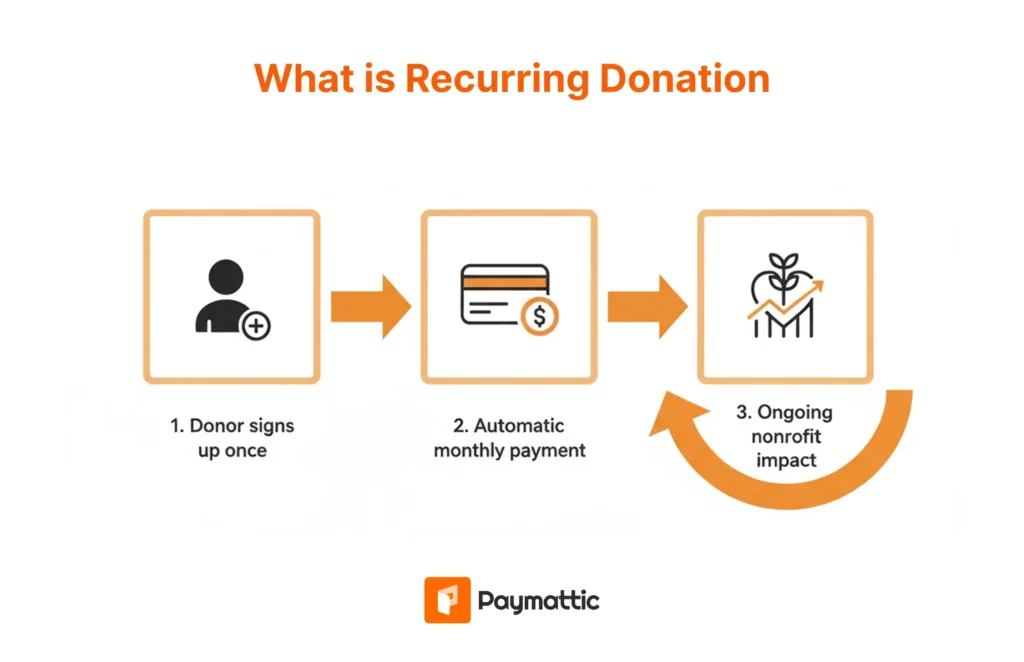
Think of it like a Netflix subscription, but for charitable giving. The donor signs up once, and the contributions flow automatically until they decide to stop.
Recurring donations solve the biggest headache in nonprofit fundraising: unpredictable revenue. When you know that 500 donors are giving $25 every month, you can plan programs, hire staff, and make commitments with confidence.
Without recurring revenue, you’re constantly chasing the next donation to keep the lights on. Organizations that ignore recurring donations for nonprofits leave substantial money on the table while their competitors build sustainable, predictable income streams.
Benefits of recurring donations
Before diving into strategies for recurring donations, let’s be clear about why recurring giving deserves your attention:
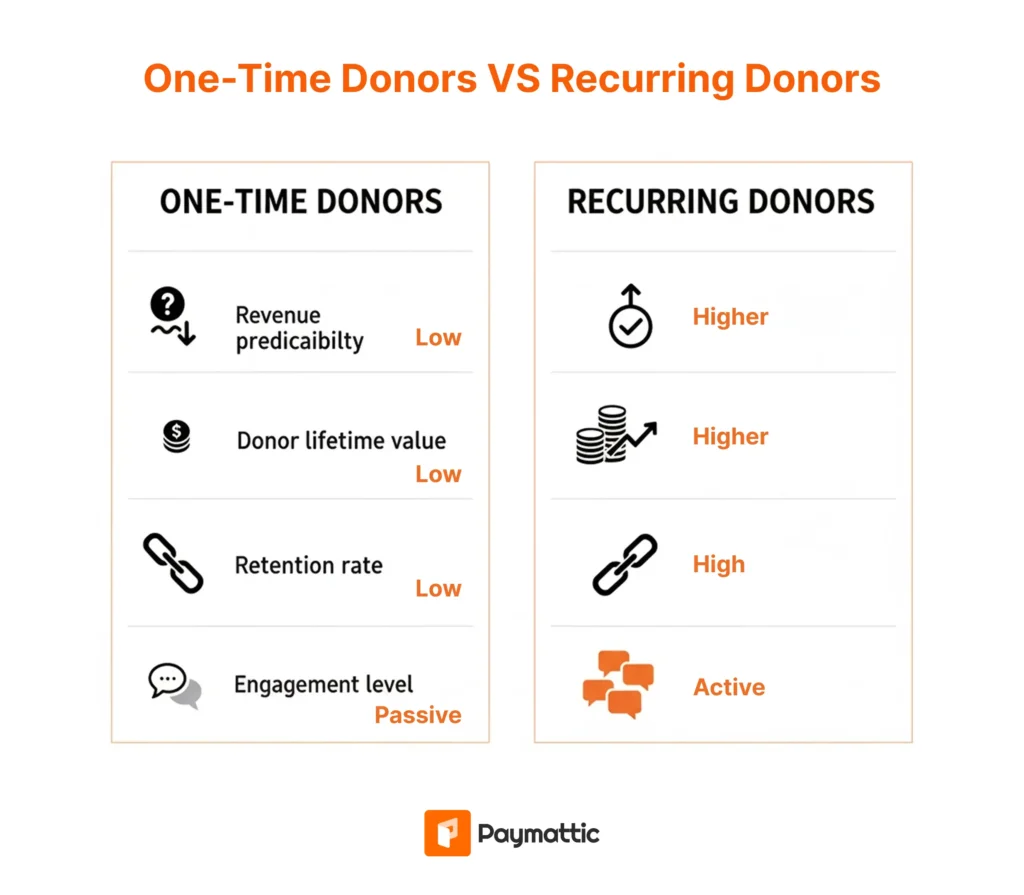
- Predictable cash flow. Knowing your recurring revenue lets you budget accurately, plan programs in advance, and avoid the feast-or-famine cycle that plagues many nonprofits.
- Lower fundraising costs. Acquiring a new donor costs significantly more than retaining an existing one. Recurring donors reduce your acquisition burden because they keep giving without repeated asks.
- Higher lifetime value: The average recurring donor will give 42% more in one year than those who give one-time gifts. A monthly donor giving $24 per month delivers $288 per year, compared to the average one-time gift of $115.
- Better retention. The more times someone donates, the more likely they are to give again. One-time donor retention sits at a dismal 18.6%. But donors who’ve given seven or more times? Their retention rate jumps to 84.3%!
- Stronger donor relationships. Monthly donors feel like members, not transactions. This emotional investment translates to higher engagement, more word-of-mouth referrals, and increased willingness to give more over time.
Now that you understand the why, let’s talk about how to increase recurring donations at your organization.
Subscribe Newsletter
Subscribe to our newsletter for updates, exclusive offers, and news you won’t miss!

21 effective strategies for recurring donations
I’ve analyzed the most successful monthly giving programs and boiled them down into 21 actionable tactics. You don’t need to do all of these tomorrow. Pick three that fit your current capacity and start there.
1. Provide exclusive updates to monthly donors
Create content that only recurring donors receive. Behind-the-scenes videos, early announcements, detailed program reports, or quarterly video calls with leadership.
This is about making monthly donors feel like insiders who get the complete picture of how their ongoing commitment drives real change.
2. Ask your best recurring donors what works
Your longest-tenured monthly donors know something you don’t: why they stayed when others left.
Interview 10-15 of them. What made them sign up? What almost made them cancel? What would they tell a friend considering monthly giving?
Their answers will shape better messaging than any fundraising marketing playbook.
3. Create matching campaigns for recurring sign-ups
“A generous donor will match your first 3 months of recurring gifts” is a powerful offer.
Find a major donor willing to fund a match specifically for new monthly sign-ups. This reduces perceived risk for hesitant donors while your matching donor effectively subsidizes your recurring growth.
The match lowers the mental barrier of monthly giving because donors feel they’re getting a bonus impact.
4. Share recurring-specific impact stories
Generic success stories work for one-time appeals. Recurring donors need to see how sustained giving creates sustained change.
Tell stories that span time: “When Maria joined as a monthly donor in 2022, she helped fund the first year of Jayden’s tutoring. Now, three years later, he’s headed to college. That arc of transformation? Only possible with sustained support.”
Show the long-term impact that monthly giving programs make possible.
5. Let donors choose their billing date
Some people get paid on the 1st. Others on the 15th. Paycheck timing affects willingness to commit to monthly expenses.
If your payment system allows it, let donors pick their preferred billing date. This small flexibility removes a practical objection that might otherwise cause hesitation.
6. Time your recurring asks thoughtfully
The best time to pitch monthly giving isn’t during your emergency appeal.
80.33% of donors who made a recurring donation on GivingTuesday made a second one-off gift before the year was out. These natural giving moments are ideal for recurring conversion campaigns because donors are already in a generous mindset.
Save your recurring pushes for times when you can focus on the long-term relationship story, not crisis messaging.
7. Optimize for mobile giving
Over half of your website traffic comes from phones. Is your recurring donation form thumb-friendly?
Test the entire giving flow on mobile: page load speed, form field sizing, button placement, and payment processing. One awkward zoom-and-scroll moment loses donors. Mobile optimization is fundamental to sustainable fundraising strategies.
8. Use social proof prominently
“Join 847 monthly supporters” is more compelling than “Become a monthly donor.”
Show the community that already exists. Feature short testimonials from current recurring donors on your giving page. Include photos and first names when possible. People follow other people, not organization logos.
9. Offer meaningful giving levels
Not swag for swag’s sake, but genuine value at each level:
- $10/month: Monthly impact email updates
- $25/month: Quarterly video updates from the field
- $50/month: Virtual coffee with a program director
- $100/month: Site visit invitation and name recognition
Scale benefits to what your organization can actually deliver consistently.
10. Celebrate Donor Anniversaries
When someone hits 12 months of consecutive giving, make it a moment.
Send a personalized message acknowledging their year of support. Share their total contribution and the specific outcomes it enabled. For your longest-tenured donors, a handwritten note goes even further.
This recognition reinforces their identity as a committed supporter and makes cancellation psychologically harder.
11. Recover failed payments automatically
Expired credit cards and insufficient funds kill recurring programs silently. Most donors don’t even realize their payment failed.
A significant portion of monthly donations fail due to expired cards and payment issues. Set up automatic retry logic and friendly notification emails: “Hey, your monthly gift didn’t go through. Want to update your card?” Many failed payments are accidental and easily recovered with a simple prompt.
12. Make cancellation easy
This sounds counterintuitive, but hiding the cancel button breeds resentment and anxiety.
When donors know they can leave anytime, they’re more comfortable committing. Include a clear “Manage your giving” link in every receipt. Some will cancel. But more will stay specifically because they don’t feel trapped.
13. Convert one-time donors strategically
Your existing one-time donors already believe in your mission. They’re your warmest audience for recurring conversion.
Build a campaign targeting donors who gave 2-3 times in the past year. Show them their total contributions, then pitch: “You gave $150 last year across three donations. Would you consider $15/month? Same impact, less hassle for you.”
This approach works because you’re not asking for more money. You’re asking for more convenience.
14. Create positive urgency
Urgency works, but desperation doesn’t. “We’re going to close without your help” doesn’t inspire long-term commitment.
Instead, create goal-based urgency: “We need 50 new monthly donors by March to launch our summer program.” This gives donors a concrete target and timeline without making them feel like they’re funding a sinking ship.
15. Use strategic suggested amounts
Don’t guess at donation amounts. Look at your actual data.
What’s your current average one-time gift? If it’s $75, your suggested monthly amounts might be $15, $25, $50, and a custom field.
The goal is to make monthly options feel proportionally reasonable compared to what donors already consider normal for your organization.
16. Offer multiple payment methods
Not everyone wants recurring credit card charges. Some prefer bank transfers (which also means lower processing fees for you). Others want PayPal or digital wallets.
The more payment options you provide, the more objections you remove. Just make sure each method supports automatic recurring billing without requiring donor intervention each month.
17. Simplify your donation form
Every extra field on your donation form is a potential dropout point. Audit ruthlessly.
Do you really need phone numbers? Employer information? Mailing addresses for digital receipts? Strip your recurring donation form to essentials: name, email, and payment details.
You can collect additional information later, after trust is established.
Read: Donor Psychology 101: The Science Behind Why People Donate
18. Build a dedicated welcome sequence
The first 3 months determine whether a recurring donor sticks around or cancels. Don’t leave this to chance.
Create an automated email sequence specifically for new monthly donors:
- Day 1: Warm thank you, explaining what to expect
- Day 7: A story showing immediate impact
- Day 30: Their first month’s impact summary
- Day 60: Introduction to your donor community
- Day 90: Personal note from someone whose gift helped
This is one of the most effective donor retention strategies for nonprofits because it reinforces the donor’s decision during the critical early period.
19. Create a named monthly giving program
Generic “monthly donors” don’t create belonging. People want to join something.
Give your recurring program a name with identity. “The Sustainers Circle,” “Impact Partners,” or something tied to your specific mission. When donors feel like members of an exclusive community rather than entries in a spreadsheet, recurring donor retention improves significantly.
20. Show the annual impact of monthly gifts
There’s a mental gap between “$20/month” and “$240/year.” Bridge it for your donors.
When someone considers a monthly gift, display what that adds up to over a year alongside specific outcomes. “Your $240 yearly contribution provides school supplies for 12 children” hits differently than “Give $20 monthly.”
This reframes a small monthly commitment into a meaningful annual impact.
21. Make monthly giving the default option
Stop burying the recurring option at the bottom of your donation form. Make “Monthly” the pre-selected choice.
This works because of default bias. People tend to stick with pre-selected options rather than actively changing them. If someone truly wants to give once, they’ll switch it. But many donors have never considered monthly giving simply because no one presented it as the normal choice.
94% of recurring donors prefer monthly giving over weekly, quarterly, or annual options. Give them what they want upfront.
How to cultivate recurring donors
Getting the first monthly gift is only half the battle. Keeping donors engaged month after month requires intentional cultivation.
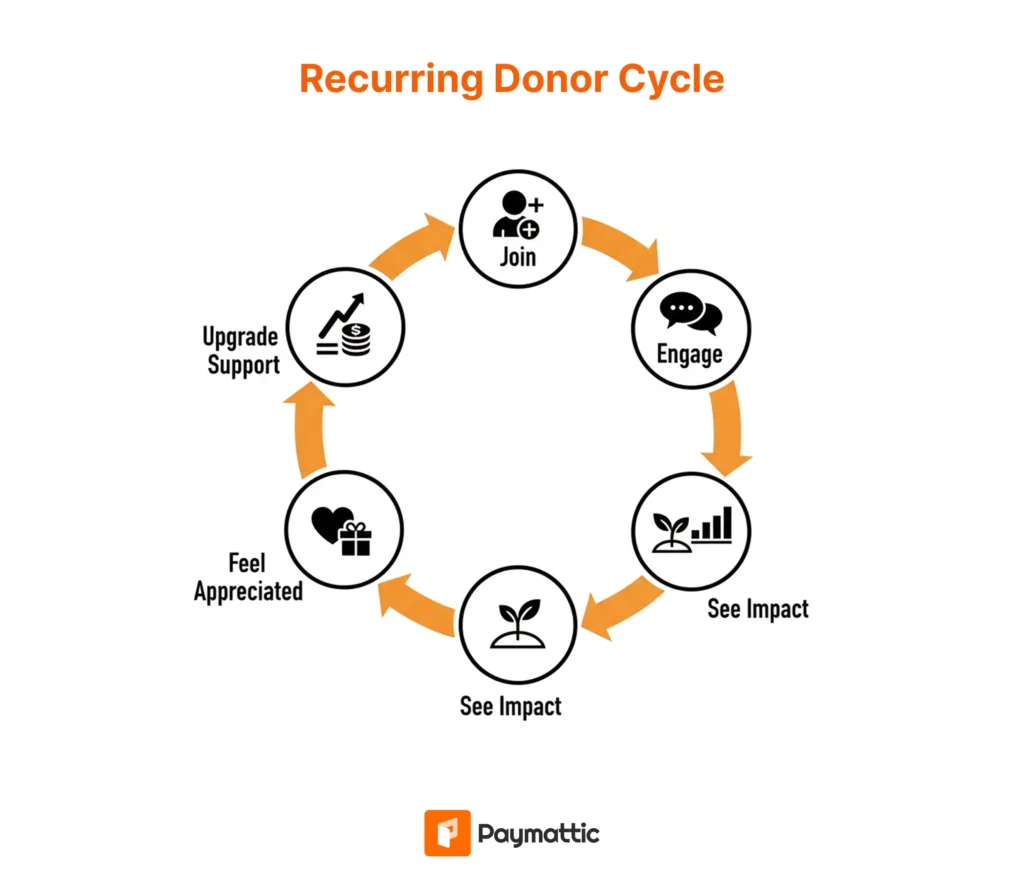
- Communicate consistently but not excessively. Monthly donors expect regular updates but not constant asks. A good rhythm includes monthly impact updates, quarterly deeper stories, and no more than 2-3 additional appeals per year. They’re already giving. Respect that commitment.
- Make them feel like partners, not ATMs. Share challenges, not just victories. Ask for their input on programs. Invite them to events. Recurring donors want to feel invested in your mission, not just your bank account.
- Offer pause options instead of forcing cancellation. Life circumstances change. When a donor hits financial difficulty, offering a pause (rather than requiring cancellation) keeps the relationship intact. A paused donor is far more likely to resume than a cancelled donor is to return.
- Track and respond to engagement signals. Are donors opening your emails? Clicking through to stories? Attending events? Low engagement often precedes cancellation. Reach out to disengaged donors before they leave.
- Upgrade thoughtfully. Once donors have been giving for 12+ months, it’s reasonable to ask if they’d consider increasing their monthly amount. Tie the ask to specific outcomes: “An extra $10/month would let us add one more child to the tutoring program.”
Healthy nonprofit recurring donation strategies aim for 80-85% annual retention. Below 70% indicates problems with your donor experience. Above 90% is exceptional.
WordPress recurring donation plugin: Paymattic
If you’re running your nonprofit website on WordPress, you need a donation plugin that handles recurring payments smoothly. This is where Paymattic stands out.
Paymattic is a simple WordPress payment and donation plugin built specifically for organizations that want to accept recurring donations without the headaches. It is, in my opinion, the best WordPress recurring donation plugin for small to mid-sized teams who want professional results without the technical headache.
Here’s what makes it worth considering:
- Zero platform fees. Unlike many donation platforms that take a percentage of every gift, Paymattic charges no platform fee. Your donors’ money goes to your mission, not to software costs.
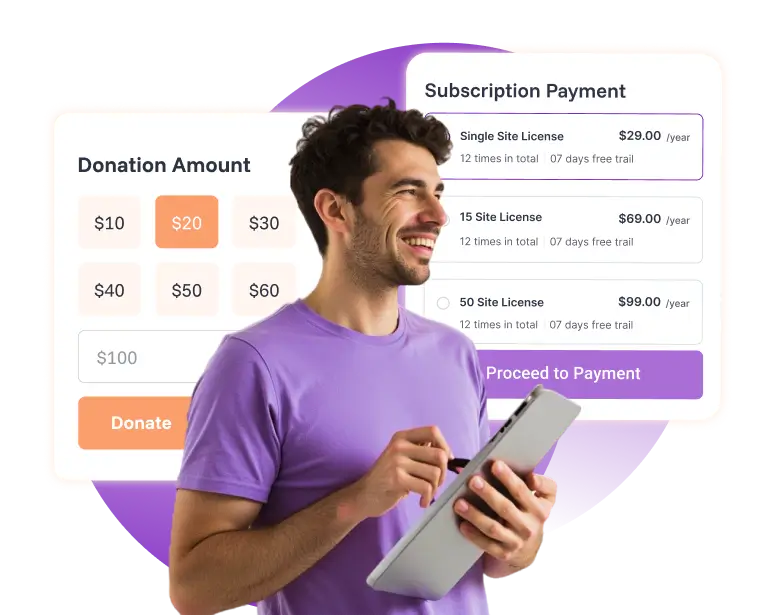
- Flexible recurring options. Let your donors choose monthly, quarterly, or annual giving with the billing date that works for them. The subscription management features handle the complexity behind the scenes.
- Global payment gateway support. Accept donations from anywhere in the world with support for 14+ payment gateways and 157+ currencies. Whether your donors prefer Stripe, PayPal, or regional payment methods, Paymattic handles it.
- Built-in donation features. Donation progress goals, donor profiles, donor dashboards, and leaderboards come included. You don’t need to cobble together multiple plugins.
- Pre-built templates. Get started quickly with donation form templates designed for nonprofits. Customize as needed, or publish immediately.
- Basic donor management. Track donor history, manage recurring subscriptions, and access detailed reports on your giving patterns, all from your WordPress dashboard.
For organizations already using WordPress, Paymattic provides a straightforward path to implementing the effective strategies for recurring donations covered in this article. The interface is simple enough that you don’t need a developer, but powerful enough to support your nonprofit’s growth.
Conclusion
Building a sustainer program isn’t a “nice-to-have” anymore; it is the lifeblood of a modern nonprofit. By implementing these effective strategies for recurring donations, you are choosing to walk away from the feast-or-famine cycle and toward a future of stable, impactful growth.
I know it can feel overwhelming to start. My advice? Don’t try to do all 21 at once. Pick three. Maybe start by making “monthly” the default on your forms, branding your giving circle, and automating your thank-you emails.
If you are looking for the easiest way to accept recurring donations on your WordPress website, I highly encourage you to give Paymattic a try. It takes the technical guesswork out of the equation so you can focus on what actually matters: your mission. Your donors want to support you long-term. You just need to give them a simple, meaningful way to do it.
Start today. Your future, more stable organization will thank you for it.
Read: The Donor Life Cycle In Fundraising: Stages and Strategies for Sustainability
Join the thousands already enjoying Paymattic Pro!
Frequently asked questions
What percentage of donors should be recurring?
Healthy nonprofit programs typically see 15-25% of individual donors on recurring plans. If you’re below 10%, there’s significant room to grow. Above 30% suggests strong retention but potentially indicates you could expand your overall donor base.
How often should I communicate with recurring donors?
Monthly donors expect regular updates but not constant asks. A good rhythm: monthly impact updates, quarterly deeper stories, and no more than 2-3 additional appeals per year. They’re already giving; respect that commitment.
What’s a good retention rate for recurring donors?
Industry benchmarks suggest 80-85% annual retention is solid. Below 70% indicates problems with your donor experience or payment recovery. Above 90% is exceptional and usually reflects strong relationship-building.
Should I ask for recurring gifts during year-end campaigns?
Year-end works for one-time gifts because of tax deadlines. Recurring asks often perform better in January (fresh start mentality) or during dedicated recurring campaigns with matching incentives. That said, always include the recurring option, just don’t make it your primary year-end push.
How do I handle donors who want to pause rather than cancel?
Always offer a pause option. Life circumstances change, and a paused donor is far more likely to resume than a cancelled donor is to return. Make pausing easy and set automatic check-in emails for 60 and 90 days into the pause.

Mahfuzur Rahman Nafi
Mahfuzur Rahman Nafi is a Marketing Strategist at WPManageNinja. With 4 years of experience in Product Marketing, he has developed marketing strategies, launched products, written content, and published websites for WordPress products. In his free time, he loves to read geeky stuffs.

Leave a Reply