
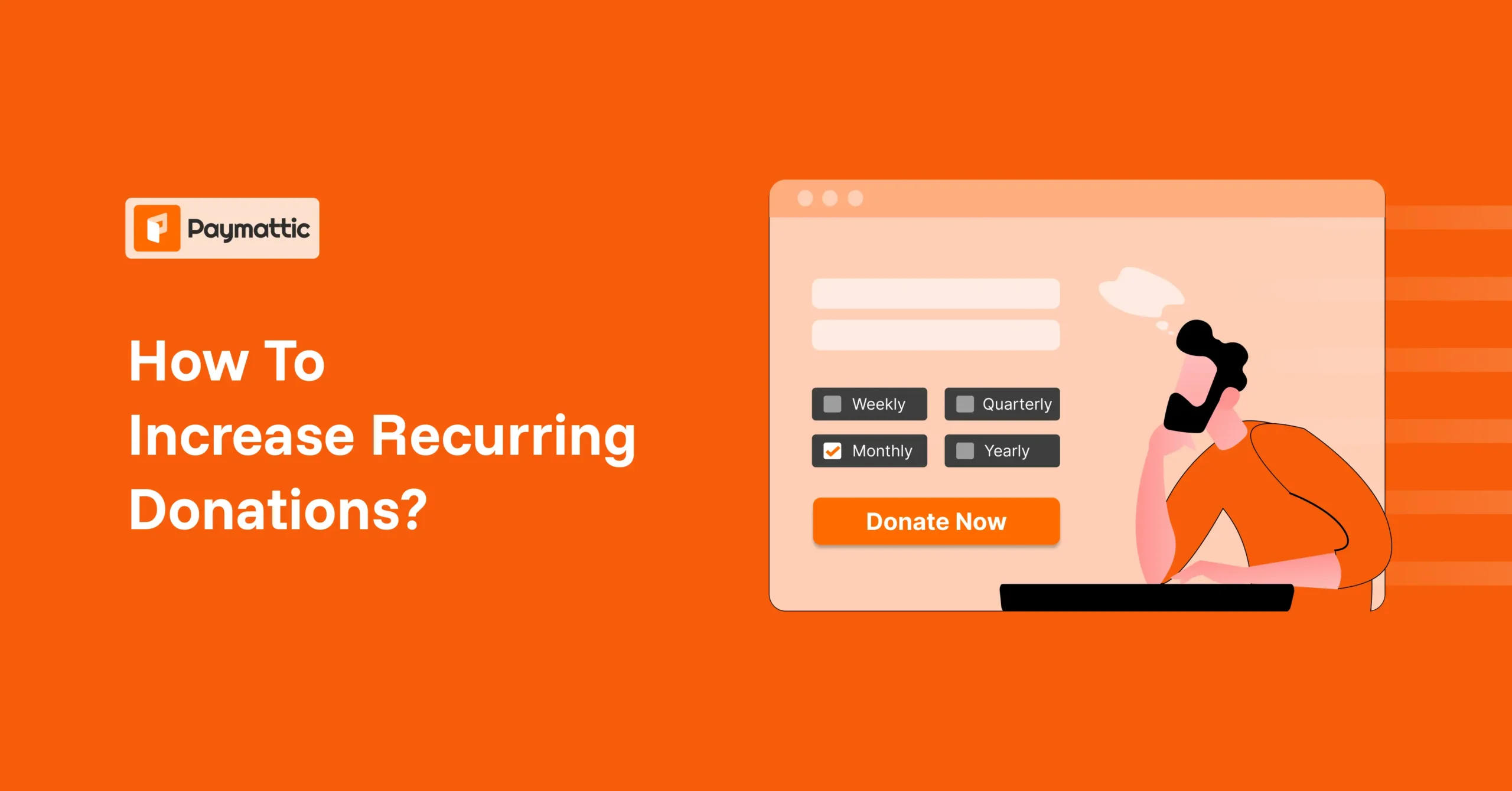
How To Increase Recurring Donations [37 Proven Strategies]


Table of Content
Download Paymattic – it’s Free!
Subscribe To Get
WordPress Guides, Tips, and Tutorials
We will never spam you. We will only send you product updates and tips.
TL;DR:
- Recurring donors are worth up to 5x more than one-time donors over their lifetime
- Make monthly giving the default option on your donation forms
- Create a named monthly giving program to build identity and belonging
- Ask one-time donors to convert within 48 hours of their gift
- Fix failed payments proactively to prevent silent churn
- Celebrate donor anniversaries to reinforce commitment
- Use tools like Paymattic that treat recurring donations as a core feature
Most organizations I’ve worked with treat monthly giving as an afterthought.
A small checkbox buried at the bottom of a donation form. Maybe an occasional email asking people to “consider becoming a monthly supporter.” That’s leaving serious money on the table.
I talked to fundraising professionals, analyzed successful monthly giving programs, and dug through the data. What I found is that increasing recurring donations isn’t about one magic tactic. It’s about getting dozens of small things right.
This guide covers 37 actionable strategies on how to increase recurring donations, pulled from analyzing 50+ nonprofit fundraising programs, donor retention studies, and platform data from organizations processing millions in monthly gifts.
Let’s jump right into it.
Optimizing donation experience strategies
The first place most nonprofits lose potential recurring donors is right on their donation page. If you’re wondering how to set up recurring donations that actually convert, start here.
1. Make monthly giving the default option
This is crucial if you are accepting recurring donations online.
When someone lands on your donation form, the “monthly” option should already be selected. People tend to go with defaults. Use that to your advantage.
This single change can increase recurring signups by 30% or more. You’re not tricking anyone. The option to give once is still right there. You’re just framing regular giving as the expected behavior.
2. Show the annual impact of monthly gifts
Don’t just say “$25/month.” Say “$25/month = $300/year.”
Better yet, connect it to outcomes: “$25/month provides clean water for 3 families every year.”
This reframes a small monthly amount as a significant annual impact. It helps donors see themselves as serious contributors, not just people dropping spare change.
3. Offer suggested monthly amounts that make sense
I see nonprofits all the time with suggested monthly amounts like $100, $250, $500. That’s intimidating.
For most donors, monthly giving works best at accessible price points: $10, $25, $50, maybe $100. These amounts feel manageable as ongoing commitments. You can always upgrade donors later.
4. Reduce form fields to the absolute minimum
Every additional field you add to your donation form costs you conversions. I’ve seen forms asking for phone numbers, employer information, “how did you hear about us,” and other questions that have nothing to do with processing a donation.
For monthly giving, you need: name, email, card details, and billing address. That’s it. Everything else can come later.
5. Enable one-click recurring upgrades for existing donors
If someone already donated to you, don’t make them fill out an entire form again to switch to monthly giving.
Send them a link that pre-fills their information and lets them convert with a single click.
6. Offer multiple payment methods
Give your donors the choice to pick as many payment gateways as you can offer. For example, Paymattic, the WordPress donation plugin, supports more than 13 payment gateways. Depending on your region, you should enable as much as you can.
Also consider digital wallets like Apple Pay and Google Pay for convenience. The easier you make it, the more people complete the process.
7. Make your donation page mobile-first
Over 50% of nonprofit website traffic comes from mobile devices. If your donation form is clunky on a phone, you’re losing donors.
Test your entire donation flow on mobile. Fill it out yourself. Time how long it takes to load. Then make it faster.
8. Use smart defaults based on giving history
If someone gave you $100 once, suggesting $10/month as a recurring option doesn’t make sense. Your donation system should be smart enough to suggest amounts based on past behavior.
Someone who gave $100 might convert to $15 or $20/month.
9. Add trust signals throughout the process
Security badges, SSL indicators, privacy policy links, and testimonials from other donors all reduce anxiety during checkout. People want to know their payment information is safe and that they can cancel easily if needed.
10. Be crystal clear about what recurring means
No one wants surprise charges. Make it obvious: “You will be charged $25 on the 15th of each month. You can cancel anytime by emailing us or clicking the link in any receipt.”
Transparency builds trust. Trust builds long-term donors.
Subscribe Newsletter
Subscribe to our newsletter for updates, exclusive offers, and news you won’t miss!
Conversion and cultivation strategies
Getting people to your donation page is one thing. Converting them to committed monthly givers requires an intentional strategy.
If you’re serious about how to increase recurring donations, this section is where the real work happens.
11. Create a named monthly giving program
Don’t just ask people to give monthly. Invite them to join something. The “Hope Builders Circle.” The “Monthly Champions.” The “Sustainer Society.”
Monthly giving programs for nonprofits work best when they feel like membership. A named program creates identity. People feel like they belong. This psychological shift matters for donor retention.
12. Launch a matching gift campaign for new monthly donors
“A generous donor will match your first three months of giving.”
This is incredibly effective because it doubles the impact during the commitment period when donors are most likely to cancel. By the time the match ends, the habit is formed.
13. Ask one-time donors to convert within 48 hours
The best time to ask someone to become a recurring donor is immediately after they give. They’ve already decided to support you. They’ve already entered their payment information. Strike while the commitment is fresh.
Your thank-you email should include an easy path to recurring: “Your $50 gift today was amazing. Did you know that $15/month would provide even more impact over time?”
14. Use the power of specific asks
“Would you consider a monthly gift?” is weak.
“Would you give $20 a month to provide school supplies for one child all year?” is specific, visual, and actionable.
Specificity outperforms vagueness every time. This is the cornerstone of donor psychology. Tell people exactly what amount you want and exactly what it does.
15. Segment your appeals by donor capacity
A donor who gave $500 last year should get a different monthly ask than someone who gave $50. Your communications should reflect what you know about each donor’s capacity and history.
Generic one-size-fits-all appeals leave money on the table from high-capacity donors and intimidate smaller donors.
16. Offer a “Start Small” entry point
Some people want to support you monthly but aren’t ready for a big commitment. Let them start at $5 or $10/month.
You can upgrade them over time. Getting them into the monthly habit matters more than the initial amount.
17. Create upgrade paths for current monthly donors
Once someone is giving monthly, don’t ignore them. Once a year (donor anniversary is perfect), ask if they’d consider increasing their gift.
“Your $25/month has done incredible things. Would you consider $35/month this year?”
This is one of the best ways to upgrade donors over time. Many will say yes. You don’t get what you don’t ask for.
18. Use social proof strategically
“Join 2,347 monthly donors who are changing lives” is more compelling than “become a monthly donor.”
People want to be part of something others have already validated. Show them your monthly giving community is real and growing. It helps build a strong donor engagement cycle.
19. Leverage recurring giving days
Giving Tuesday gets all the attention, but you can create your own recurring giving moments.
“Every March, we focus on building our monthly donor base.” Run a campaign. Set a goal. Create urgency around monthly signups specifically.
Looking for giving campaign ideas? Theme each quarter around a different program area and tie monthly giving to that impact.
20. Ask board members and major donors to give monthly too
Your most committed supporters should model the behavior you want. When board members give monthly, they can authentically encourage others to do the same. Plus, their recurring gifts provide a stable base of funding.
Ready to get started?
Experience WordPress payment and donation like never before. Try Paymattic now!
Marketing and engagement tactics
Your marketing strategy should consistently reinforce the value and ease of recurring giving. This section covers how to get donors engaged with your monthly program.
21. Feature monthly donors in your communications
Spotlight real monthly donors (with permission) in your newsletter, social media, and annual report. Let them share why they give monthly in their own words. This provides social proof and makes monthly giving feel aspirational.
22. Create content specifically about the monthly impact
Most nonprofit content focuses on one-time impact: “Your $100 provided a home for Russel.” It’s okay. But it can be better.
Create content that shows sustained impact: “Here’s what your monthly gift accomplished over the past year.”
Help donors see that consistency compounds into something bigger.
23. Build an email sequence for recurring conversion
After someone makes a one-time gift, they should enter an email sequence that, over several weeks, makes the case for monthly giving.
Not pushy. Educational and story-driven. By email number four or five, you make a direct ask.
24. Use retargeting ads for abandoned donation forms
Someone started filling out your donation form but didn’t complete it. That’s a warm lead. If you look at the donor life cycle; you’d understand how important this step can be.
Retarget them with ads specifically about monthly giving. “Still thinking about supporting Joana? $20/month makes a bigger difference than you’d expect.”
25. Add monthly giving CTAs to your most-visited pages
Look at your analytics. Which pages get traffic? Your “About” page? A popular blog post?
Add monthly giving CTAs to those pages. Don’t assume people will find their way to your donation page. If you’re trying to figure out how to find donors for nonprofit organizations, start by optimizing the traffic you already have.
26. Create a dedicated landing page for monthly giving
Your main donation page tries to serve everyone. A dedicated monthly giving page can focus entirely on the benefits of recurring support, feature monthly donor testimonials, and remove distractions.
This page becomes your destination for all monthly giving campaigns.
27. Use video to make the ask personal
A 60-second video from your Executive Director personally asking viewers to become monthly donors can outperform any email.
Video creates a connection. Use it thoughtfully in your monthly giving campaigns.
28. Partner with influencers or ambassadors
Identify people who already love your cause and have audiences.
Ask them to share why they give monthly. User-generated advocacy reaches people your marketing never will.
29. Run a “Monthly Giving Challenge”
Set a public goal: “We want 100 new monthly donors by June 30.”
Track progress publicly. Create urgency. When people see the goal getting closer, they want to help you reach it.
Retention and stewardship tactics
Acquiring monthly donors means nothing if they cancel after three months. Retention is where the real value lives.
Understanding how to increase recurring donations means understanding that keeping donors matters as much as getting them.
30. Send different Thank-Yous to monthly donors
Monthly donors shouldn’t get the same generic receipt as one-time donors. Create a special acknowledgment for them. Remind them they’re part of something ongoing. Make them feel valued differently.
31. Provide exclusive updates to recurring supporters
Give monthly donors something special: a quarterly impact report just for them, early access to news, or insider updates.
This little step creates perceived value beyond the basic acknowledgment.
32. Celebrate donor anniversaries
“One year ago today, you became a monthly supporter. Here’s what you’ve helped accomplish.” This is powerful. It reinforces their decision, shows impact, and creates a natural moment to ask for an upgrade.
33. Fix failed payments proactively
Credit cards expire. Payments fail. Most nonprofits let this revenue just disappear.
Set up automated emails when payments fail, and follow up personally if automated attempts don’t work. This alone can recover 10-20% of otherwise lost recurring revenue.
34. Survey monthly donors about their experience
Once a year, ask your monthly donors: “How are we doing? What would make you feel more connected to our work?”
You’ll get valuable feedback, and you’ll make donors feel heard.
35. Make Cancellation easy (Yes, really)
This sounds counterintuitive, but hiding the cancellation process creates resentment.
Make it easy to cancel, and some donors will pause instead of quitting. Others will come back later. A frustrated donor who had to call three times to cancel will never support you again.
36. Win back lapsed monthly donors
Someone who used to give monthly is a warm lead for reactivation. Create a specific campaign for lapsed recurring donors: “We’ve missed you. Here’s what’s happened since you left. Would you consider rejoining our monthly community?”
37. Treat monthly donors as partners
This is the foundation of everything else. Monthly donors are your most committed community members. Communicate with them that way. Ask for their input. Share behind-the-scenes updates. Invite them to events.
When donors feel like partners, they don’t cancel. They increase their giving. They recruit their friends.
Why recurring donations matter more than you think?
It’s worth understanding the importance of recurring donors to your organization’s sustainability.
The math is compelling. According to nonprofit industry data, recurring donors have a retention rate of around 80-90%, compared to just 20-30% for first-time one-time donors. That’s the difference between constantly chasing new donors and building a stable revenue foundation.
There’s more. Monthly donors typically give 42% more annually than one-time donors. They’re more likely to volunteer, attend events, and leave legacy gifts. They become advocates for your cause.
And from an operational standpoint, predictable monthly revenue lets you plan programs, hire staff, and make commitments without the anxiety of wondering if next month’s donations will come through. For recurring donations for nonprofits, this stability is transformative.
Paymattic: Simplest WordPress payment & donation plugin
If you run your nonprofit website on WordPress, you might want to take a look at Paymattic.
It’s a simple, secure WordPress payment and donation plugin that comes with super useful donation features like a donation progress bar, donor leaderboard, donor profile, and donor dashboard.
And the best part? There’s no platform fee.
Let’s take a look at what Paymattic offers to you, fundraisers:
- Flexible recurring options: Donors can choose their own amount and frequency. You can offer suggested amounts or let them enter a custom figure. Weekly, monthly, quarterly, yearly. It’s all configurable.
- Zero platform fee: Unlike other donation plugins that take a cut of every donation, Paymattic charges zero platform fee. Your payment processor fees are the only transaction costs.
- Multiple payment gateways: Paymattic supports Stripe, PayPal, and all the major payment gateways. Donors can pay with cards, bank transfers, or digital wallets, depending on what you enable.
- Donor management: You get a dashboard showing all your subscribers, their payment history, and their status. When a payment fails, you know about it.
- Customizable donation forms: Paymattic gives a simple, fast, and customizable donation form builder. Add custom fields, conditional logic, and branding. Your donation form looks like it belongs on your site.
- Donor dashboard: Paymattic features a donor dashboard where your donors can see their donations and manage recurring donations if you allow them to.
- Multiple integrations: Paymattic seamlessly integrates with other WordPress plugins like FluentCRM, FluentSupport, FluentCommunity, Zapier, MailChimp, and more.
Here’s an article on how you can replace Patreon with Paymattic and FluentCommunity.
Start Your Journey for Free!
With Paymattic free, you get a full suite of features to manage transactions from the moment you are in.
Putting it all together
Now you know how to increase recurring donations. But knowing isn’t enough. Implementation is everything.
Start with your donation experience. Make monthly giving easy, clear, and default. Then work on conversion. Ask one-time donors to upgrade. Create a named program. Use matching gifts to reduce early cancellations.
Layer in marketing that consistently positions monthly giving as the best way to support your cause. And invest heavily in retention, because a recurring donor who stays for five years is worth far more than five monthly donors who each stay one year.
Monthly giving is the foundation of sustainable nonprofit funding. The organizations that master how to increase recurring donations build stability that lets them focus on their mission instead of constantly chasing the next gift.
You don’t have to implement all 37 strategies at once. Pick three that seem most relevant to your situation. Execute them well. Measure results. Then add more.
Read: Ultimate Donor Engagement Guide: Strategies, KPIs, Actions
Frequently asked questions
Here are answers to some frequently asked questions regarding recurring donations:
What is a good recurring donor retention rate?
A healthy recurring donor retention rate is 80-90% annually. If yours is below 70%, focus on stewardship and fixing failed payments before trying to acquire more monthly donors.
How much should I suggest for monthly donations?
Start with accessible amounts: $10, $25, $50. Most successful monthly giving programs have an average gift between $20-35. You can always upgrade donors over time.
When should I ask one-time donors to become monthly?
The best time is within 48 hours of their first gift, ideally in your thank-you email. The commitment is fresh and they’ve already entered payment information.
How do I reduce recurring donor cancellations?
Focus on three areas: immediate great onboarding, consistent impact communication, and easy payment updating when cards expire. Most cancellations happen from neglect, not dissatisfaction.
What’s the best day of the month to charge recurring donations?
The 1st and 15th are common paydays, so they work well. Avoid end-of-month dates when bank accounts might be lower. Some organizations let donors choose their preferred date.
Join the thousands already enjoying Paymattic Pro!

Mahfuzur Rahman Nafi
Mahfuzur Rahman Nafi is a Marketing Strategist at WPManageNinja. With 4 years of experience in Product Marketing, he has developed marketing strategies, launched products, written content, and published websites for WordPress products. In his free time, he loves to read geeky stuffs.
Leave a Reply