
Recurring Donations: A Detailed Guide For Nonprofits


Table of Content
Download Paymattic – it’s Free!

Subscribe To Get
WordPress Guides, Tips, and Tutorials
We will never spam you. We will only send you product updates and tips.
TL;DR:
Recurring donations are automatic, scheduled contributions that give nonprofits predictable revenue instead of the fundraising rollercoaster. They deliver higher donor lifetime value, lower fundraising costs, and stronger relationships compared to one-time gifts.
• To build a successful recurring program: make monthly giving the default option, create a named giving club, show the impact of small monthly amounts, and keep the signup process simple.
• Convert one-time donors by following up fast, telling impact stories, and making the transition frictionless.
• For WordPress nonprofits, Paymattic offers a straightforward solution with flexible recurring options, multiple payment gateways, and flat pricing (no percentage fees on donations).
Here’s a hard truth I learned after talking to dozens of nonprofit organizers: monthly giving accounts for nearly a third of all online nonprofit revenue. Yet most organizations still treat it as an afterthought.
They run a campaign, celebrate the donations, spend every dollar, and then panic when it’s time to pay next month’s bills. Does it sound familiar?
The problem isn’t that people don’t want to give. It’s possible that your nonprofit might be leaving predictable revenue on the table by not asking donors to give regularly.
I wrote this guide to change that. Whether you’re running a small community initiative or managing a growing nonprofit, I’ll walk you through everything you need to know about recurring donations.
From why they matter to how you can start collecting recurring donations today.
Let’s get into it.
What are recurring donations?
Recurring donations are contributions that donors authorize to be charged automatically on a regular schedule. This could be weekly, monthly, quarterly, or annually. Instead of making a one-time gift, the donor agrees to give a set amount repeatedly until they decide to stop.
Think of it like a subscription, but for generosity. When someone signs up for recurring giving, their payment method gets charged automatically at the interval they choose.
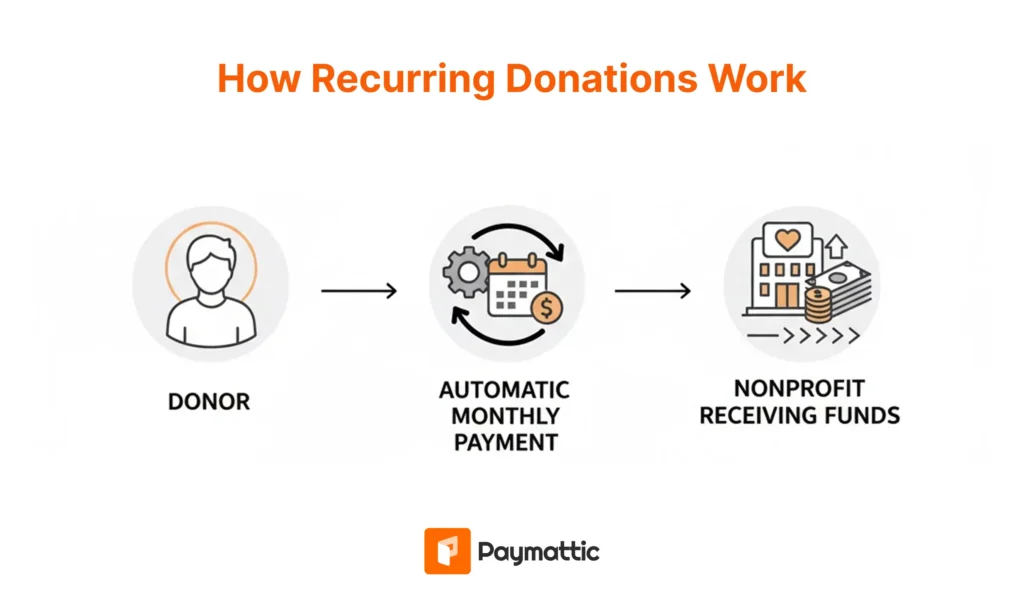
For example, a donor might commit $25 per month to your animal shelter. Every month, that $25 lands in your account without anyone lifting a finger.
No reminders needed. No awkward follow-up emails. The donation just happens automatically.
Recurring donations vs. one-time Donations
Both types of donations keep nonprofits alive. But they work very differently in practice. Here’s a quick breakdown to help you understand the key differences between recurring giving:
| Factors | Recurring Donations | One-Time Donations |
| Best for | Sustained operations, planning | Campaigns, emergencies, events |
| Donation frequency | Automatic, scheduled intervals | Single transaction |
| Revenue predictability | High (you know what’s coming) | Low (unpredictable) |
| Donor lifetime value | Higher (gives over months/years) | Lower (one gift only) |
| Administrative effort | Low after setup | High (constant outreach needed) |
| Donor relationship | Deeper, ongoing connection | Transactional, often brief |
Neither is “better” in absolute terms. But if you want financial stability, recurring donations should be a core part of your fundraising strategy.
Importance of recurring donations
Why do recurring donations matter so much for your nonprofits? Because they solve the biggest headache in fundraising: uncertainty.
Americans donated $592.50 billion to charities in 2024, and a growing share of that comes from recurring giving. According to the M+R Benchmarks Study, monthly giving now accounts for 31% of all online nonprofit revenue.
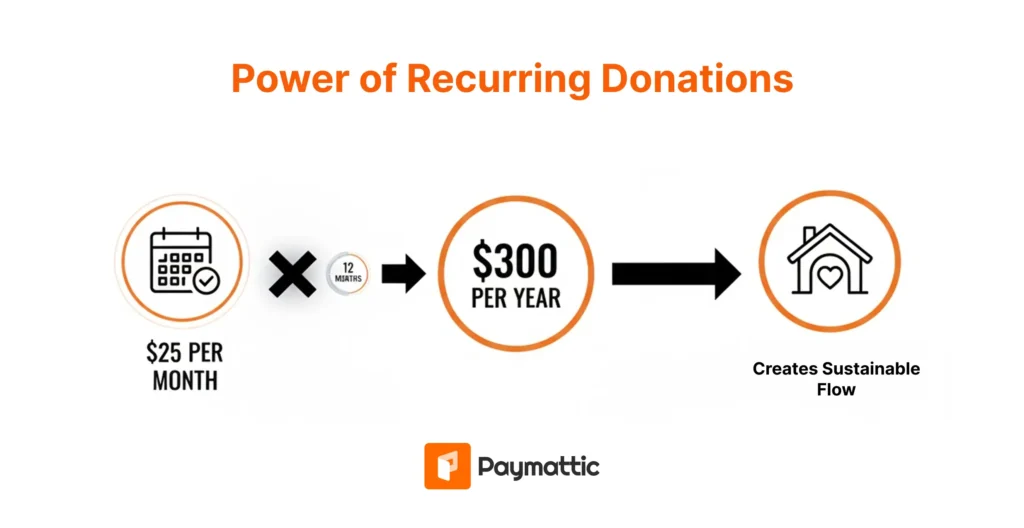
When you rely only on one-time gifts, your revenue looks like a rollercoaster. Big spikes during campaigns, flat lines in between. That makes it nearly impossible to plan ahead, hire staff, or commit to long-term programs.
Recurring giving flattens that curve. You wake up on the first of the month knowing exactly how much is coming in. You can budget with confidence. You can say yes to that new community program because you know the money will be there.
There’s also a psychological shift that happens. When donors commit to giving monthly, they start seeing themselves as partners in your mission. They’re not just dropping cash in a bucket. They’re investing in outcomes. That identity shift leads to stronger loyalty and higher lifetime value.
How do nonprofits benefit from recurring donations?
Let me break down the five biggest benefits I’ve seen nonprofits gain from building a recurring donor base:
Predictable, steady cash flow
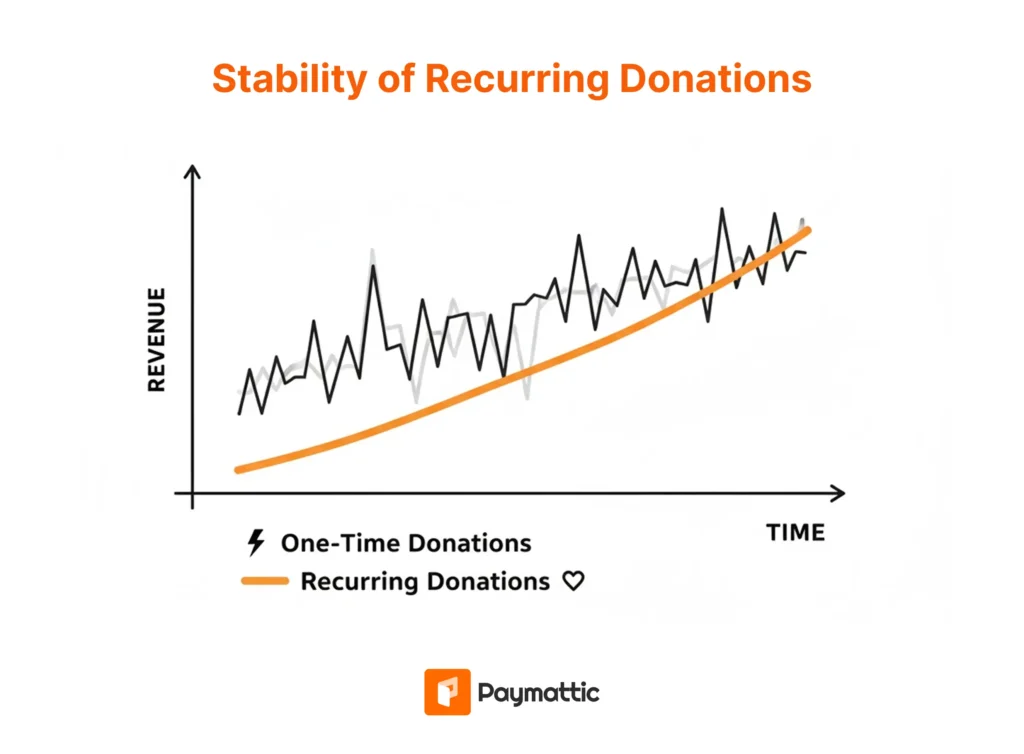
This is the obvious one, but it’s worth emphasizing. When you have 200 donors giving $20 per month, you know $4,000 is coming in every month.
That predictability changes everything. You can plan projects months in advance. You can negotiate better rates with vendors. You stop making decisions out of financial panic.
Higher donor lifetime value
A donor who gives $50 once is worth $50. A donor who gives $15 monthly for three years is worth $540. The math is simple, but the impact is massive.
Recurring donors have retention rates of 80-90%, compared to just 45% for one-time donors. That consistency is what makes their lifetime value so much higher.
Recurring donors almost always end up contributing more over time than one-time donors, even when their individual gifts are smaller.
Lower fundraising costs
Acquiring new donors is expensive. You’re spending money on ads, events, outreach, and staff time. Once someone becomes a recurring donor, you don’t have to re-acquire them every time you need funds. They’re already in. Your cost per dollar raised drops significantly.
Stronger donor relationships
Monthly giving creates ongoing touchpoints. You have more opportunities to update donors, thank them, and involve them in your work.
While the average nonprofit donor retention rate sits around 44.5%, recurring donor programs consistently retain 80% or more of their supporters year over year. Over time, these donors feel like insiders. They’re more likely to attend events, volunteer, and spread the word about your mission.
More time for mission work
When you’re not constantly chasing the next donation, you can focus on what actually matters: your programs. Recurring revenue buys you breathing room. Your team spends less time fundraising and more time creating impact.
Common challenges with recurring donations
Recurring giving isn’t all sunshine. There are real challenges you’ll need to navigate.
- Payment failures: Credit cards expire. Bank accounts change. Studies show that involuntary churn from failed payments can account for 20-40% of subscription cancellations. When a recurring payment fails, you lose that revenue unless you have a system to recover it. Some platforms handle this automatically with retry logic and donor notifications. Others leave you to figure it out.
- Donor fatigue: Some donors sign up with enthusiasm but lose interest over time. If you’re not communicating your impact regularly, they might cancel without a second thought. Retention requires ongoing effort.
- Tech complexity: Setting up recurring donations requires the right tools. If your donation platform is clunky or doesn’t support subscriptions well, you’ll struggle to convert donors. The signup process needs to be simple.
- Visibility concerns: Some donors worry about automatic charges they might forget about. You need to be transparent about how the subscription works and make it easy for them to manage or cancel.
Subscribe Newsletter
Subscribe to our newsletter for updates, exclusive offers, and news you won’t miss!
Effective strategies for recurring donations
If you want to build a strong recurring giving program, you need more than a donate button. Here are five strategies that actually work.
1. Make monthly giving the default option
When someone lands on your donation page, what do they see first? If the default is a one-time gift, you’re nudging them in that direction. Flip the script. Make monthly giving the pre-selected option. You’ll be surprised how many donors stick with it simply because it’s the default. This isn’t just theory. Revenue from monthly giving grew 5% in 2024, while one-time giving stayed flat.
2. Create a named giving program
People like belonging to something. Instead of just asking for monthly donations, create a club. Call it “The Changemakers Circle” or “Monthly Heroes” or whatever fits your brand. Give members exclusive updates, early access to events, or special recognition. A named program feels more meaningful than a checkbox.
3. Show the impact of small monthly gifts
$10 a month sounds small. But $10 a month feeds a child for a week. Frame your ask in terms of tangible outcomes. Help donors see that their “small” contribution creates real change when it adds up over time.
4. Use social proof
When donors see that others are giving monthly, they’re more likely to do the same. Add a counter to your donation page showing how many monthly donors you have. Share testimonials from recurring givers. Normalize the behavior you want to encourage.
5. Simplify the signup process
Every extra field on your donation form is a chance for someone to abandon it. Keep it simple. Ask for the essentials only. Offer popular payment options like credit cards, PayPal recurring donations, and digital wallets. The easier you make it, the more signups you’ll get.
How to increase recurring donations
Already have a recurring program but want to grow it? Here are ideas to boost your recurring giving numbers.
- Upgrade existing donors: Reach out to current monthly givers and ask if they’d consider increasing their gift by a few dollars. Frame it around impact: “An extra $5 a month means one more meal per week for a family in need.”
- Promote during peak moments: When donors are most engaged (after an event, after reading an impact story, during giving season), that’s when you ask for recurring commitments. Strike while the emotional connection is strong.
- Add recurring options everywhere: Your website, your emails, your social media, your event registration pages. Every touchpoint is an opportunity to invite someone into monthly giving.
- Test different amounts: Sometimes $10/month converts better than $25/month. Sometimes it’s the opposite. Run A/B tests on your donation pages to find the sweet spot for your audience.
- Highlight sustainer milestones: Celebrate when a donor hits their one-year anniversary of giving. Send a personal thank-you when they cross $500 in total contributions. Recognition keeps donors engaged and reduces churn.
How to turn One-Time Donors into Recurring Donors
Your one-time donors are your best prospects for recurring giving. They’ve already proven they care about your cause.
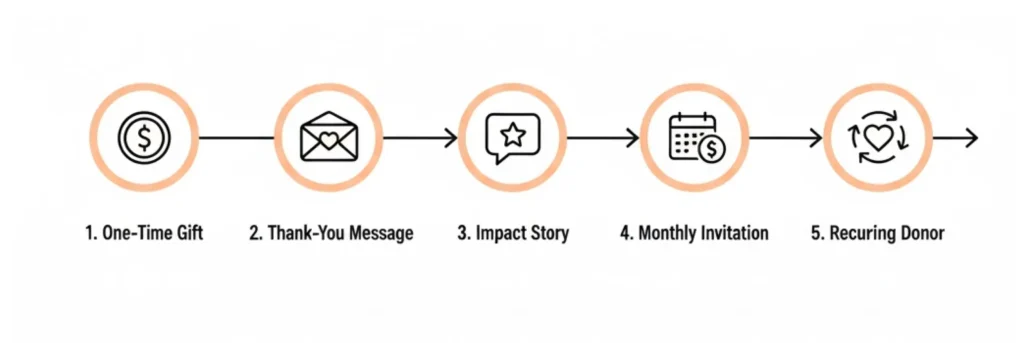
Here’s how to convert your one-time donors to recurring donors:
Follow up fast
Within 48 hours of a one-time gift, send a personal thank-you email. In that email, mention your monthly giving program as a way to continue their impact. Don’t be pushy. Just plant the seed.
Tell a story
A few weeks after their donation, send an update showing what their gift accomplished. Then ask: “Want to make this kind of impact every month?” Stories convert better than statistics.
Offer a smooth transition
Make it ridiculously easy for one-time donors to become recurring donors. A single click should be enough. Pre-fill their information if possible. Remove all friction.
Time your ask around renewals
If a donor gave last year during your holiday campaign, reach out a month before that date. Say something like: “Last year you gave $100. Would you consider giving $10 a month this year instead?” You’re anchoring to their past behavior.
Create urgency without pressure
Let donors know that consistent monthly support helps you plan better and serve more people. You’re not guilting them. You’re showing them why their commitment matters.
How to set up recurring donations online
Here are three ways to set up recurring donations for online fundraising, depending on your platform:
Option 1: WordPress website
If your nonprofit runs on WordPress, you’re in luck. There are several WordPress donation plugins, like Paymattic, that let you accept recurring donations directly on your site. The best ones integrate with payment gateways like Stripe and PayPal, handle subscription management, and let you customize your donation forms.
The advantage of WordPress is control. You own your data, you control the experience, and you’re not paying hefty platform fees on every transaction. I’ll cover one specific plugin below that makes this process simple.
Option 2: Dedicated donation platforms
Platforms like Donorbox, Givebutter, and Fundraise Up are built specifically for nonprofits. They offer hosted donation pages, recurring giving options, and donor management tools out of the box.
The trade-off is cost. Most of these platforms take a percentage of each donation (often 3-5% on top of payment processing fees). For larger nonprofits, that adds up fast. But if you want a stock solution without touching much customizability, they’re a solid choice.
Option 3: Payment processor direct integration
If you have technical resources, you can integrate directly with Stripe or PayPal to handle recurring payments. This gives you maximum flexibility but requires development work. You’ll need to build your own forms, handle subscription logic, and manage donor communication.
This approach makes sense for organizations with unique needs and in-house tech talent. For most small to mid-sized nonprofits, it’s overkill.
Paymattic: The simplest way to accept recurring donations on WordPress
If you’re running a nonprofit on WordPress and want to accept recurring donations without the complexity, Paymattic is worth a look.
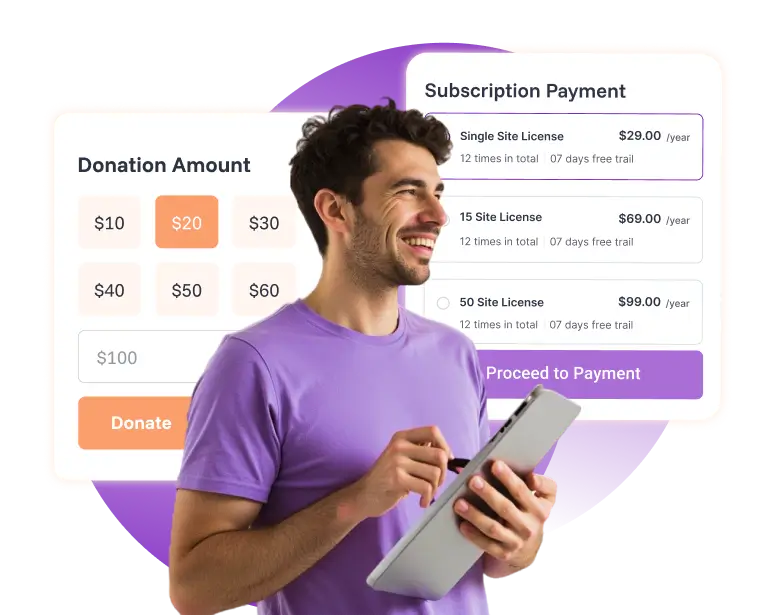
Paymattic is a WordPress plugin that lets you create donation forms with built-in features for recurring payments. You connect your Stripe or PayPal account, design your form, and start collecting monthly, quarterly, or annual donations. The cherry on top is that there’s no platform fee in Paymattic.
Here’s what makes Paymattic stand out for nonprofits:
- Flexible recurring options: Donors can choose their own amount and frequency. You can offer suggested amounts or let them enter a custom figure. Weekly, monthly, quarterly, yearly. It’s all configurable.
- Multiple payment gateways: Paymattic supports Stripe, PayPal, and all the major payment gateways. Donors can pay with cards, bank transfers, or digital wallets, depending on what you enable.
- Donor management: You get a dashboard showing all your subscribers, their payment history, and their status. When a payment fails, you know about it.
- Customizable donation forms: Paymattic gives a simple, fast, and customizable donation form builder. Add custom fields, conditional logic, and branding. Your donation form looks like it belongs on your site.
- Low cost: Unlike hosted platforms that take a cut of every donation, Paymattic charges zero platform fee. Your payment processor fees are the only transaction costs.
- Donor dashboard: Paymattic features a donor dashboard where your donors can see their donations and manage recurring donations if you allow them to.
If you want to keep things simple while maintaining full control, Paymattic handles recurring donations for nonprofits without the overhead of enterprise platforms.
Start Your Journey for Free!
With Paymattic free, you get a full suite of features to manage transactions from the moment you are in.
The bottom line
Recurring donations aren’t just a nice-to-have. For most nonprofits, they’re the difference between scrambling for funds and building something sustainable.
The good news is you don’t need a huge budget or a technical team to get started. Pick a platform (WordPress with Paymattic, a hosted solution, or whatever fits your setup), create a simple recurring giving option, and start inviting your donors to become monthly supporters.
Start small. Even 20 recurring donors at $15 a month gives you $300 in predictable revenue. That’s a phone bill, a software subscription, or supplies for your next event. And it compounds from there.
The donors are out there. They already believe in your mission. You just need to give them an easy way to show up for you, month after month.
Now go build that recurring giving program.
Read: How To Keep Your Donors For Life Using The Donor Engagement Cycle?
Frequently asked questions
How do recurring donations work?
Donors authorize automatic charges to their payment method (credit card, bank account, or digital wallet) at set intervals. Once set up, donations process automatically runs on schedule without requiring any action from the donor or nonprofit.
Can donors cancel their recurring donations anytime?
Yes. Donors can cancel or modify their recurring donations at any time. Most platforms let donors manage subscriptions through a donor portal, or they can contact the nonprofit directly to make changes.
What is the average recurring donation amount?
According to the M+R Benchmarks Study, the average monthly recurring gift is approximately $25. The average recurring donor will give 42% more in one year than those who give one-time gifts.
What happens when a recurring payment fails?
Most donation platforms automatically retry failed payments and notify donors to update their payment information. Some platforms use “card updater” services to refresh expired card details automatically, reducing involuntary churn.
Are recurring donations tax-deductible?
Yes, recurring donations to registered 501(c)(3) nonprofits are tax-deductible in the US. Donors receive receipts for each transaction or an annual summary they can use for tax filing purposes.
Join the thousands already enjoying Paymattic Pro!

Mahfuzur Rahman Nafi
Mahfuzur Rahman Nafi is a Marketing Strategist at WPManageNinja. With 4 years of experience in Product Marketing, he has developed marketing strategies, launched products, written content, and published websites for WordPress products. In his free time, he loves to read geeky stuffs.

Leave a Reply