

Ultimate Donor Engagement Guide: Strategies, KPIs, Actions


Table of Content
Download Paymattic – it’s Free!
Subscribe To Get
WordPress Guides, Tips, and Tutorials
We will never spam you. We will only send you product updates and tips.
I’ve been working with nonprofits for years. And I still remember the first time I created a donor engagement plan for my uncle’s charity. It was a mess. I was asking so many questions, so fast, and got lost in the process.
Should I call the donors? Should I email them and call them later? Is there any established donor engagement method? Am I doing it right?
If you are asking the same questions, you are not alone. Creating a donor engagement strategy often confuses new nonprofits, but the thing is, it’s one of the simplest once you understand the tasks and follow a specific plan.
Donor engagement is the continuous process of building meaningful relationships with your donors via constant communication and involvement that motivates their continued support and loyalty to your cause.
In this article, I’ll walk you through what donor engagement is, why it matters, and how you can engage your donors without much effort.
Let’s get started.
What is donor engagement?
Donor engagement is the ongoing process of building and nurturing relationships between your nonprofit organization and your donors to sustain long-term loyalty and continuous involvement.
By communicating with your donors regularly, involving them in your events, and making them feel appreciated and connected, you make sure they are more likely to stay involved and donate again in the future.
Your donor engagement will determine your donor retention rate. The more engaged your donors are, the more likely they are to stay involved with your charity.
Donor engagement strategies involve sharing your campaign updates, expressing thanks when they donate, inviting donors to your charity events, and similar initiatives.
With a strong donor engagement strategy, you make sure your future donations are secured. A study suggests that first-time donors whose first project was successfully funded are about 5% more likely to donate again than those whose project failed, which represents a 29% relative increase in the chance of a second donation. This pattern is similar when donors give again to the same campaign.
9 Effective donor engagement strategies and best practices
I know the whole donor engagement procedure can get a little overwhelming. I felt the same way my first time. But over time, you get better.
And here are 13 high-yield donor engagement strategies that I’ve personally implemented in my workflow and got better results.
1. Personalize your communication
When you talk with donors, address them as real people. Use their name, remember their giving history, and tailor messages based on what they care about.
Segmenting your contributors into groups based on interests or past behavior helps you customize what and how you convey. Always start with their name when sending an email or message.
2. Create a Welcome Journey for new donors
When a new donor contributes to your cause for the first time, give them a tour of your organization and all the good deeds you’ve already done.
If your nonprofit is new, show them why and how you are collecting money.
For online donations, you need a series of three to four automated but personal-feeling emails over their first 60 days. Your idea email sequence can look like this.
- Email 1: Immediate gratitude and a receipt.
- Email 2: A deep dive into the specific problem they are helping solve.
- Email 3: A “meet the team” or “behind the scenes” look.
- Email 4: An invitation to follow social media or join a newsletter.
3. Segment donors by motivation, not by amount
I’ve seen a tendency to segment donors based on their given amount range. And from my experience, this is the wrong way to segment your donors. You should group your donors by why they give.
Use your database to tag donors based on specific programs they’ve supported. If a donor specifically gives to your “Clean Water” initiative, your next update to them should be about wells and filtration, not your general building fund.
Subscribe Newsletter
Subscribe to our newsletter for updates, exclusive offers, and news you won’t miss!

4. Build trust with your donors
If you want a donor to stay with you long-term, they need to know you are a responsible steward of their money. Building trust with your donors should be your fundamental building block.
Here are some ways I tried to build trust with my donors, and it worked.
- Show that you are using the money
- Show where the money was wasted and brought no result
- Show your failure for specific campaigns
- Ask for suggestions from the donors and notify them when you implement it
- Get feedback from donors and implement feedback fast
5. Conduct thorough donor research
This strategy should be at the top of the list. Because you cannot engage donors if you don’t know their financial capacity or their specific interests.
Run a thorough research on your donors. Analyzing public records and professional networks. Through deep research, you determine the correct “ask” amount and identify which donors have the social capital to make a warm introduction.
You can use tools like LinkedIn, DonorSearch, and Candid (GuideStar) to research donors if you see them fit your scenario.
6. Optimize your website for ease of use
Your site navigation must prioritize the “Donate” button by placing it in a high-contrast color in the top right corner of every page. Optimize your website so that the action elements, like the “Donate” button, are noticeable.
Your donation page must be a dedicated space with no external navigation links that might pull the user away from the transaction. Limit your form fields to the absolute essentials like name, email, and payment info.
Also, make your website faster. A study shows that a slow webpage increases the user drop-off. You can hire a Conversion Rate Optimization (CRO) expert to optimize your website for maximum donor retention.
You can also use tools like Google PageSpeed Insights, Hotjar, and Axe DevTools to optimize your website.
7. Stay active on social media
Use your campaigns’ social platforms not just to broadcast but to engage. Post timely updates, invite donors to comment, respond when they reach out, and give them opportunities to share your posts with their own networks.
Donors who interact with your content feel part of the mission.
8. Conduct regular donor surveys
Stop guessing what your donors want, and start collecting hard data through structured surveys. Send a brief, three-to-five-question survey twice a year to your entire database.
Your questions must be specific: ask which programs they prioritize, how frequently they want to be contacted, and what information they feel is missing from your updates.
Use Likert scales for quantitative data and a single open-ended text box to capture qualitative feedback. You can use tools like Typeform, SurveyMonkey, or Qualtrics to conduct donor surveys.
9. Recognize your donors
You must implement a tiered recognition system that acknowledges donors through both public and private channels. Create a digital or physical donor wall that you update quarterly to reflect current contributions.
For major donors, issue formal press releases or dedicated social media features.
For mid-level and recurring supporters, list their names in your annual report and use anniversary markers, such as “10-Year Donor”, to recognize loyalty rather than just gift size.
You also need to send physical tokens of appreciation, such as certificates or plaques, for significant milestones to provide a tangible record of their standing. Ensure your recognition is consistent by assigning specific tiers
For example,
Use titles like Visionary, Partner, Supporter for every donation level in your database.
Benefits of a strong donor engagement strategy
I’ve built and implemented donor engagement strategies long enough to see the difference a strong strategy can make.
I’ve seen that when you invest in your donors, your donors don’t just donate once and disappear. They tend to stay, notice, cheer, donate again, and actively support your cause.
Here are some high-impact benefits that come from a strong donor engagement strategy:
• Higher donor retention rates
In my opinion, this is the best benefit of a strong donor engagement strategy. Donors who hear from you regularly are more likely to give again. Keeping existing donors costs less than finding new ones.
• More effective donor segmentation
From my experience, I’ve noticed that donors are more likely to respond to your messages. Segmenting donors by activity or interest makes your messages relevant. This prevents one-size-fits-all communication that often gets ignored.
• Stronger long-term donor relationships
Regular, meaningful engagement helps donors feel familiar with your mission and people. This is how their giving becomes personal instead of just a transaction.
• Greater lifetime value per donor
This one is my favorite. If you are a nonprofit and you are keeping your donors’ lifetime value higher, you are winning the game. Your engaged donors often give more or give more often. This increases revenue without needing more donors.
• Improved donor trust and credibility
Sharing clear updates about your donation campaigns shows donors that their money is used wisely. Your donors feel confident in supporting your campaign again.
• Early prevention of donor attrition
Low engagement is often a warning sign. Identifying these signals early gives you time to re-engage your donors instead of losing them permanently.
• Stronger brand perception
Your brand identity is your most precious jewel. And from my experience, I’ve seen that modern charities are focusing more on the brand identity because it works. Regular, responsive communication shapes how donors see your brand. It shows that you value them.
• Clear visibility into donor engagement levels
Keeping track of who is active and who isn’t helps you spot early warning signs. Tracking engagement shows who is active and who is losing interest. You can reach out before donors drop off.
• Stronger personalization in communication
I’ve noticed that when messages reflect a donor’s past involvement, they are more likely to engage. Using donor history makes your messages feel personal. Donors respond better to something that speaks directly to them.
• Identification of major gift prospects
This is what most nonprofits fail to observe. Donors’ engagement patterns show which donors are ready to give more. You can start building relationships with them early. Spotting them early lets you build a stronger relationship before making a bigger ask.
• Better strategic decision-making
Nonprofit is all about strategic decision-making. And your donors’ engagement data tells you what works and what doesn’t. By implementing a strong donor engagement strategy, you can make smarter choices instead of guessing.
• Higher fundraising efficiency
Focusing on the right donors saves time and money. It helps your team get more results with focused communication. Spreading too thin will hamper both resources and time.
• Discovery of future volunteers and advocates
Some of your supporters do not just want to help with money. Some donors want to give time or skills. Tracking engagement shows who might volunteer, advocate, or bring in others. This is very important for your community-built charities.
• More meaningful donor experiences
Well…knowing how donors engage helps you plan events, updates, or campaigns they’ll actually enjoy. Knowing engagement levels helps plan events and updates that fit each donor.
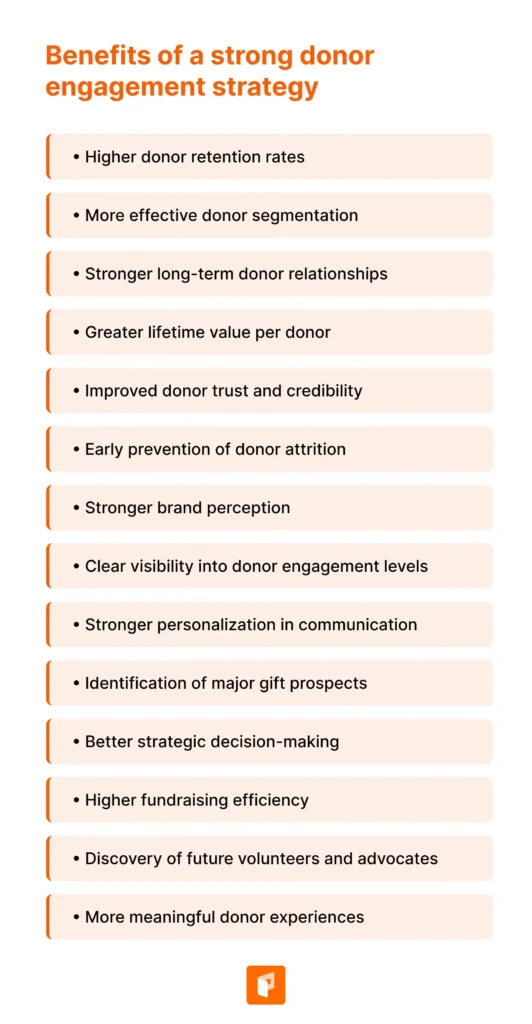
And the benefits of a good donor engagement strategy are not limited only to these. As you go on with a planned strategy, you’ll discover benefits that touch only your cause. I think this is the beauty of a strategy, and this is why all of you should adopt one.
Now, let’s talk about how your donors function.
The donor engagement cycle
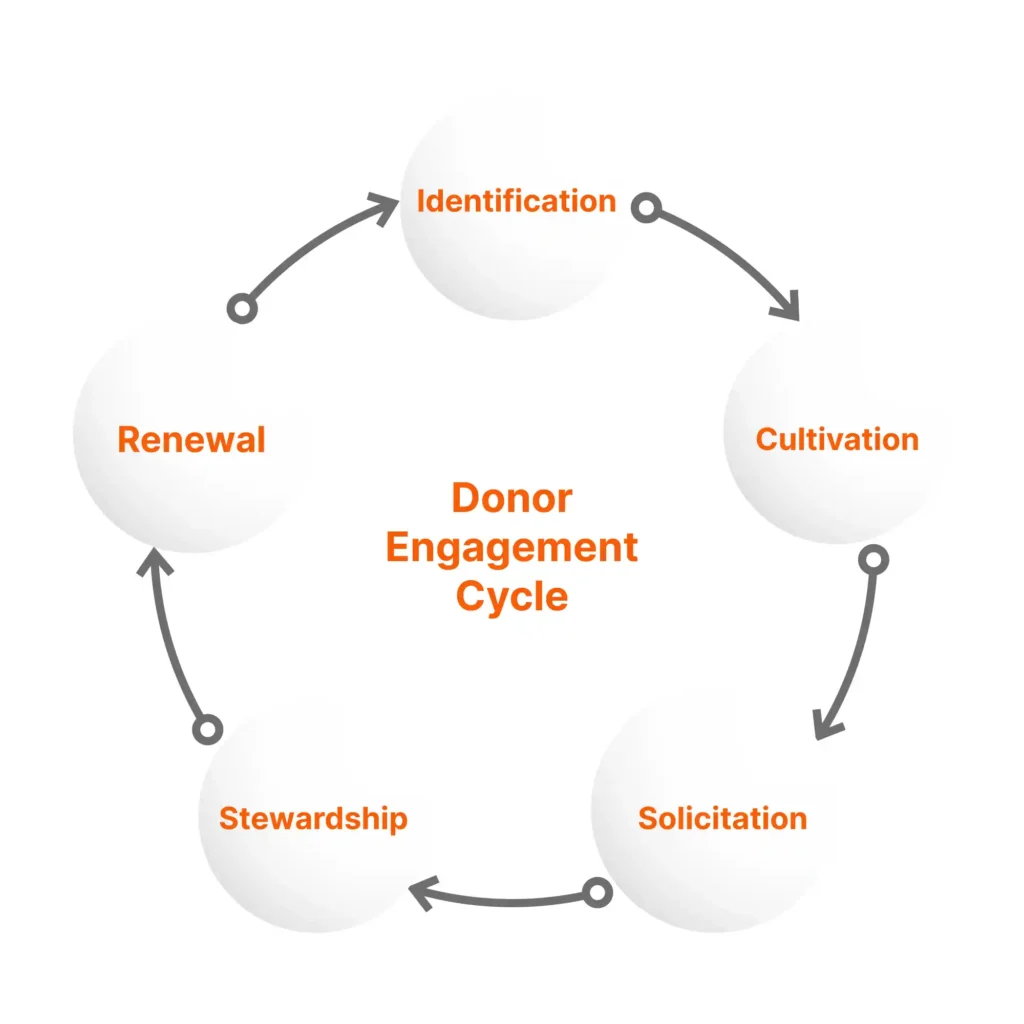
The donor engagement cycle is a simple 5-step procedure that every nonprofit should follow while raising money and maintaining a relationship with its donors. Any strong donor engagement strategy should implement the donor engagement cycle into its core framework.
The 5 steps of the donor engagement cycle are:
- Identification
- Cultivation
- Solicitation
- Stewardship
- Renewal
Let’s break these steps down into simple, actionable terms so that you can use this framework in your donor engagement strategy.
1. Identification (Discovery)
This is the discovery phase. The theory here is simple: you are looking for people who have a personal connection to your cause and the financial capacity to contribute.
Without this initial filtering, your donation outreach leads to a high volume of rejections. When donation outreach is not targeted and researched, you waste resources contacting individuals who have no interest in your specific field or who do not have the resources to help.
At this identification phase, you aren’t asking for anything. You are simply filtering who should be in your network.
For example,
If you run a local animal shelter, your identified group might include people who have recently adopted a pet or local veterinarians.
If you are a library seeking funding for a new children’s wing, you should identify local parents, retired educators, or business owners in the immediate neighborhood.
2. Cultivation (Getting to know you)
Cultivation is the getting to know you phase. Your goal here is to educate the person about your work and show them why your organization is a credible solution to a problem they care about.
Once you’ve identified your target people, you move into cultivation. You share stories, explain the “why” behind your work, and listen to what the donor cares about.
When you ignore this phase and jump straight to asking for money, you make the person feel like a transaction. They haven’t had a chance to see your work in action or understand your goals, so they have no reason to trust you with their money.
Give your donors a chance to see your value before you ask for a contribution. You can cultivate a donor by inviting them to visit your site, sending them a brief update on a recent success, or asking for their advice on a project.
3. Solicitation (Ask)
This is the moment where you make a request for a contribution.
The theory is that you are matching a specific need within your organization to the specific interests that you found out during the donor cultivation phase.
If you make a request without being specific, you leave your donor feeling unsure about how they can actually help. Vague requests like “we just need more funding” are rarely successful.
For example,
A clear request sounds like “We need to raise $2,000 to buy new laptops for our after-school program. Would you be willing to contribute $200 toward one of those laptops?” This gives the donor a clear role in a specific outcome.
4. Stewardship (Proof)
In my opinion, this is the most important step. This phase starts as soon as you receive a gift. The theory here is you must thank the donor fast and, more importantly, show them exactly how their money was spent.
If you stop talking to a donor the moment their check clears, they will feel used. Without consistent follow-up and proof of impact, you damage the trust you’ve built, making it very unlikely that the person will ever give to you again.
A good example of stewardship is sending a photo of the specific playground equipment a donor helped purchase, along with a handwritten note from the project coordinator.
As an organizer, you are closing the loop and proving that you are a good manager of their resources.
5. Renewal (Repeat)
The final stage is renewal, where you ask the donor to support you again. The theory here is lifetime value. You are looking for a long-term partner who will support your organization year after year.
If you don’t have a plan for renewal, you’ll find yourself in a constant cycle of trying to find new donors to replace the ones you’ve lost. This is both expensive and exhausting. Without keeping the donors you already have, your organization will struggle to find long-term financial stability.
At this stage, you might ask a donor to renew their annual gift or perhaps move to a monthly giving plan. Because you’ve already proven that you are trustworthy and effective, this conversation feels like a natural continuation of the work you’re doing together.
Donor engagement signals: How to spot engaged donors
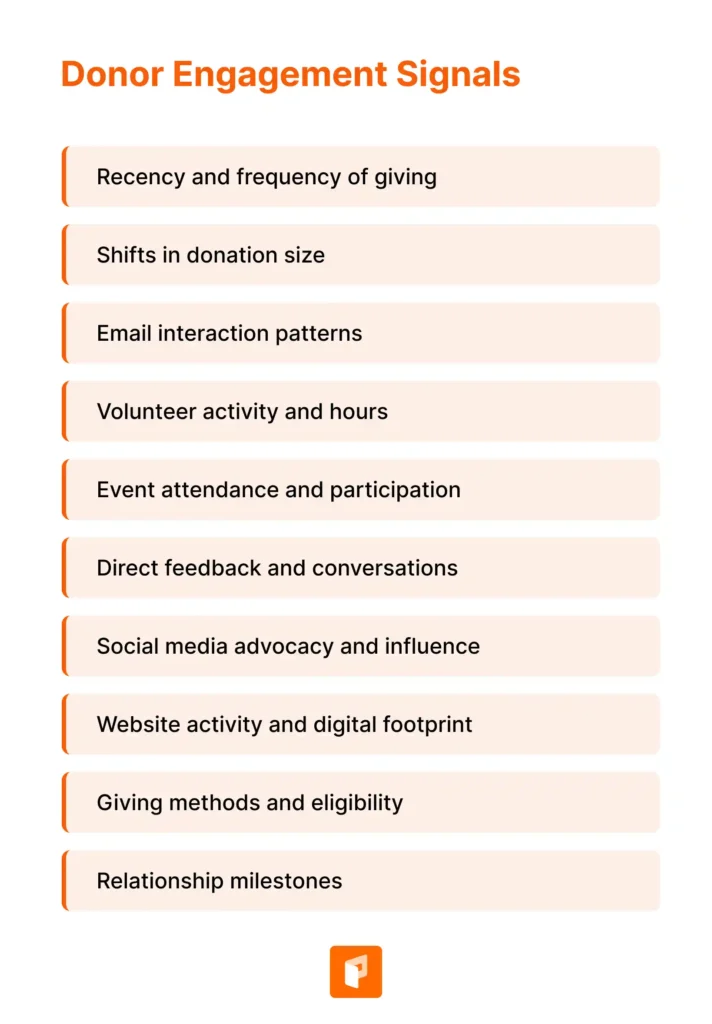
Donor engagement signals are behaviors and data points showing a supporter’s connection to your nonprofit, including direct actions, giving patterns, and digital interactions.
Donor engagement signals include volunteering, event attendance, survey replies, email clicks, frequency, amount, donation amount upgrades, website visits, and social media engagement.
By paying attention to these cues, you get a holistic picture of who your supporters are. Tracking these signals allows you to see who is leaning in and who might be drifting away.
Key donor engagement signals to watch:
- Recency and frequency of giving:
A person who gives $20 every single month is often more tuned in than someone who gave a large amount once three years ago. The regularity and the total years they have stayed with you show that your mission is a permanent part of their life. - Shifts in donation size:
You should watch for upgrades or downgrades in gift amounts. A donor who moves from $500 to $1,000 is signaling increased trust, while a sudden drop might mean they are re-evaluating their commitment or their financial situation. - Email interaction patterns:
Beyond just staying on your list, specific metrics like open rates and click-through rates tell you if your stories are actually resonating. On the other hand, an unsubscribe is a loud signal that a donor is becoming disenchanted or overwhelmed. - Volunteer activity and hours:
When someone gives you their Saturday morning, they are giving you something more finite than money. Tracking the specific hours logged or the types of projects they choose helps you understand the depth of their personal commitment. - Event attendance and participation:
Whether it’s a formal gala, a webinar, or a 5K run, showing up takes effort. Repeated donor attendance is a clear indicator that a donor values the community you’ve built around your mission. - Direct feedback and conversations:
This includes survey responses, direct messages, or notes written on a check. When a donor takes the time to tell you what they think or how they prefer to be contacted, they are actively investing in the relationship. - Social media advocacy and influence:
Watch for people who tag your organization or share your posts with their own followers. These supporters are acting as ambassadors, and their social influence can often be as valuable as their direct donations. - Website activity and digital footprint:
If your system shows a donor frequently visiting your “Our Impact” page or checking out your wealth scoring data through your backend tools, they are likely looking for a deeper way to get involved before they ever speak to you. - Giving methods and eligibility:
Details like whether they give via credit card or check, or if they are eligible for corporate matching gifts, provide practical signals. A donor who utilizes a matching gift is signaling that they want to maximize their impact as much as possible. - Relationship milestones
The way a donor reacts to a giving anniversary or a personalized thank-you note from your leadership is a signal in itself. Their continued engagement following these touchpoints shows that your stewardship efforts are working.
Think of donor engagement signals as the pulse of your relationship with a supporter.
To capture donor signals, you can use a donor management system (CRM) that automatically logs giving history, volunteer hours, and personal interactions into one central profile.
You should also integrate your email and website analytics to see exactly who is clicking your links or browsing your “About Us” pages in real time. Also, donor screening tools can provide the wealth and social data needed to identify which of your active supporters has the most potential for a major gift.
5 easy steps to create a donor engagement plan
A donor engagement plan is a roadmap for your nonprofit on how you’ll get in touch with your donors over a time period. It includes questions like when you should reach out, what you should share, and how often is too often.
Not only that, but our donor engagement plan should also talk about the timing, channels, and nature of your communications to ensure you are not just reaching out when you need a donation.
A donor engagement plan is a must because it prevents donor fatigue and reduces the possibility of your donors feeling like they are being used only when you need them.
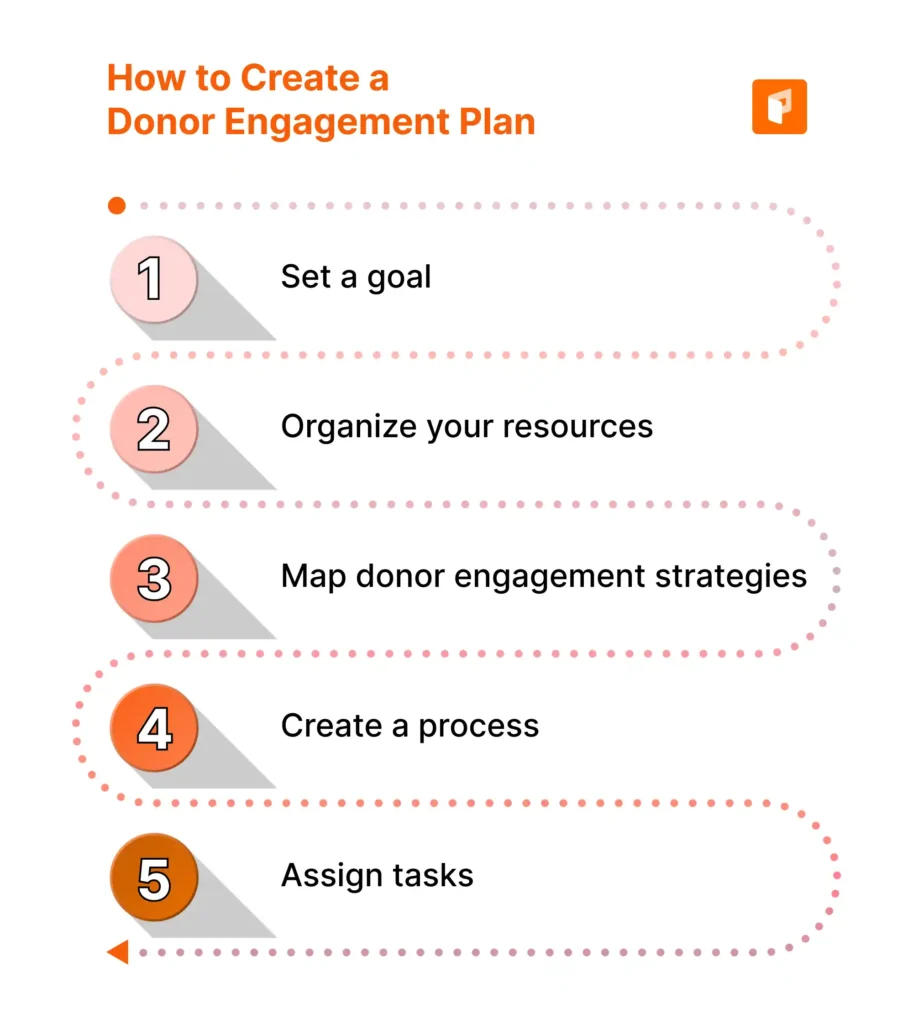
Here’s how to create your donor engagement plan in 5 steps.
Step 1: Set a goal
Firstly, make up your organization’s goal for a donor engagement plan.
You need a clear target that defines what success looks like for your organization. Is it the lifetime value of a donor you’re trying to increase? Is it the volunteer response rate? Is it the donation amount?
To set a specific goal, I recommend that you analyze the current donor data in your hands. Then pick one primary metric to improve over the next target period. Write this goal at the top of your planning document.
Once you have defined whether your success lies in additional revenue, recurring gifts, or engagement metrics, I know you can shape all the other steps to hit that mark.
Step 2: Organize your resources
I’ve seen that you need to conduct a thorough assessment of what is in your hands to execute a successful plan. This includes your financial budget, the number of staff members available, marketing materials, and your volunteer base.
To do that, list every asset you currently have, including sponsors and tools. If you find that your goals require more than what you currently have, you must prepare a business case for your leadership.
Your document should outline exactly what additional headcount or budget you need to make the engagement plan functional.
Step 3: Map donor engagement strategies
This is the step where you create a master plan of every donor engagement strategy and activity you want to use to reach your donors. I’ll talk about high-converting donor engagement strategies later in this article.
Then, take your strategy list and map each activity to a specific stage in the donor lifecycle, from the first gift to long-term support. I’ve found it helpful to check for gaps in your timeline where communication might drop off.
By seeing all your options in one place, you can ensure you have a diverse range of touchpoints that cover the entire year.
Step 4: Create a process
Use your donor engagement strategies from Step 3 to create a simple, repeatable workflow. Make sure you research donor psychology and consider both new and existing donors in this repeatable process.
You can build a checklist for each workflow or implement these steps directly into your project management software. Create templates for emails and letters so that your team does not have to start from scratch every time.
The goal is to make the execution of the plan a routine part of your organization’s operations.
Step 5: Assign tasks
Now it’s time to assign specific roles based on your tasks.
You need to designate who is responsible for writing content, who manages the database, and who makes personal phone calls to major supporters. Without assigned roles, tasks often get duplicated or missed entirely.
I’d suggest you review your team’s strengths and current workloads to distribute these responsibilities. If you have a small team, one person may handle multiple steps.
For larger nonprofits, you can delegate specific stages of the donor cycle to different departments. Document these assignments clearly so everyone knows exactly what they are responsible for.
And you are done creating a donor engagement plan for your nonprofit.
Donor engagement KPIs (Key Performance Indicators)
In my years working alongside nonprofit leaders and development teams, I have seen most of the organizations painfully miss the most important metrics of donor engagement. I know exactly which levers move the needle and which metrics are merely vanity numbers that look good on paper but do nothing for your bottom line.
The following KPIs are the essential benchmarks I use to evaluate the health of a fundraising program.
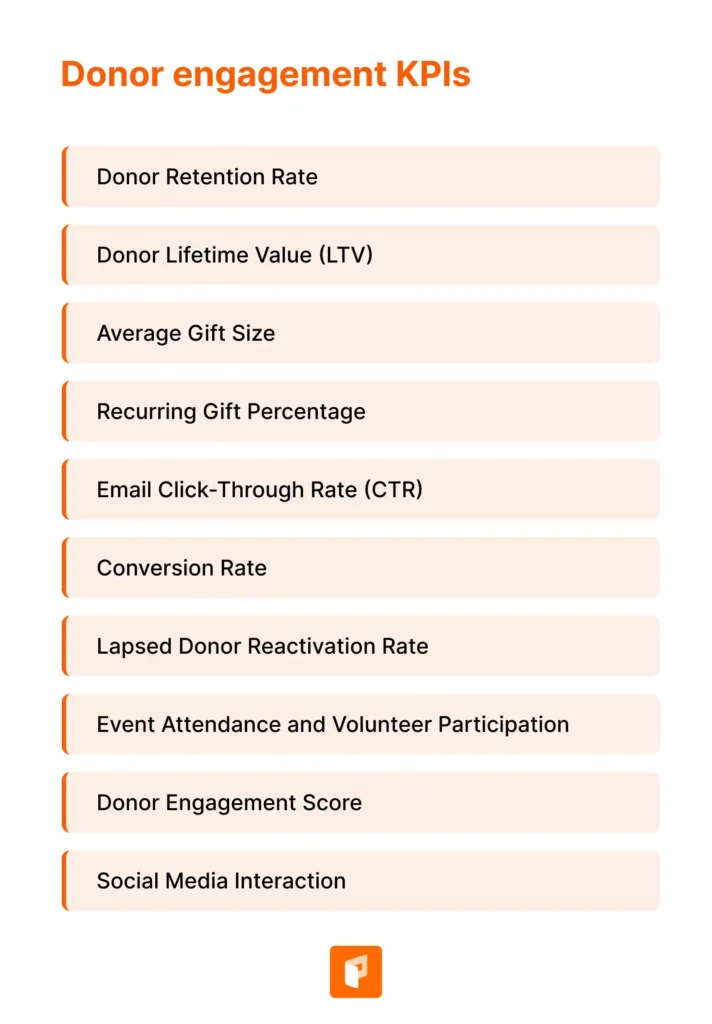
- Donor Retention Rate
This metric measures the percentage of donors who continue to give to your organization year over year. You can track this by dividing the number of donors who gave this year (and last year) by the total number of donors from the previous year. - Donor Lifetime Value (LTV)
Donor lifetime value is the total amount of revenue a single donor is expected to contribute throughout their entire journey with your nonprofit. It is calculated by multiplying the average gift size by the average frequency of gifts and the average donor lifespan. - Average Gift Size
This metric identifies the average dollar amount of all donations received within a specific timeframe. To track it, divide the total donation revenue by the total number of gifts received during that period. - Recurring Gift Percentage
This indicates the portion of your donor base that has committed to a regular giving schedule, such as monthly or quarterly. You can track this by dividing the number of recurring donors by your total number of active donors. - Email Click-Through Rate (CTR)
This measures how effectively your digital content inspires donors to take a specific action, such as reading a story or visiting a donation page from your sent emails. Most email marketing platforms track email CTR automatically by dividing the number of people who clicked a link by the total number of emails delivered. - Conversion Rate
This KPI tracks the percentage of people who completed a requested action, such as making a gift after landing on your donation page. It is tracked by dividing the number of completed actions by the total number of visitors to that specific page or form. - Lapsed Donor Reactivation Rate
This metric shows your success in winning back supporters who have not given for a set period, typically 12–24 months. You track this by dividing the number of previously lapsed donors who made a new gift by the total number of lapsed donors you targeted in a re-engagement campaign. - Event Attendance and Volunteer Participation
These non-financial metrics indicate deep engagement by measuring how many donors are willing to give their time as well as their money. You can track these through sign-up sheets, digital check-ins, or your CRM’s volunteer management module. - Donor Engagement Score
This is a holistic metric that assigns a numerical value to a supporter’s relationship with your brand based on various interactions like giving, attending events, and opening emails. To track it, you must establish a weighted point system within your CRM that automatically tallies points for specific actions taken by the donor. - Social Media Interaction
This KPI measures the level of active involvement your donors have with your organization’s social content through likes, comments, and shares. You can track this by using platform-specific analytics tools to calculate your total engagement rate relative to your total follower count.
Your next steps
Phew… if you’ve come this far, congratulations!
In this article, I’ve only recommended things that I’ve tested in the nonprofit field and found really useful for keeping a strong donor engagement rate.
It might sound like a lot, but once you get on the train, it’s a really easy and smooth ride. So, grab your notepad, take notes from the article, and implement these donor engagement tricks in your nonprofit’s strategy.
Thank you for reading. Hope this article helps.
Join the thousands already enjoying Paymattic Pro!
Donor engagement FAQs
Here are answers to some commonly asked questions about donor engagement.
- Q. What does donor engagement mean?
Answer: It is building strong, caring relationships with supporters so they feel valued and connected to your mission and stay involved beyond just giving. - Q. What is the 80-20 rule for nonprofits?
Answer: It’s the idea that about 80 percent of your funds often come from about 20 percent of your donors, so you focus cultivation on your most impactful supporters. - Q. What are the 4 pillars of donor relations?
Answer: They are acknowledgment, stewardship, recognition, and engagement, which together sustain strong donor relationships and long-term giving. - Q. How to track donor engagement?
Answer: Monitor behaviors like donations, event attendance, email opens, clicks, and volunteering to see who is actively interacting with your nonprofit. - How often should donors be contacted?
Answer: Communicate consistently but respectfully, offering value beyond just donation requests. - How can nonprofits improve donor engagement?
Answer: Use personalized communication, share impact updates, and invite donors to participate beyond giving money.
Read More: WordPress Patreon Alternative – Paymattic X FluentCommunity

Mahfuzur Rahman Nafi
Mahfuzur Rahman Nafi is a Marketing Strategist at WPManageNinja. With 4 years of experience in Product Marketing, he has developed marketing strategies, launched products, written content, and published websites for WordPress products. In his free time, he loves to read geeky stuffs.
Leave a Reply