

Understanding Different Types Of Donors For Nonprofit Organizations


Table of Content
Download Paymattic – it’s Free!

Subscribe To Get
WordPress Guides, Tips, and Tutorials
We will never spam you. We will only send you product updates and tips.
TL;DR: Different Types of Donors for Nonprofits
Stop treating every donor the same; it wastes money and burns out your team. Different donors have different motivations, capacities, and expectations. Some give once and vanish, others stick around for years, and a few can transform your organization overnight. When you segment your list and tailor your approach to each group, you raise more money with less effort. Personalize outreach, allocate resources wisely, and focus on building relationships that last.
We’ve seen nonprofits make the same mistake over and over. They get a donation, send a generic thank-you, then make the same appeal to everyone and wonder why people stop giving!
Honestly, in the nonprofit world, it’s easy to look at a spreadsheet and just see numbers. But not all your donors are the same.
Some give once and disappear. Others stick around for years, quietly funding your mission month after month. A few write massive checks that can transform your entire organization overnight.
If you’re treating all of these people the same way, you’re not just leaving money on the table; you’re probably burning out your team.
Understanding donor types for nonprofits isn’t about jargon. It’s about building a sustainable engine for your mission.
When you know who’s giving, why they give, and what motivates each group, you can craft messages that resonate, build relationships that last, and ultimately raise more money with less effort.
So, let’s break down the different types of donors you need to know and how to work with each one effectively.
Why do types of donors matter for your fundraising success?
Most nonprofits spend way too much time chasing new donors while ignoring the ones they already have. It costs 5 to 10 times more to find a new donor than it does to keep an old one.
Yet the average nonprofit donor retention rate hovers around 43%. That means more than half of your donors from last year won’t give again this year.
Why? Usually, it’s because most organizations send the same generic email to someone who gave $25 once three years ago and someone who’s been giving $500 monthly for a decade.
They have different motivations, different bank accounts, different expectations, and preferred communication styles as well.
When you segment your donor list, you can:
- Personalize your outreach
- Allocate resources wisely
- Predict revenue more accurately
- Reduce donor fatigue
- Identify upgrade opportunities
That’s why donor segmentation isn’t extra work; it’s the work that makes everything else work better.
Different types of donors for nonprofit organizations
So, what are the different types of donors for nonprofit organizations? Let’s get specific. Here are the main types of donors you’ll encounter. You need to understand who they are, what motivates them, and how to approach each one.
1. First-time donors
Who they are: Someone who just made their first gift to your organization. They might have found you through social media, a fundraising event, a friend’s recommendation, or a viral campaign.
Why they matter: First-time donors are your pipeline. Every major donor, every loyal recurring supporter started here. But here’s the catch: most first-time donors never give again.
Industry data shows that only about 20% of first-time donors make a second gift.
How to approach them:
- Send a thank-you within 48 hours (faster is better)
- Make them feel like part of the community, not just an ATM
- Show immediate impact: What did their specific gift help accomplish?
- Don’t ask for another donation right away; focus on building the relationship first
- Create a dedicated welcome series that introduces your mission, team, and impact
The goal: Convert them into repeat donors before they forget about you.
2. Recurring donors
Who they are: Recurring donors are types of donors who give on a regular schedule; monthly, quarterly, or annually. They’ve set up automatic payments and are actively choosing to support you continuously.
Why they matter: Recurring donors are gold. They provide predictable, sustainable revenue you can actually budget around. They also tend to give more over time; a $25/month donor gives $300/year, often more than they’d give in a single annual gift.
Plus, their retention rates are dramatically higher than one-time donors (80-90% vs. 40-45%).
How to approach them:
- Celebrate them! Create a special program name (like a “monthly heroes” club)
- Provide exclusive updates on how their ongoing support creates lasting change
- Don’t bombard them with additional asks—they’re already giving
- Once a year, gently suggest an upgrade (even $5/month more adds up)
- Make it easy to manage their subscription (update payment info, pause, adjust amount)
The goal: Keep them engaged and appreciated so they never hit “cancel.”
3. Major donors
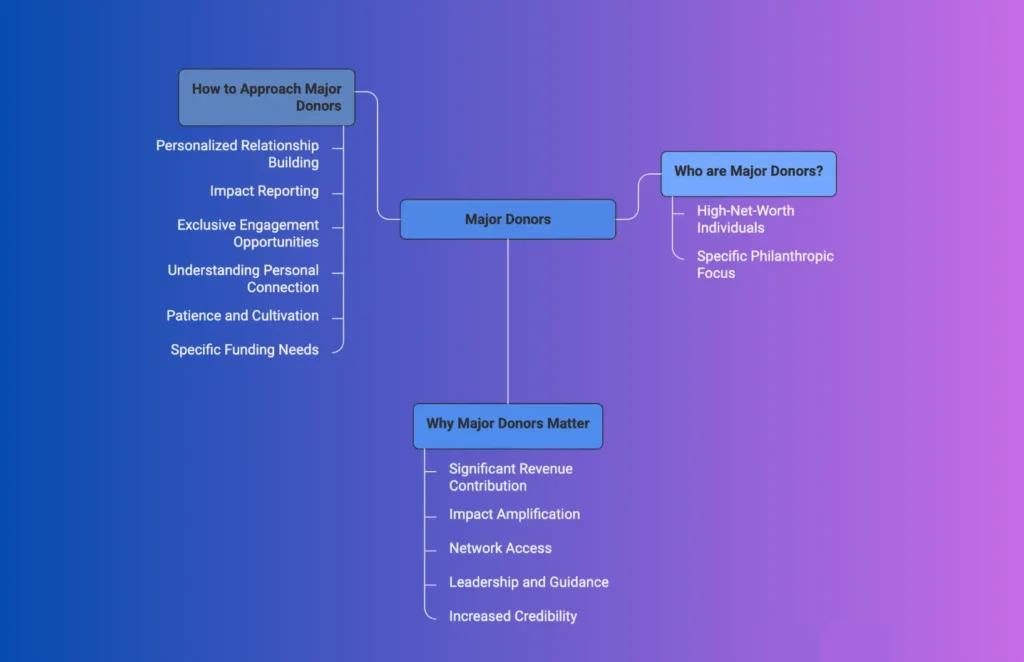
Who they are: Major donors are individuals who make significant gifts. The threshold varies by organization, but typically $1,000+ for smaller nonprofits, $10,000+ for larger ones.
These are often high-net-worth individuals with deep pockets and specific philanthropic interests.
Why they matter: Major donors can account for 80-90% of total fundraising revenue at many organizations. One major gift can equal hundreds of smaller donations. They can also open doors to their networks, serve on boards, and provide strategic guidance.
How to approach them:
- Personalized, one-on-one relationship building is essential
- They want to see exactly how their gift creates impact, give them detailed reports
- Invite them to exclusive events, site visits, or meetings with leadership
- Understand their personal connection to your cause
- Be patient, major gifts often take 12-18 months of cultivation
- Always have a specific, compelling project or need to fund
The goal: Build a genuine relationship where they feel like partners in your mission, not just checkbooks.
4. Corporate donors
Who they are: These types of donors are basically businesses that support your organization through direct donations, sponsorships, cause marketing campaigns, or matching gift programs.
This could range from local small businesses to big companies that donate to nonprofits.
Why they matter: Corporate partnerships can bring significant funding, plus in-kind support, employee volunteers, and credibility. A well-known corporate sponsor can boost your visibility and attract other donors.
How to approach them:
- Understand what they get out of it: positive PR, employee engagement, community goodwill, tax benefits
- Create sponsorship packages with clear benefits and visibility opportunities
- Align your pitch with their corporate social responsibility (CSR) goals
- Make it easy for them to promote the partnership (logos, social media assets, impact stats)
- Build relationships with the decision-makers, not just the CSR department
- Deliver on your promises and provide detailed reports that they can share internally
The goal: Create win-win partnerships where both organizations benefit.
5. In-kind donors
Who they are: This category of donors is supporters who donate goods or services instead of cash. This could be anything from office supplies and auction items to professional services like legal advice, graphic design, or accounting.
Why they matter: In-kind donations reduce your operating costs and can provide things you couldn’t otherwise afford. They also engage people who might not have cash to give but want to contribute their skills or resources.
How to approach them:
- Be specific about what you need (a vague “we accept donations” doesn’t work)
- Make the process easy, clear drop-off instructions, and pickup options if possible
- Provide documentation for tax purposes
- Thank them just as enthusiastically as cash donors
- Consider whether they might also become financial donors over time
The goal: Accept what genuinely helps your mission (and politely decline what doesn’t).

6. Lapsed donors
Who they are: People who gave in the past but haven’t donated in a defined period, usually 12-24 months, are defined as lapsed donors. They’re not your current donors, but they’re not strangers either.
Why they matter: Reactivating a lapsed donor is easier and cheaper than acquiring a new one. They already know you, they already cared enough to give once, something just broke the connection.
How to approach them:
- Acknowledge the gap honestly: “We noticed it’s been a while…”
- Remind them why they gave in the first place
- Update them on what’s happened since their last gift
- Make a specific, compelling ask tied to current needs
- Consider a “welcome back” incentive or matching gift opportunity
- Find out why they stopped (survey them!) and address those issues
The goal: Re-engage them before they forget about you entirely.
7. Loyal donors (Mid-level donors)
Who they are: Supporters who give consistently year after year, typically in the $100-$500 range. They’re not quite major donors, but they’re way more engaged than one-time givers. These are often your most overlooked segments.
Why they matter: Loyal mid-level donors are your most promising major donor prospects. They’ve already demonstrated commitment; they just need the right cultivation to step up. They also provide stable, reliable revenue.
How to approach them:
- Don’t treat them like everyone else—they deserve more attention
- Personal thank-you calls or handwritten notes go a long way
- Invite them to special events or behind-the-scenes opportunities
- Share stories of impact that connect to their giving history
- Gently explore whether they have the capacity and interest to give more
- Consider a mid-level donor program with dedicated staff attention
The goal: Deepen the relationship and identify who’s ready for major gift conversations.
Subscribe Newsletter
Subscribe to our newsletter for updates, exclusive offers, and news you won’t miss!

8. Donors from employee giving campaigns
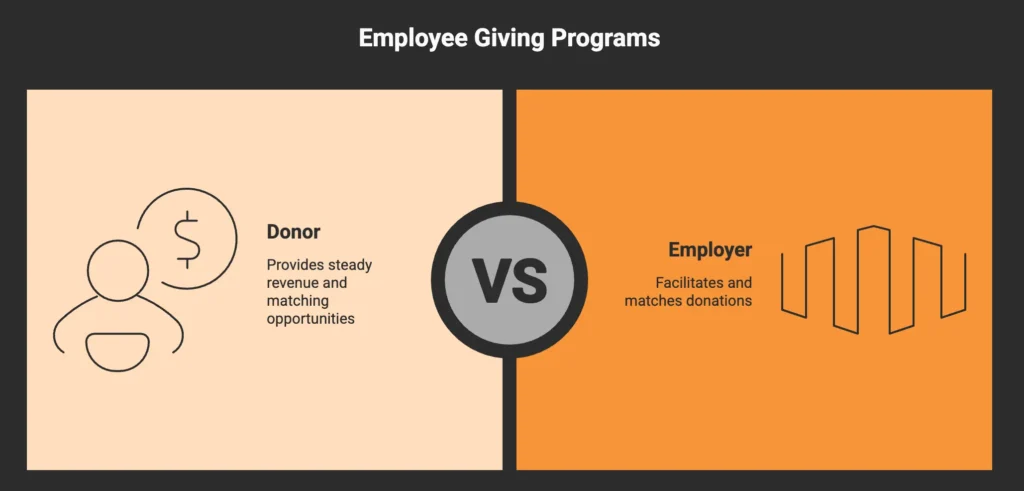
Who they are: Individuals who give through workplace giving programs, like United Way campaigns, payroll deductions, or employer matching gift programs. Their employer facilitates (and often matches) their donation.
Why they matter: Workplace giving provides steady, often recurring revenue. Matching gifts can double donations at no extra cost to the donor. These donors are also captive audiences during workplace campaigns.
How to approach them:
- Make sure you’re registered with major workplace giving platforms
- Promote matching gift opportunities heavily (many donors don’t know their employer matches!)
- Provide easy-to-share materials for workplace campaign coordinators
- Thank both the donor and their employer
- Try to capture their personal contact info so you can build a direct relationship
The goal: Maximize matching opportunities and convert workplace givers into direct supporters.
9. Prospective donors
Who they are: These types of donors are people who haven’t hit the “donate button” yet but show signs of potential interest. They might be your newsletter subscribers, event attendees, volunteers, social media followers, or people in your network who care about your cause.
Why they matter: Every current donor was once a prospect. Your prospective donor pool is your future funding base.
How to approach them:
- Warm them up with value first, educational content, inspiring stories, and invitations to free events
- Look for signals of engagement (opens emails, attends events, shares your posts)
- Make the first ask easy and low-commitment
- Peer-to-peer referrals work well; ask current donors to invite friends
- Segment prospects by how they found you and tailor messaging accordingly
The goal: Convert interest into action with the right ask at the right time.
10. Mass donors (Small-Dollar Donors)
Who they are: Individuals who give small amounts, typically in the range of $10-$50. They might give once a year, respond to emergency appeals, or contribute through crowdfunding campaigns.
Why they matter: While individual gifts are small, mass donors can add up to significant revenue, especially during viral campaigns or year-end pushes. They’re also a large pool for potential upgrades.
How to approach them:
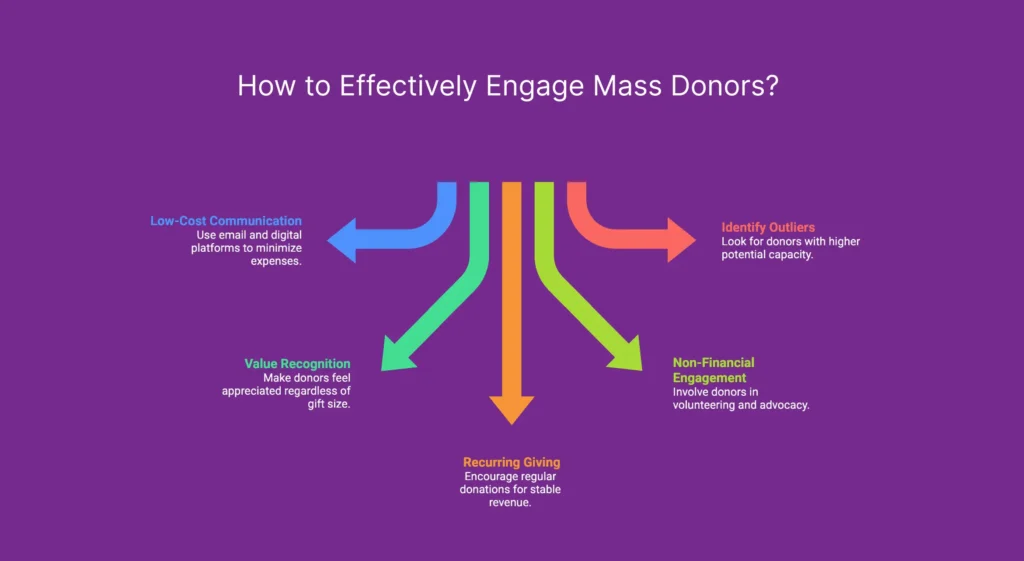
- Keep communication costs low (email, not expensive mail pieces)
- Make them feel valued despite their gift size
- Look for opportunities to convert them to recurring giving
- Engage them in non-financial ways (volunteering, advocacy, sharing on social media)
- Identify outliers who might have more capacity than their giving suggests
The goal: Engage efficiently and identify hidden gems who could become bigger supporters.
How to find donors for nonprofit organizations
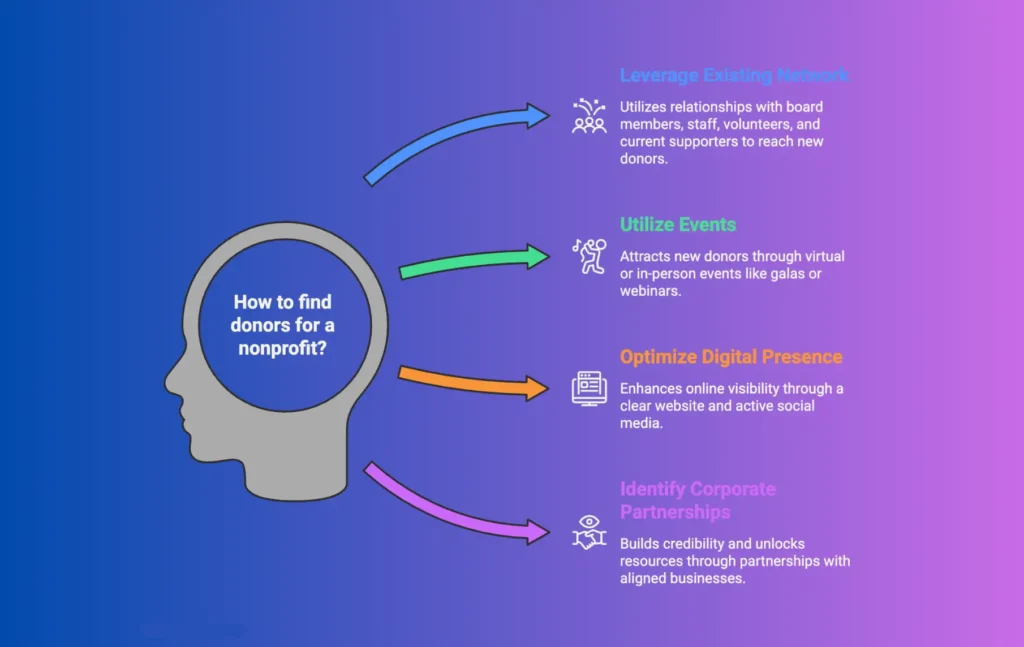
Knowing the types of donors is step one. But the real question is, how to find donors for a nonprofit? Here are proven strategies that work for nonprofit organizations.
Start with your existing network
Your existing network is the best place to start when looking for new donors. Board members, staff, volunteers, and current supporters all have connections who might care about your cause.
Encourage them to share campaigns, make introductions, and host small gatherings where friends can learn about your mission. Peer-to-peer fundraising leverages these relationships and consistently outperforms cold outreach.
Utilize events (Virtual and in-person)
Events remain one of the most reliable ways to find new donors for nonprofit organizations. Whether virtual or in-person, events like galas, community runs, webinars, or open houses bring new people into your orbit.
The key is capturing contact information and following up quickly while your mission is fresh in their minds.
Optimize your digital presence
Your digital presence does heavy lifting around the clock. Most prospective donors will research your organization online before giving, so make sure your website clearly communicates your impact and includes an obvious donation button.
Stay active on social media where your audience spends time, and consider targeted digital ads to reach new supporters interested in your cause.
Identify corporate partnership opportunities
Corporate partnerships offer another way to find donors for nonprofit organizations while building credibility. Look for businesses with CSR goals aligned to your mission, companies headquartered in your community, or employers whose staff already volunteer with you.
These relationships can unlock sponsorships, matching gift programs, and access to employee giving campaigns.
Apart from these, there are other ways to attract and find new donors for your nonprofits, such as using donor prospecting tools, asking for referrals, running Google ads, etc.
Building effective donor lists for nonprofits
Donor lists for nonprofits are the physical manifestation of your donor types. If you don’t know who is a “Sustainer” versus a “Lapsed donor,” your data is just noise.
Creating a strategic list is how you turn your understanding of donor psychology into a functional workflow. By tagging and organizing your supporters, you ensure the right message reaches the right person at the right time.
Segment your lists by:
- Donor type (first-time, recurring, major, etc.)
- Giving level ($1-$99, $100-$499, $500-$999, $1,000+)
- Engagement level (highly engaged, moderately engaged, minimally engaged)
- Interest areas if you work on multiple programs
- Last gift date to identify active vs. lapsed donors
Wrapping Up
Understanding the different types of donors for nonprofits isn’t about putting people in boxes; it’s about meeting them where they are.
A first-time donor needs a different experience than a major donor. A corporate sponsor has different motivations than a monthly sustainer. When you recognize these differences and respond accordingly, you raise more money, build stronger relationships, and create a sustainable funding base for your mission.
Start simple, audit your current donor list, segment by type, create communication plans, and track results.
You don’t need to overhaul everything overnight. Small improvements in how you treat different donor types compound over time.Ready to take your donor relationships to the next level? Check out our guide on donor engagement strategies to learn how to keep your supporters connected and committed for the long haul.
Join the thousands already enjoying Paymattic Pro!

Tipu Deb
Hey! Tipu here, working as a Marketing Strategist at WPManageNinja & Paymattic. A nature lover and a person who is addicted to exploring historical events. In my leisure, you’ll find me playing with different musical instruments.
Leave a Reply