

How to Start a 501(c)(3) Nonprofit: The Beginners Guide


Table of Content
Download Paymattic – it’s Free!

Subscribe To Get
WordPress Guides, Tips, and Tutorials
We will never spam you. We will only send you product updates and tips.
Every great nonprofit began with one simple thing: someone who cared enough to act.
Maybe you’ve watched your community struggle with a problem nobody seems to be solving. Maybe you’ve been volunteering for years and thought, “I could build something better.” Or maybe you just have a cause so close to your heart that starting your own organization feels less like a choice and more like a calling.
Starting a 501(c)(3) nonprofit organization can feel overwhelming at first; there are forms, legal terms, IRS applications, and enough acronyms to make your head spin.
But thousands of people with zero legal background have done this successfully. And with the right guide, you can too.
This beginner-friendly walkthrough covers everything you need to know about how to start a 501(c)(3) nonprofit, from writing your mission statement to opening your first bank account.
Let’s get into it.
Key Takeaways
- What a 501(c)(3) is and how it works, as well as the blog breaks down the difference between a nonprofit and a 501(c)(3).
- A complete guide to starting your nonprofit, from writing your mission statement and forming a board to getting an EIN, drafting bylaws, and submitting your 501(c)(3) application to the IRS.
- The blog covers exactly how much it costs to start a 501(c)(3) (as low as $300–$700 DIY), the difference between Form 1023 and 1023-EZ.
- A handy documents checklist and mistakes to avoid, including the most common errors first-time founders make.
- A clear comparison of 501(c)(3) vs. other nonprofit types, so you can understand how it stacks up against 501(c)(4) and 501(c)(6) organizations.
What Is a 501(c)(3) Nonprofit?
A 501(c)(3) is a type of organization recognized by the IRS as tax-exempt. That means the organization itself doesn’t pay federal income taxes, and more importantly, donations made to it are tax-deductible for the donor.
That last part is a big deal when it comes to fundraising.
The “501(c)(3)” name comes directly from the section of the U.S. tax code that defines these organizations. People often use “nonprofit” and “501(c)(3)” interchangeably, but they’re not exactly the same thing.
Understanding the difference between a nonprofit and a 501(c)(3) matters: a nonprofit is a legal structure formed at the state level, while a 501(c)(3) is a federal tax status.
You can be a nonprofit without being a 501(c)(3), but you won’t have tax-exempt status or donor tax deductions without it.
So, can a nonprofit operate without a 501(c)(3)? Yes, technically. But most organizations pursue 501(c)(3) status because the benefits, credibility, tax savings, and donor appeal are too valuable to skip.
Types of 501(c)(3):
Public charities: Public charities are the most common type. They receive funding from a wide range of sources, including individual donors, grants, government funding, and serve the general public. Think food banks, schools, and health clinics.
Private foundations: Private foundations are typically funded by a single source, like a family or corporation. They usually don’t run their own programs but instead distribute grants to other nonprofits.
The Bill & Melinda Gates Foundation is the classic example.
Step-by-step guide to start a 501(c)(3) nonprofit organization
Here’s the honest version: starting a nonprofit isn’t complicated, but it does require patience and attention to detail.
Each step builds on the last, so don’t skip ahead. Follow this process, and you’ll have a legally compliant, tax-exempt organization ready to make a real impact.
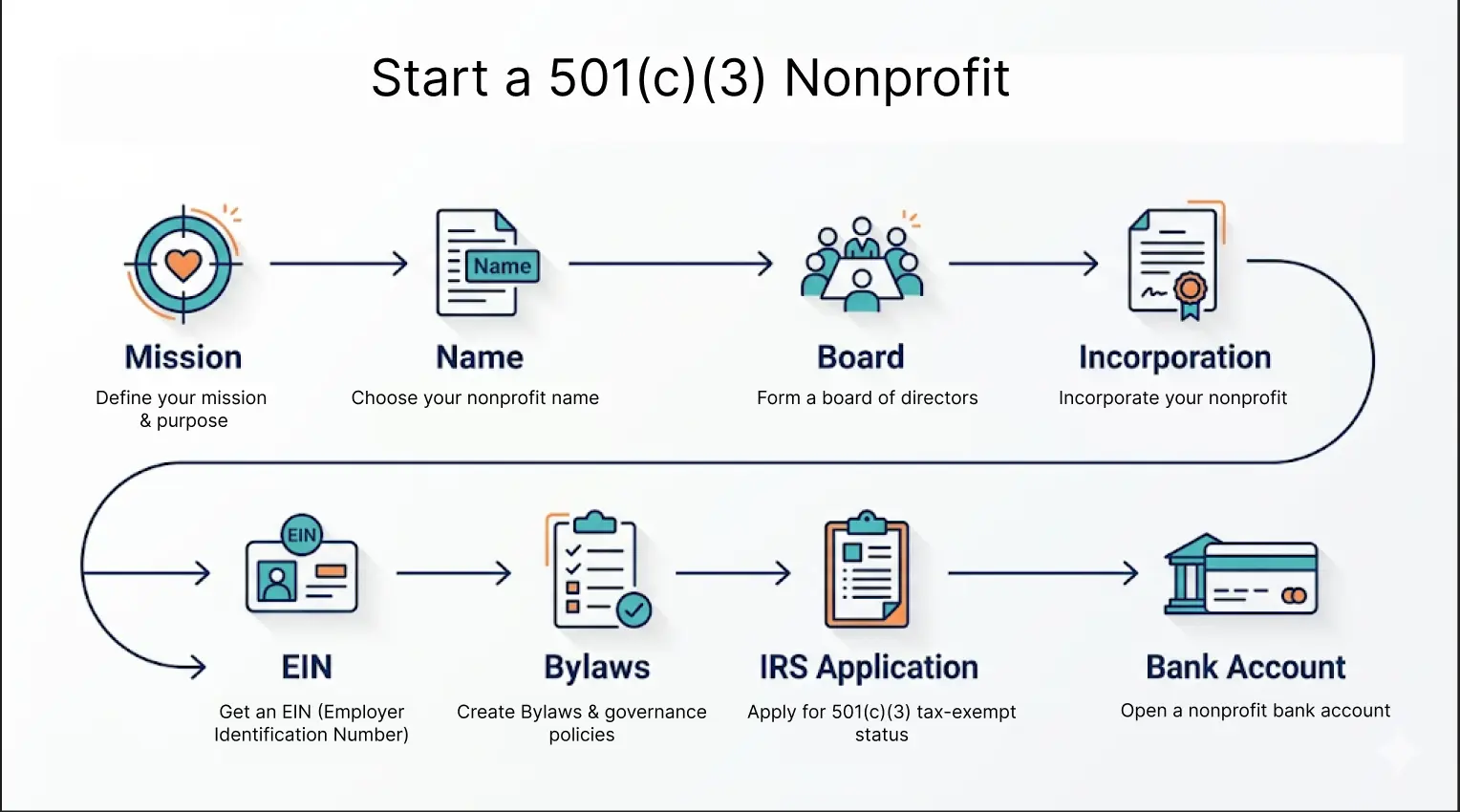
Define your mission & purpose
Before you fill out a single form, get crystal clear on why your nonprofit exists.
Your mission statement is the foundation of everything, your IRS application, your fundraising pitch, your board conversations. It needs to be specific, meaningful, and actionable.
“Helping people” is too vague. “Providing free after-school tutoring to low-income students in rural Georgia” is a mission.
The IRS recognizes 501(c)(3) organizations that operate for charitable, educational, religious, scientific, or literary purposes (among others). Make sure your mission fits one of these categories.
Choose your nonprofit name
Your name is your brand. Choose it carefully.
First, it needs to be unique in your state; most states won’t let you register a name that’s too similar to an existing organization.
Check your state’s Secretary of State website to search existing names before falling in love with one.
Second, check if the domain name is available. Even if you don’t plan to build a website right away, securing your domain early is smart. Use a tool like Namecheap or GoDaddy to search.
A few quick naming tips: keep it memorable, make it reflect your mission, and avoid names that are too narrow (in case your work evolves).
Also, avoid terms like “National” or “Federal” unless you truly operate at that scale; some states restrict these.
Subscribe Newsletter
Subscribe to our newsletter for updates, exclusive offers, and news you won’t miss!

Form a board of directors
Every 501(c)(3) nonprofit organization is required to have a board of directors. This isn’t just a legal formality; your board is your organization’s backbone.
Most states require a minimum of three board members. Your board should include, at a minimum, a President (or Chair), a Secretary, and a Treasurer. Some organizations combine roles early on, but as you grow, separate them.
Incorporate your nonprofit
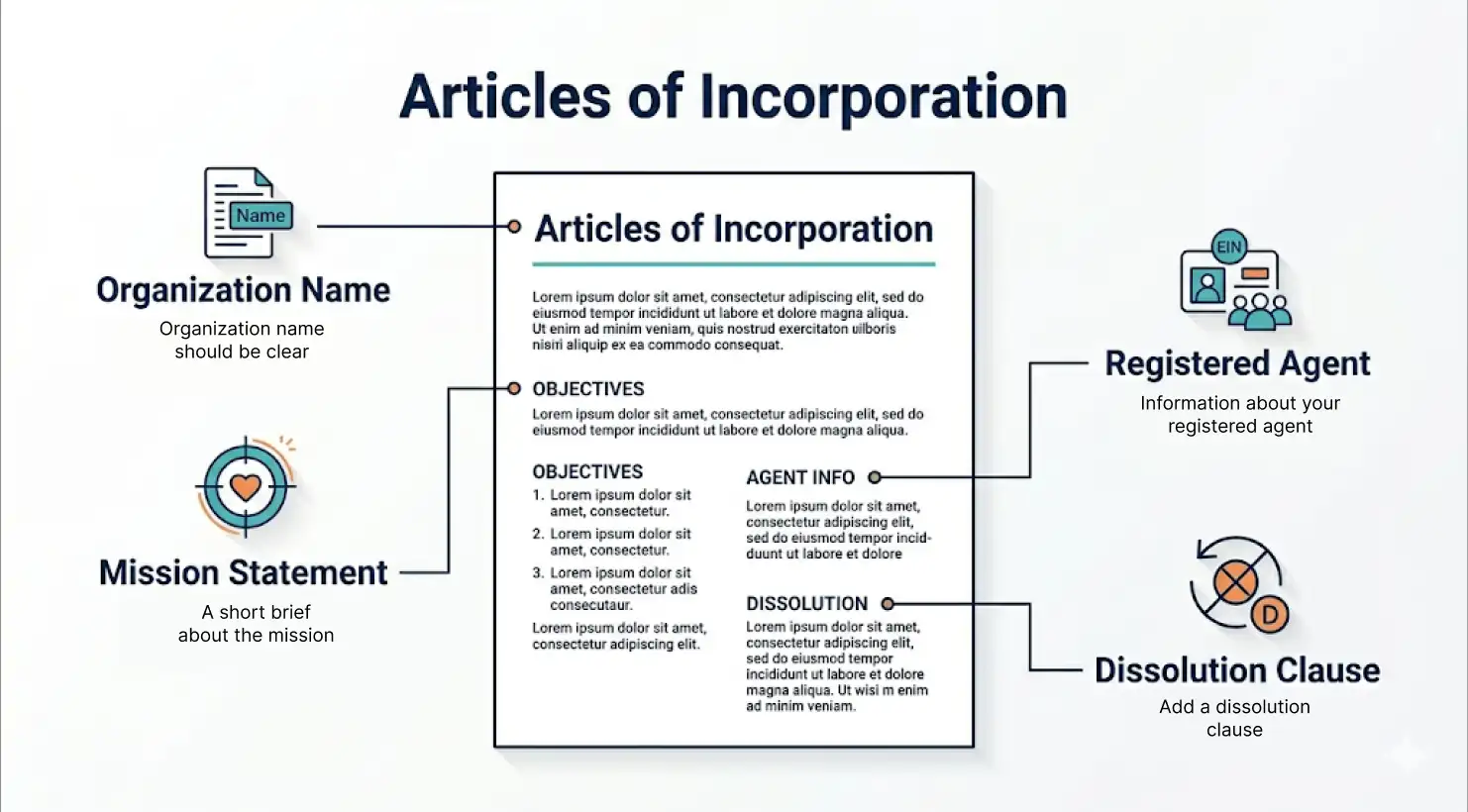
Incorporation makes your organization a legal entity at the state level. This is a separate step from getting your federal tax-exempt status; you need to do both.
To incorporate, you’ll file Articles of Incorporation with your state’s Secretary of State office. The document typically includes:
- Your nonprofit’s name and address
- Your mission and purpose statement
- Information about your registered agent (the person or service that receives legal documents on behalf of your org)
- A dissolution clause (what happens to assets if you shut down)
Filing fees vary by state, usually between $25 and $100.
If you’re learning how to start a nonprofit in California specifically, note that California has additional requirements and a $30 filing fee, plus a required Statement of Information filed within 90 days.
Get an EIN (Employer Identification Number)
Think of an EIN as your nonprofit’s Social Security number. The IRS uses it to identify your organization, and you’ll need it for almost everything: opening a bank account, filing taxes, and submitting your 501(c)(3) nonprofit application.
The good news? It’s completely free and takes about 10 minutes. Apply directly on the IRS website. You’ll get your EIN immediately after completing the online form.
Don’t pay a third-party service to do this for you; it’s unnecessary and a waste of money.
Create Bylaws & governance policies
Bylaws are your nonprofit’s rulebook. They explain how your organization operates, how meetings are held, how decisions are made, how board members are elected and removed, and what happens in a dispute.
The IRS doesn’t dictate exactly what your bylaws must say, but 501(c)(3) bylaws requirements do exist at the state level.
Most states require bylaws to include board structure, meeting frequency, voting procedures, and officer roles.
Beyond bylaws, you’ll also need a Conflict of Interest Policy. This is a document your board members sign to confirm they won’t use their position for personal financial gain. The IRS specifically looks for this when reviewing your application; don’t skip it.
You can find free bylaw templates for 501(c)(3) nonprofit organizations through resources like the National Council of Nonprofits. Customize a template rather than starting from scratch.
Apply for 501(c)(3) tax-exempt status
This is the big one. To start a 501(c)(3) nonprofit organization, you need to apply to the IRS, and this is where most people feel nervous. It’s a detailed process, but it’s very doable.
You’ll use one of two forms:
Form 1023-EZ: The simplified version. You can use this if your projected annual gross receipts are $50,000 or less and your total assets are under $250,000. The 501(c)(3) application fee for Form 1023-EZ is $275, and processing typically takes 2–4 weeks.
Form 1023: The full application. Required for larger or more complex organizations. The filing fee for Form 1023 is $600, and it can take anywhere from 3 to 12 months to process.
Both forms are filed through Pay.gov. Your application will ask about your mission, activities, finances, governance, and board members. Answer thoroughly and honestly. Incomplete applications are the number one reason for delays.
Register for state tax exemption
Federal 501(c)(3) status doesn’t automatically exempt you from state taxes. Most states offer their own sales tax exemption and income tax exemption for nonprofits, but you need to apply separately.
Requirements vary widely by state. Some states grant exemption automatically once you have federal status; others require a separate application.
Check with your state’s Department of Revenue or taxation agency for the specific process.
If you’re operating in multiple states, you may need to register in each one.
Apply for licenses & permits
If your nonprofit will be soliciting donations from the public, which most nonprofits do, then many states require charitable solicitation registration. This is separate from incorporation and tax exemption.
About 40 states have this requirement. You’ll typically need to register before you start any fundraising and renew annually. Again, requirements differ by state, so check your state’s charity registration rules directly.
Also, check whether your local city or county requires any business licenses for nonprofits. It’s less common, but some jurisdictions do.
Open a nonprofit bank account
Once you have your EIN, Articles of Incorporation, and bylaws in hand, you can open a dedicated bank account for your nonprofit.
Never mix personal and organizational funds; this is one of the most common 501(c)(3) violations that can jeopardize your status.
Most banks will ask for your EIN, a copy of your Articles of Incorporation, your bylaws, a board resolution authorizing the account, and a photo ID for the authorized signers.
Look for accounts with no or low monthly fees, many banks offer special nonprofit accounts.
Set up basic financial tracking from day one, even if you’re starting small. Good financial habits early save enormous headaches later.
How much does it cost to start a 501(c)(3) nonprofit organization?
Here is a breakdown of how much it may cost to start a 501(c)(3) nonprofit organization.
| Expense | Estimated Cost |
| State incorporation filing fee | $25–$100 (varies by state) |
| IRS Form 1023-EZ filing fee | $275 |
| IRS Form 1023 filing fee | $600 |
| State tax exemption registration | Free–$100 |
| Charitable solicitation registration | $0–$200 per state |
| Legal/accounting help (optional) | $500–$3,000+ |
If you do everything yourself, you can get started for as little as $300–$700. Hiring a nonprofit attorney or accountant will increase costs but reduce errors, worth considering if your organization is complex.
How long does it take to get 501(c)(3) status?
Realistically, plan for 3 to 12 months from start to finish.
The fastest path is using Form 1023-EZ; many applicants receive their Determination Letter within 2–4 weeks of submission.
Form 1023 takes considerably longer, often 6 months to a year, especially if the IRS requests additional information.
Incorporation at the state level usually takes 1–4 weeks. Getting your EIN is instant. The bottleneck is almost always the IRS application.
The good news: you can start operating and building your organization while you wait. You just can’t officially claim tax-exempt status until you receive that letter.
Required documents checklist to start a nonprofit organization
Before you submit your 501(c)(3) nonprofit application, make sure you have these documents ready:
- Articles of Incorporation (filed and approved by your state)
- Bylaws (signed by your board)
- EIN from the IRS
- Form 1023 or Form 1023-EZ (completed and ready to submit)
- Conflict of Interest Policy (signed by all board members)
- Financial projections or statements
- Narrative description of programs and activities
Common mistakes to avoid while submitting a 501(c)(3) nonprofit application
Even well-intentioned founders make mistakes that slow down or derail the process. Here are the most common ones:
A weak mission statement: If your mission is vague or doesn’t clearly fit an IRS-recognized purpose, your application can be delayed or denied. Be specific.
Poor board selection: Filling your board with people who won’t challenge you, contribute skills, or show up is a recipe for long-term dysfunction. Choose carefully.
Skipping state compliance: Getting 501(c)(3) status doesn’t mean you’re done. Many founders forget about charitable solicitation registration, state tax exemption, or annual reporting requirements, and face penalties later.
Underestimating the workload: Running a nonprofit is a real job. Many first-time founders are surprised by how much administrative, legal, and financial work is involved. Go in with clear eyes and a realistic plan.
501(c)(3) vs other nonprofit types
The 501(c)(3) vs 501(c)(4) distinction is one people often ask about, and it matters.
501(c)(4) organizations are “social welfare” organizations. They can engage in political lobbying and advocacy in ways that 501(c)(3)s cannot. However, donations to 501(c)(4)s are generally not tax-deductible for donors.
501(c)(6) organizations are business leagues, chambers of commerce, and trade associations. They serve the interests of a specific industry or profession rather than the general public.
If your primary goal is charitable work, education, or religious activity, and you want donors to receive tax deductions, then 501(c)(3) is the right fit for you. The other types exist for specific purposes that most new nonprofit founders simply don’t need.
Wrapping up
Starting a nonprofit organization is one of the most meaningful things you can do, and yes, it takes work. But look at what you’re building: a legally recognized, tax-exempt organization with the power to attract grants, inspire donors, and create real change in your community.
You don’t need a law degree. You don’t need a massive budget. You need a clear mission, the right people around you, and the willingness to follow the process one step at a time.
Whether you’re figuring out how to start a nonprofit 501(c)(3) from scratch or trying to formalize something you’ve already been doing informally, the path forward is clearer than it looks.
Take the first step, define your mission, and the rest will follow.
Join the thousands already enjoying Paymattic Pro!

Tipu Deb
Hey! Tipu here, working as a Marketing Strategist at WPManageNinja & Paymattic. A nature lover and a person who is addicted to exploring historical events. In my leisure, you’ll find me playing with different musical instruments.

Leave a Reply