
Major Donor Fundraising: How to Find and Engage


Table of Content
Download Paymattic – it’s Free!

Subscribe To Get
WordPress Guides, Tips, and Tutorials
We will never spam you. We will only send you product updates and tips.
TL;DR:
Major donor fundraising isn’t about chasing rich strangers. It’s about finding the right people, building real relationships, and making asks that actually land. This guide breaks down who major donors are, what drives them to give, practical ways to find them, and howtouc to cultivate those relationships from first contact to long-term retention.
Key takeaways
– A “major donor” is relative to your org’s size, could be $1K or $100K.
– People give because of personal connection, legacy, impact clarity, and peer influence, not just money to spare.
– Your best prospects are already in your database: consistent givers, event attendees, volunteers.
– Cultivation takes 6–18 months; most touchpoints should be relationship-building, not asking (5–7 non-ask interactions per ask).
– Find prospects via wealth screening tools, board networks, lapsed donors, and 990 forms from similar orgs.
– The ask should be in-person, specific, and mission-aligned, not a generic “we’d love your support.”
– After the gift: thank within 48 hours, report impact all year, treat renewal as a continuation, not a new pitch.
If you’ve been in the nonprofit world for any length of time, you already know that not all donors donate equally. Some give $25 a year. Others give $25,000.
And that difference? It changes everything about how you run your organization.
Most small nonprofits pour their energy into bake sales, crowdfunding campaigns, and email blasts to a list of $25 donors. And those things work to a point.
But if your organization is constantly scrambling for the next donation, you’re not building a fundraising program. You’re running a treadmill.
Major donor fundraising is how organizations break that cycle. It’s often the backbone of a nonprofit’s financial health. Yet so many fundraisers either don’t know where to start or feel uncomfortable asking for large donations.
This guide will walk you through who major donors really are, what motivates them to give, how to identify them, how to cultivate real relationships, and how to ask for major gifts in a way that doesn’t feel awkward or transactional.
Who are the major donors for nonprofit organizations?
80% of your nonprofit’s donations will come from just 20% of your donors. It’s a general rule of thumb, and it holds across nearly every organization, big or small.
That top 20%? Those are your major donors for a nonprofit organization.
But what exactly qualifies someone as a “major donor”? There’s no universal threshold. For a small community nonprofit, a major gift might start at $1,000, nonprofit with a $200K annual budget, a $5,000 donation is a major gift.
For a university or a hospital foundation, it might be $10,000, $50,000 or even more.
“In short, a major donor is someone whose gift is large enough to significantly impact your mission, given your organization’s scale.”
Major donors for nonprofit organizations include individuals (the most common), as well as corporate donations to nonprofits, family foundations, and giving circles.
Major gifts vs. other giving types
| Type | Typical Range | Relationship Depth |
| Small/recurring donors | $5–$250/year | Transactional |
| Mid-level donors | $250–$2,500/year | Some cultivation needed |
| Major donors | $2,500–$25,000+ | Deep, ongoing relationship |
| Principal/legacy gifts | $25,000+ or planned giving | Highest-touch, multi-year |
What motivates major donors to give?
Before you can ask for a major contribution, you need to understand what gets a donor to say yes in the first place. People don’t make major contributions because they got your newsletter.
There’s always something deeper driving it. Understanding that something is the whole game.
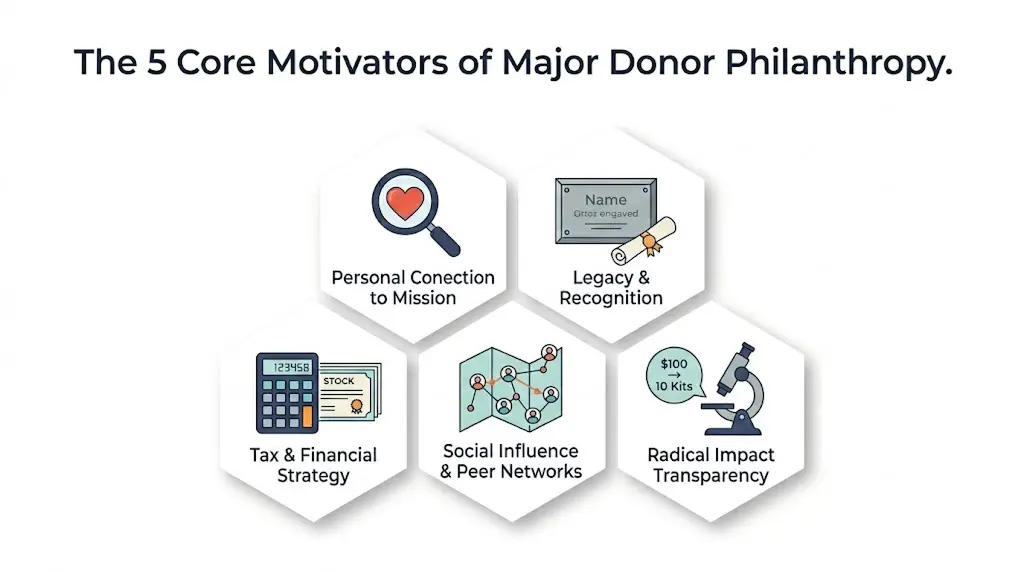
Personal connection to your mission
This one isn’t complicated, but it’s easy to underestimate. Major donors almost always have a personal reason for caring about your cause.
Maybe they lost a family member to a disease your nonprofit is fighting. Maybe they grew up in poverty, and your literacy program speaks to their own story.
You can’t manufacture this connection, but you can create the conditions for it to surface. Ask questions. Listen. Don’t rush to your talking points. Sometimes a donor will tell you exactly why they care if you give them enough space to get there.
Legacy and recognition
A lot of major giving is tied to legacy, the human desire to leave something behind that matters. Named scholarships, memorial funds, named buildings or rooms, these aren’t vanity projects. For many donors, they’re deeply personal.
That said, don’t assume every donor wants their name on a wall. Some do. Some would be mortified. Know which kind you’re talking to before you bring it up.
Tax benefits and financial planning
Major donations often happen at year-end or during estate planning conversations. Donors, especially those with appreciated assets like stocks or property, may have strategic reasons to give. While you shouldn’t provide tax advice, being aware of this motivator helps you time your asks and conversations.
Social influence and peer networks
Philanthropy travels in circles. When one respected person in a community makes a significant gift, others notice. Sometimes they ask about it. Sometimes they want to be part of the same thing.
This is why your existing major donors are one of your best acquisition tools. A peer-to-peer introduction carries more weight than anything your development team can put in an envelope.
Impact transparency: seeing where their money goes
Major donors for nonprofit organizations are not passive. They want to know exactly what their gift does.
“We helped hundreds of families” doesn’t cut it. “Your gift of $8,000 covered six months of job training for 14 people, three of whom are now employed full-time.” That’s what lands.
The more specific you can be about impact, the more confident a donor feels about giving again and giving more.
Emotional vs. rational giving: what really drives the decision?
Most donors decide to give emotionally and then justify it rationally. The story of one person whose life changed because of your work will move someone faster than a spreadsheet of outcomes.
Then they’ll spend weeks looking at your 990, reading your annual report, and talking to people who know your organization. They’re not being cold. They’re being responsible. You need to satisfy both impulses.
Lead with the human story. Have the data ready when they ask.
Effective major donor fundraising strategies and tips
So you know what major donors strive to be a major donor. Now you should utilize the opportunities. Let’s talk about some effective major donor fundraising strategies here.
Building a major donor fundraising plan from scratch
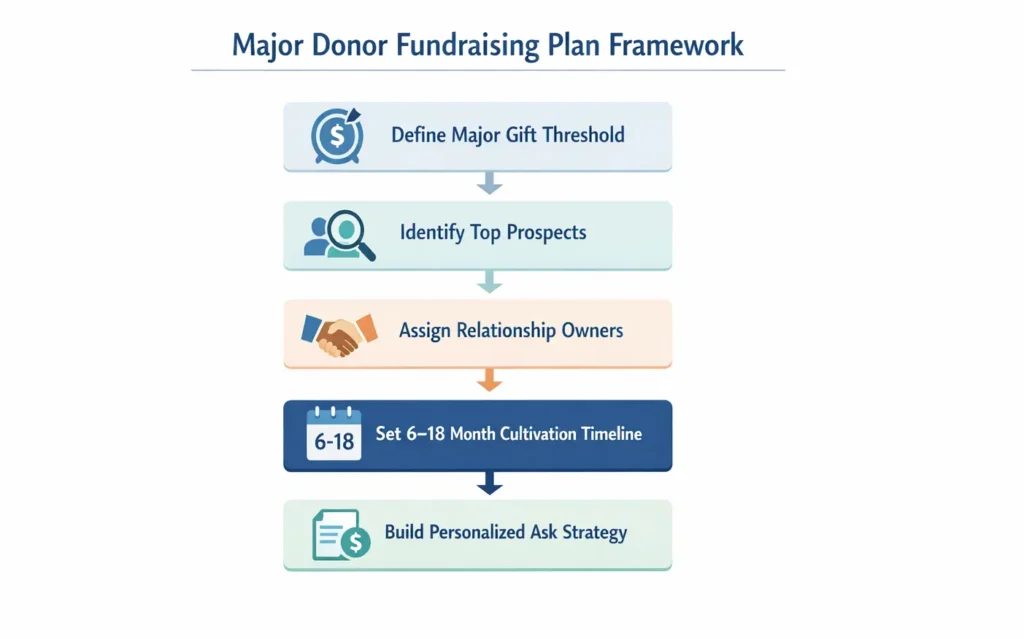
You don’t need a Major Gifts Officer on staff to build a plan. What you need is a simple framework:
- Define your major giving threshold – What dollar amount qualifies as a major gift for your org?
- Identify your top prospects – Start with your existing donor base (more on this below)
- Assign relationship owners – Who on your team or board will build the relationship?
- Set a major donor cultivation timeline – Major contributions don’t happen in a week. Plan for 6–18 months
- Build your ask strategy – Personalized, mission-aligned, and specific
Even a one-page plan is better than no plan.
Setting realistic goals and gift ranges
Don’t set arbitrary dollar goals. Set goals based on your prospect pool. If you have 20 prospects with an average gift potential of $5,000 each, your realistic major gift revenue for the year might be $40,000–$60,000 (accounting for conversion rates).
Build a gift range chart: how many gifts at what level do you need to hit your goal? This also helps you have honest conversations with your board.
Aligning your ask with donor interests
This is a key major donor fundraising strategy. Your ask should align with the donor’s interest.
A generic ask is a weak ask. If you know a donor cares deeply about education access, don’t ask them to fund your general operating budget. Instead, show them how their contribution funds a specific scholarship, a curriculum, or a teacher training program.
The more aligned your ask is with their values, the easier it is for them to say yes.
Stewardship vs. Solicitation: getting the balance right
A lot of nonprofits either over-solicit (every touchpoint is a request) or under-solicit (they’re afraid to ask at all). The sweet spot is to have a major donor cultivation plan where most interactions are relationship-building; impact updates, program invites, check-ins, and asks happen naturally as a next step.
A rough guide: for every one ask, aim for five to seven meaningful non-ask touchpoints.
These touchpoints don’t need to be elaborate; a handwritten note, a recognition shoutout, or a small token of gratitude can go a long way. See our latest list of smart donor gift ideas for budget-friendly inspiration.
How to make a compelling major gift ask
The ask itself should:
- Be made in person or via video call, not email
- Come after genuine relationship-building, not cold outreach
- Be specific: “We’d love to ask you to consider a gift of $X to fund Y”
- Leave room for conversation, don’t rush to fill the silence
- Be followed up in writing with a clear, specific proposal
Remember: the ask is a conversation, not a pitch.
10 Ways to find major donors for nonprofit organizations
Finding major donors is different from attracting regular donors for a nonprofit. It’s not just about luck; it’s about strategy, research, and building the right relationships.
Let’s see the proven ways to identify potential major donors who have both the capacity and the interest to support your mission. These methods will help you move beyond guesswork and create a focused approach to major donor fundraising.
Assess your existing donor database
Your best major donor prospects are already giving to you, just at a smaller level. Look for:
- Donors who give consistently year after year
- Anyone who has given multiple times in a single year
- People who opened every email, attended events, or volunteered
Consistency and engagement are stronger predictors of major donation potential than the size of their current gift.
Use prospect research tools and wealth screening
Tools like DonorSearch, iWave, or WealthEngine can analyze your donor list and flag people with the financial capacity to give more.
They pull public data like real estate, business ownership, and past charitable gifts to give you a clearer picture.
Wealth screening doesn’t replace relationship-building, but it helps you prioritize who to focus on.
Leverage board member networks and referrals
When you want to do major donor fundraising, utilize your board members’ network.
Your board members are your single most valuable major donor resource. Ask each board member to identify three to five people in their network who might care about your mission.
A warm introduction from someone a prospect trusts is worth more than the best cold outreach letter ever written.
Attend high-net-worth networking events
Community foundation events, Chamber of Commerce dinners, charity galas, professional association meetings, these are places where philanthropically minded individuals show up. Try to attend those events and communicate.
Go with a relationship mindset, not a sales mindset.
Analyze lapsed donors with high giving history
Someone who gave $500 for three years and then stopped isn’t lost; they might just need re-engagement. Reach out personally, not with a mass appeal. Find out what happened. He is your potential major donor.
Often, life got in the way, not a loss of interest in your mission.
Research donors who give to similar causes
Check 990 forms from similar nonprofits (publicly available via ProPublica Nonprofit Explorer or Foundation Directory). People who give major gifts to organizations with a similar mission to yours are warm prospects for your work.
Use social media and LinkedIn for prospect discovery
LinkedIn is particularly useful for identifying business owners, executives, and professionals in your community. Look at who engages with your content, who follows your page, and who shares your posts. These are people who already care.
LinkedIn is the go-to platform to attract corporate donations.
Partner with community foundations and giving circles
Community foundations often know who the philanthropically active donors in your region are. Giving circles, groups of donors who pool resources, can also be a path to larger gifts.
Build relationships with program officers at local foundations.
Identify volunteers with strong financial capacity
People who give their time are often more committed to your mission than people who only give money. A volunteer who shows up consistently and has financial capacity is one of your best major donor prospects. They already believe in what you do.
Work with a fundraising consultant or prospect researcher
If you’re serious about major donor fundraising and don’t have internal capacity, a fundraising consultant or prospect researcher can help you identify, prioritize, and approach prospects.
It’s an investment, but for the right organization at the right stage, it pays off.
Subscribe Newsletter
Subscribe to our newsletter for updates, exclusive offers, and news you won’t miss!

How to cultivate major donors
So, we’ve talked about how to motivate major contributors, strategies to utilize the opportunities, and how to find them. The missing piece in the puzzle is how to cultivate major donors.
Cultivating major donors is about building meaningful, long-term relationships, not just asking for large gifts. It requires thoughtful communication, personalized engagement, and consistent stewardship to deepen trust over time.
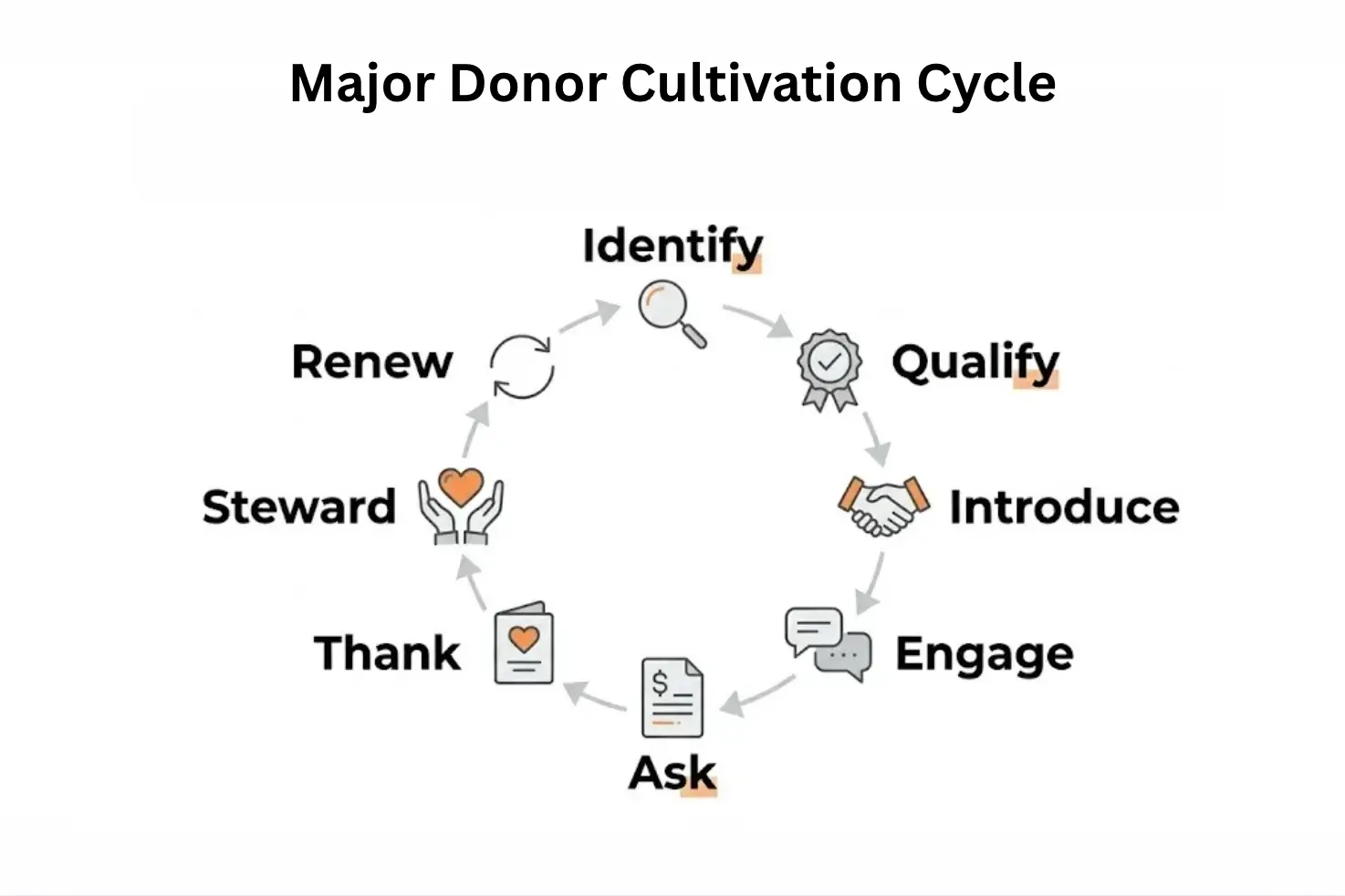
The donor cultivation cycle explained
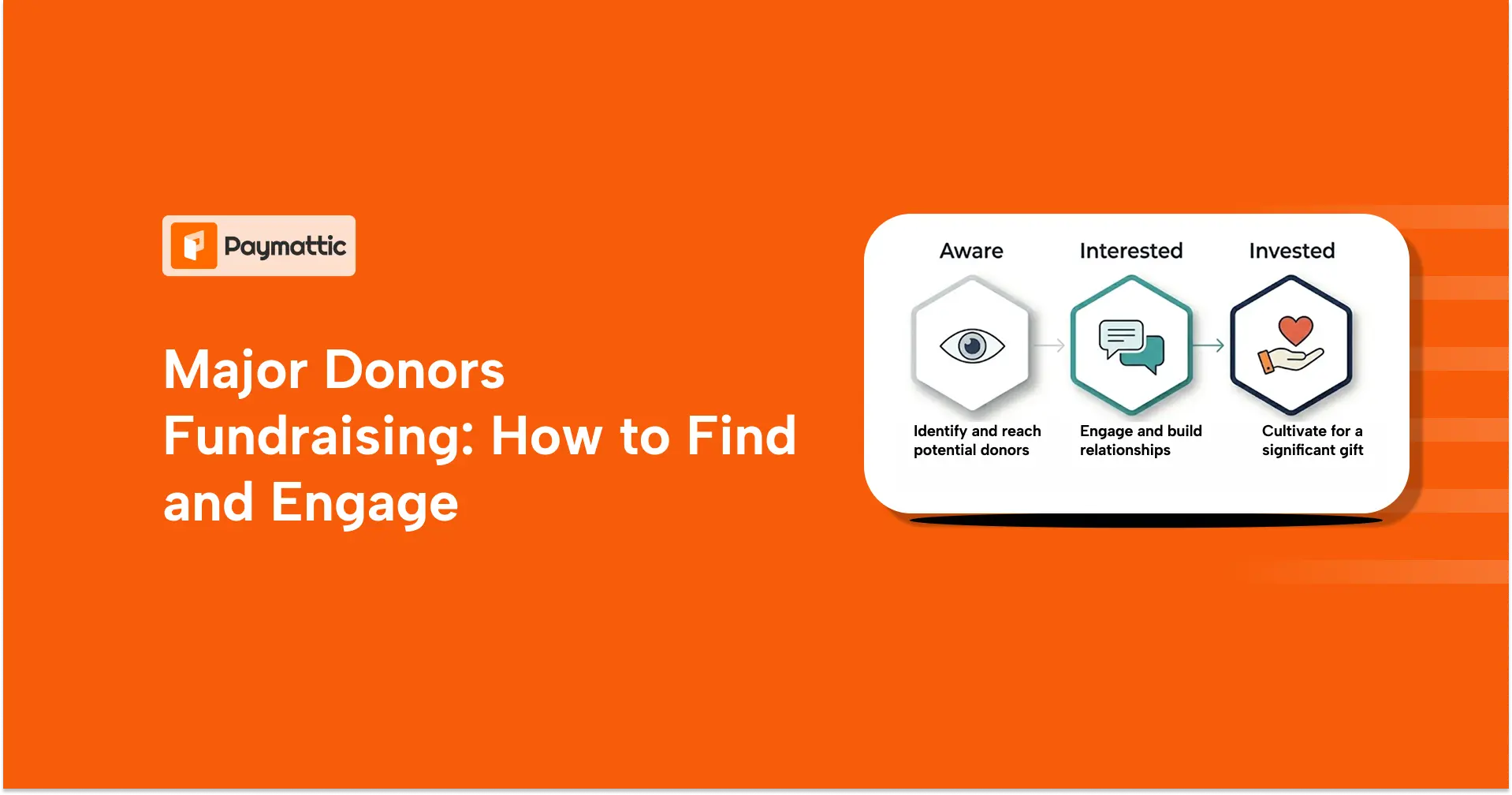
Cultivation is the process of moving a prospect from aware → interested → invested. It’s not a straight line, and it doesn’t happen fast. But with intention, it’s very repeatable.
The basic cycle:
Identify → Qualify → Introduce → Engage → Ask → Thank → Steward → Renew
Each stage has its own touchpoints, and skipping stages is how relationships break down before they begin.
First contact: making a memorable introduction
This is the most important part of your major donor cultivation plan. Your first interaction with a prospect shouldn’t be an ask. It should be an invitation to hear your story, see your organization’s work, and meet your team.
A coffee meeting, a tour of your facility, a virtual mission briefing, all of these are low-pressure ways to start a real conversation. Come with genuine curiosity about them, not just a rehearsed pitch about you.
“I’d love to connect and share how your background in education reform connects to a program we’re launching” will always outperform “We’d love to tell you about our organization.“
Moving donors from interested to invested
There’s a real difference between a donor who likes what you do and one who feels like part of it. The cultivation phase is about closing that gap.
Meetings matter. So do calls from your executive director, invitations to see programs in action, and conversations that go beyond the transactional. The more a donor feels like an insider, the more likely they are to give at a meaningful level
Personalizing communication at every stage
Form letters kill major donor relationships. Every communication should feel like it was written for them specifically, because it should be. Reference past conversations, their interests, and updates relevant to what they care about.
This doesn’t mean hours of custom writing for every email. It means one or two personal details that show you actually know who you’re talking to.
Exclusive engagement opportunities: events, site visits, and briefings
Seeing your work firsthand makes a difference. A donor who watches a program in action, meets a kid whose life was changed, or talks to a staff member who’s been there for 15 years connects more deeply than one who has only read your brochure.
Small, intimate events also work well. A dinner with your executive director and four prospects is more powerful than a gala with 400 people.
How often should you touch base with a major donor prospect?
Roughly every four to six weeks during active cultivation, but quality matters more than frequency. A rushed, generic check-in does more harm than good.
Read the donor. Some people appreciate regular contact and respond quickly. Others are busier and need more space. Follow their lead, but don’t disappear.
After the gift: retention and relationship deepening
The gift isn’t the finish line. It’s the beginning of the next phase.
Within 48 hours of a major donation: thank them personally (call, not email). Within 30 days: send a formal acknowledgment and tax receipt. Throughout the year, update them specifically on the impact of their gift. At renewal: the conversation should feel like a natural continuation, not a new ask.
Major donors who feel genuinely appreciated don’t need to be re-cultivated from scratch each year. They become partners. That’s what you’re actually building toward.
Common mistakes to avoid in major donor fundraising
A few patterns that derail even experienced fundraisers:
Asking before the relationship is ready: The major donor cultivation stage exists for a reason. Skipping it to hit a quarterly goal almost always backfires.
Being vague in the ask: “Anything you could give would be wonderful,” is not a major gift ask. Name a number. Explain what it does. Be specific.
Neglecting stewardship after the gift: This might be the most common mistake and the biggest retention killer in major donor fundraising. Donors who don’t hear from you until the next renewal cycle feel used, because in a way, they were.
Treating a no as the end: “Let me think about it,” or even a hard no in December might be a yes in March. Stay in a relationship. Keep the door open.
Ignoring your existing base while chasing new prospects: The warmest, most convertible prospects are usually already in your database. Don’t overlook them.
Conclusion
Major donor fundraising is, at its core, about people. Not wealth screens or gift ranges or cultivation timelines, though all of those matter. At the end of it, you’re asking someone to trust you with a significant amount of money and believe it will do something meaningful in the world.
That kind of trust is built slowly. It’s built through honesty, consistency, and genuine interest in who the donor is, not just what they can give.
Start small. Start with who you already know. Identify five to ten prospects from your existing base. Build a simple major donor cultivation plan. Make your first ask when you feel completely ready.
And then keep showing up for your donors the way you’re asking them to show up for your mission.
And if you want to make the operational side easier, tracking donor interactions, processing gifts seamlessly, and giving donors a smooth giving experience, that’s exactly what Paymattic is built for. Whether you’re collecting one-time major gifts or setting up recurring giving programs, Paymattic helps nonprofits manage donations without the administrative headache.
Join the thousands already enjoying Paymattic Pro!

Tipu Deb
Hey! Tipu here, working as a Marketing Strategist at WPManageNinja & Paymattic. A nature lover and a person who is addicted to exploring historical events. In my leisure, you’ll find me playing with different musical instruments.
Leave a Reply