


Why Your Donors Stop Giving: How Donor Recognition Fixes It


Table of Content
Download Paymattic – it’s Free!

Subscribe To Get
WordPress Guides, Tips, and Tutorials
We will never spam you. We will only send you product updates and tips.
Most nonprofits focus heavily only on getting donations. But what happens after someone gives?
That’s where many organizations fall short.
A donor makes a contribution, receives a basic receipt, and then… nothing. No real appreciation, no connection, no reason to come back again.
And that’s a missed opportunity.
Because donor recognition isn’t just about saying “thank you for your donation.” It’s about making people feel seen, valued, and part of something meaningful.
When done right, it can turn a one-time donor into a long-term supporter. You don’t need a big budget or a full team to do this well. Small, thoughtful actions can make a big difference.
In this guide, you’ll learn practical donor recognition ideas, simple ways to appreciate your supporters, and how to build stronger donor relationships without overcomplicating things.
TL;DR
Donor recognition is more than just saying thank you; it’s how you build lasting relationships with your supporters. This guide shows you when and how to appreciate donors in ways that actually make them feel valued.
– Donor recognition helps turn one-time donors into long-term supporters by making them feel seen and appreciated
– The timing of your appreciation matters; acknowledge donors immediately and consistently
– Simple gestures like personalized messages often matter more than expensive recognition efforts
– Repeat donors and long-term supporters should receive extra attention and thoughtful acknowledgment
– Sharing the impact of donations makes supporters feel part of something meaningful
– Creative donor recognition ideas don’t need a big budget, focus on sincerity over cos
– Strong donor relationships come from consistency, personalization, and transparency
– A genuine “thank you for your donation” message can leave a lasting impression when done right
– Avoid common mistakes like generic messaging, delayed responses, or ignoring small donors
– A simple checklist can help you apply these ideas and improve your donor recognition process immediately
What is donor recognition?
Donor recognition simply means acknowledging and appreciating the people who support your organization. It sounds basic, but if anyone has done well, it changes everything about how your donors relate to your cause.
People don’t just give money to nonprofits; they give because they believe in something. It makes them feel good, or because they want to be part of a story bigger than themselves. When you recognize them for that, you’re affirming those feelings and building a relationship, not just recording a transaction.
How donor recognition impacts donor retention?
Research consistently shows that the number one reason donors stop giving is that they feel unappreciated or disconnected. They didn’t leave because they ran out of money or stopped caring about the cause. They left because nobody made them feel like their contribution mattered.
On the flip side, donors who feel genuinely recognized tend to give again, give more over time, and even bring in new donors by telling their friends and family. Recognition is not just a courtesy; it’s one of the highest-ROI things you can do in fundraising.
Donors want to feel seen. A simple, sincere acknowledgment, even a short handwritten note, can do more for donor loyalty than a polished newsletter ever will. People remember how you made them feel. That’s how donor recognition directly impacts donor retention for your nonprofit.
When should you recognize donors?
Donor recognition isn’t just what you say, it’s when you say it.
A well-timed thank-you can make someone feel valued. A delayed or missed one can make them feel overlooked. Here are the moments that truly make your appreciation count:
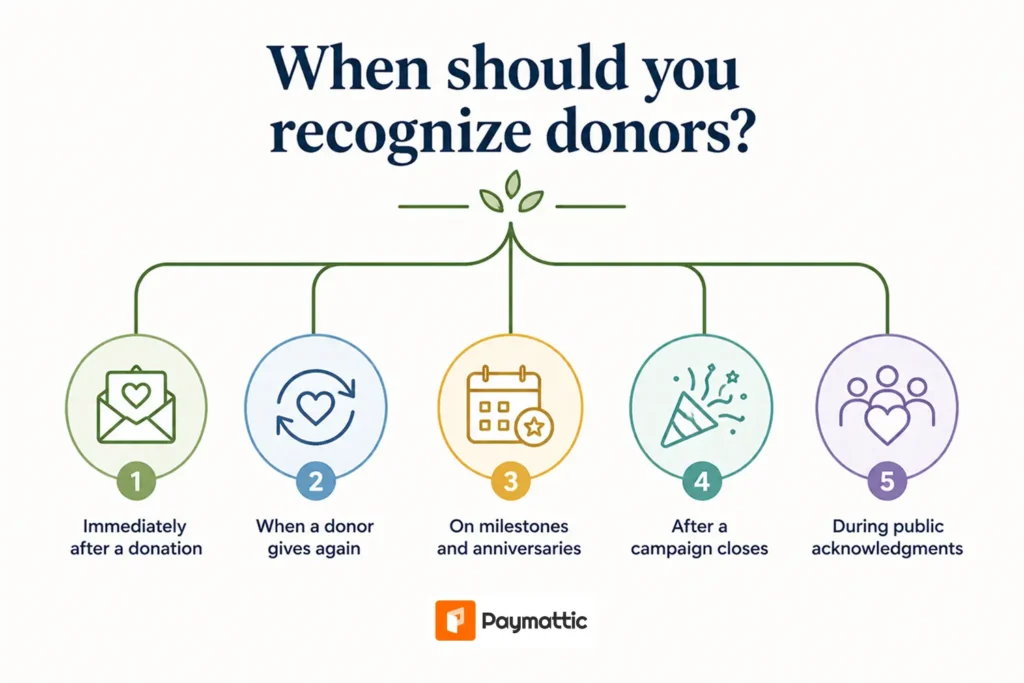
Immediately after a donation
This is the most important moment, no exceptions.
When someone donates, they’ve already said “yes” to your cause. Don’t leave them waiting. A quick, warm acknowledgment reassures them that their contribution matters.
This doesn’t have to be complicated. A simple, human message works far better than a formal receipt. Instead of something cold and transactional, write as you would to a real person:
- “Thank you for your donation, we truly appreciate your support.”
- “We’re so grateful you chose to support us today.”
Quick tip: Even if you’re using automated emails, write them as a human would write them. Avoid corporate-sounding language. Say “We’re genuinely grateful” instead of “Your contribution has been processed successfully.”
When a donor gives again
Repeat donors are gold; they choose you again. That’s a big deal.
When someone gives a second or third time, they deserve extra recognition. Recognizing this moment shows that you’re paying attention. It tells the donor they’re not just another name in your system.
Make it personal:
- Mention their past support
- Acknowledge their continued trust
Something as simple as: A personal note that references their history, “This is your third year supporting us, and it means so much,” makes a huge impression.
On milestones and anniversaries
Donor relationships grow over time, and those moments deserve recognition. Whether it’s:
- A one-year giving anniversary
- Reaching a total contribution milestone
- Supporting multiple campaigns
These are perfect opportunities to reach out without asking for anything in return. Just say: “We noticed, and we’re grateful you’ve been part of this journey.”
That kind of message builds loyalty in a way no fundraising ask can.
After a campaign closes
Donors don’t just give money; they want to see what it accomplished. When a campaign wraps up, close the loop. Share the outcome and make donors feel like part of the success.
Instead of a generic update, make it collective and meaningful:
- “Together, you helped raise $12,000…”
- “Because of you, 300 children now have school supplies.”
This shifts the experience from a transaction to a shared achievement.
During public acknowledgments
Sometimes, appreciation should be visible.
Social media, newsletters, events, or even a donor recognition wall can help highlight your supporters and show others the community behind your cause.
That said, not everyone wants to be in the spotlight. Always give donors the choice to stay private. When done thoughtfully, public recognition becomes more than a gesture; it becomes a way to inspire others to give.
Subscribe Newsletter
Subscribe to our newsletter for updates, exclusive offers, and news you won’t miss!
Donor recognition ideas that work
You don’t need a massive budget to recognize your donors well. Here’s a breakdown from free ideas all the way up to high-impact gestures:
Low-cost ideas
Personalized thank-you emails
Go beyond “Dear Donor.” Use their first name, mention what they gave, and tell them specifically what it will be used for. Even a few extra sentences of personalization can make the difference between an email that gets deleted and one that gets forwarded to a friend.
Email Template (Simple & Warm):
Hi [First Name],
Thank you so much for your donation of $[Amount]. It genuinely means a lot to us. Because of people like you, we’re able to [specific impact]. We’re grateful to have you in our corner.
With appreciation, [Your Name] [Organization Name]
Social media shoutouts
A simple post tagging a donor (with their permission) or thanking your donor community publicly costs nothing and makes donors feel celebrated. You can do a monthly “Donor Spotlight” post or a simple thank-you story on Instagram.
Social media template:
We’re so grateful for supporters like [Name], who made a donation this month to help [mission]. Thank you for believing in what we do. 💚 #DonorAppreciation #ThankYou
Handwritten notes
This takes 5 minutes, and it’s one of the most powerful things you can do. In a world of digital everything, a handwritten card stands out. It doesn’t have to be long; even three sentences feel personal and memorable.
Listing names on your website
A simple “Thank You to Our Donors” page with names listed (for those who consent) costs nothing to set up and gives donors a visible, lasting acknowledgment. You can tier it by giving a level, but even a flat list is meaningful.
Click here to discover “Donor Engagement Strategies To Boost Recurring Giving”
Mid-level ideas
Donor recognition wall
A physical or digital recognition wall is a classic for a reason. It creates a permanent record of generosity and gives donors something to point to proudly.
Monthly donor spotlight
Pick one donor each month to feature in your newsletter or on your website. Share a little about why they give, what the organization means to them, and what their support has accomplished. Most donors love this, it makes them feel seen without being overwhelming.
Exclusive updates and newsletters
Give donors a behind-the-scenes look at your work. A monthly “for donors only” email update that shares real stories, photos, and numbers makes them feel like insiders, not just checkbooks. This deepens the connection without requiring a big event or printed materials.
High-impact ideas
Donor appreciation events
Even a small gathering, a casual lunch, a virtual Q&A with your team, or a behind-the-scenes tour can be enormously meaningful to loyal donors. It doesn’t have to be fancy. What matters is that you made time for them.
Custom donor gifts
A thoughtful, branded gift sent to your top donors can leave a lasting impression. Make your donors feel valued by gifted them custom donors gifts that may also helpful for them.
Naming opportunities
For larger capital campaigns or long-term programs, naming a room, a scholarship, or a program after a major donor is one of the most powerful forms of recognition. It creates a lasting legacy they’ll be proud of and talk about.
Sponsor recognition ideas (for larger contributors)
Corporate sponsors and major institutional donors often expect and deserve a more formal level of recognition.
Logo placements
Event banners, printed programs, email footers, and your website are all appropriate spots. Get the high-resolution version and display it cleanly; a pixelated logo is worse than no logo.
Event mentions
Verbally acknowledging sponsors during events goes a long way. A simple “This event was made possible by our generous sponsor, [Name]” is appreciated and appropriate.
Website features
A dedicated “Our Sponsors” page with logos, links, and a brief description creates a professional, visible acknowledgment. Some sponsors actively look for this as evidence of their corporate giving.
Co-branded campaigns
For major sponsors, consider running a co-branded campaign that prominently features their name alongside yours. It gives the sponsor visibility and demonstrates that their investment matters.
Pro tip: Before an event or campaign, ask your sponsors how they prefer to be recognized. Some want logo placement, others want verbal mentions, and some care most about social media tags. Asking shows professionalism and helps you get it right.
Click here to discover 60+ companies with online donation request
Creative donor gift ideas
People don’t expect gifts when they donate, but when they receive one, it leaves a lasting impression.
A thoughtful gift tells your donors: “We see you, and we appreciate what you’ve done.” And that feeling goes a long way in building a stronger connection.
Here are some creative donor gift ideas that feel thoughtful and worth remembering:
Branded merchandise
A quality tote bag, notebook, or mug with your organization’s logo is a practical gift that keeps your nonprofit top of mind. The word “quality” matters here a flimsy item will feel like an afterthought. If you’re going to do branded merchandise, invest in something people will actually use.
Personalized Items
Anything with the donor’s name on it instantly feels more special. A personalized certificate of appreciation, a custom bookmark, or even a thank-you card with a hand-drawn element by a staff member can make a small gift feel big.
Impact-based gifts
One of the most creative options: give donors something that represents their impact. For example, a photo print of the family their donation helped feed, a small packet of seeds from the garden their support built, a handmade item created by program participants, or a “you did this” card with a specific, real story. These gifts cost very little but carry enormous emotional weight because they make the impact tangible.
Experience-based rewards
For mid-level and major donors, consider offering experiences over objects: a one-on-one meeting with your executive director, a visit to your program site, an invitation to a planning session, or a video message from a beneficiary whose life they helped change. These cost almost nothing but communicate that you value the donor as a person, not just as a source of funds.
Donor recognition best practices to engage supporters
Recognition is one piece of the broader puzzle of donor relations. Here are the principles that make the difference between a transaction and a relationship:
Personalization over automation
Automation has its place; you can’t hand-write every receipt. But wherever possible, add a human touch. Even a single personalized sentence in an otherwise automated email can transform the tone entirely. Segment your donor list so that long-term donors, first-time donors, and major donors all get messages tailored to them.
Consistency matters
Recognition isn’t a one-time event. It’s a rhythm. Donors should hear from you regularly, not just when you need something. A consistent cadence of appreciation (quarterly updates, birthday acknowledgments, annual impact reports) builds trust over time.
Transparency in impact
Donors want to know their money is actually doing something. Share specific, real stories. Show photos. Report on outcomes. Vague statements like “your support makes a difference” are much weaker than “your $75 paid for a child’s school supplies for an entire year.”
Avoid over-communication
Lead with appreciation and information, and reserve direct asks for no more than 2–3 times a year. Donors who feel respected are far more likely to respond to those asks.
Remember: Any donations are appreciated and your donors should know it. Whether someone gives $10 or $10,000, make them feel equally valued as a human being.
Examples of “Donor recognition” messages
A good donor recognition message doesn’t need to be long, it just needs to feel real. The best ones are personal, specific, and clearly show the impact of the donor’s support.
Examples of “Thank You for Your Donation” messages you can use or adapt:
Short and simple
Hi [Name],
Just a quick note to say thank you. Your donation of $[Amount] arrived, and it’s already being put to work for [cause/program]. We’re really glad you’re part of this.
With gratitude, [Your Name]
Emotional and story-driven
Dear [Name],
A few weeks ago, a family walked into our center with nowhere to go. Because of donations like yours, we were able to give them a hot meal, a safe bed, and a plan for what comes next. That family is doing better now and you’re a part of that story.
Thank you for giving $[Amount]. It’s not just money to us, it’s a family’s turning point.
With deep appreciation, [Your Name]
Professional and formal
Dear [Name],
On behalf of [Organization Name], I want to formally acknowledge and thank you for your generous contribution of $[Amount] on [Date]. Your investment supports [specific program or goal], and we are grateful for your continued belief in our mission.
A tax receipt is enclosed for your records. We look forward to sharing the impact of your support in our upcoming annual report.
Sincerely, [Executive Director Name]
Instagram / Facebook
We’re so grateful for every single person who shows up for [cause]. This month, incredible supporters like [Name] helped us [specific achievement]. Thank you from the bottom of our hearts. Every donation big or small, makes a real difference. #ThankYou #DonorAppreciation
LinkedIn (Sponsor or major donor)
We are honored to recognize [Donor/Organization Name] for their generous contribution to [Campaign or Program]. Their support is helping us [specific outcome]. Thank you for investing in [mission]. #Grateful #NonprofitImpact
Donor recognition: Common mistakes to avoid
Donor recognition often falls short when it feels generic, delayed, or only focused on large contributors. Small, timely, and genuine appreciation matters more than grand gestures that lack personalization.
1. Only recognizing large donors: Smaller donors notice when they’re invisible. A first-time $25 donor who gets ignored is unlikely to become the $1,000 donor they might have been in a few years. Treat every donor like they matter, because they do.
2. Delayed responses: Waiting a week to acknowledge a donation is a lost opportunity. By that point, the emotional warmth of giving has faded. Aim to acknowledge within 24–48 hours. For major gifts, the same day is ideal.
3. Generic messaging: If your thank-you email could have been sent by any nonprofit to any donor, it’s not doing its job. Just mention the donor’s name, the specific gift amount, and what it will help accomplish.
4. Ignoring repeat donors: Create a separate communication track for recurring and multi-year donors that acknowledges their ongoing commitment. They’ve earned it.
5. Making recognition feel transactional: If every message that thanks a donor also includes an ask for more, it starts to feel manipulative. Dedicate some communications entirely to appreciation with no strings attached. This builds more goodwill and leads to more giving over time.
Quick reference: Donor recognition checklist
- Send a personalized thank-you within 48 hours of every donation
- Use the donor’s name and mention the specific gift amount
- Describe what the donation will be used for
- Acknowledge repeat donors with extra appreciation
- Create a donor recognition wall (physical or digital)
- Feature a monthly donor spotlight in your newsletter
- Share campaign results with all donors who participated
- Recognize sponsors with logo placement and event mentions
- Offer impact-based updates such as stories, photos, and real numbers
- Review and refresh your donor list quarterly
- Never make every message an ask lead with gratitude first
- Treat every donor, regardless of gift size, with equal warmth
Recognition is not about budget. It’s about intention. And intention costs nothing.
Final thoughts
Donor recognition doesn’t have to be expensive, complicated, or time-consuming. What it has to be is intentional.
A handwritten card takes five minutes. A personalized email takes ten. A public shoutout on social media costs nothing. And yet, these small acts of appreciation are what separate the nonprofits that struggle with donor retention from the ones that build lifelong communities of support.
Your donors are not ATMs. They’re people who believed in your mission enough to give you their money. When you recognize that, when you say “we see you, we appreciate you, and here’s what your generosity made possible” you’re not just being polite. You’re building the foundation of a long-term relationship.
Start small if you have to. Pick one or two ideas from this guide and try them this week. The organizations that consistently show up for their donors are the ones that consistently get donations in return.
Any donations are appreciated, and the donors who give them deserve to know it. Recognition is how you show them that you mean it.
Join the thousands already enjoying Paymattic Pro!
Frequently asked questions
Here are some commonly asked questions that people often ask regarding donor recognition.
1. What is the best way to recognize donors?
The best way to recognize donors is to be timely, personal, and genuine. A quick thank-you, followed by meaningful updates and occasional recognition, helps donors feel valued and keeps them connected to your cause.
2. Why is donor recognition important?
Donor recognition helps build trust and long-term relationships. When supporters feel appreciated, they’re more likely to give again, stay engaged, and advocate for your cause instead of donating just once and leaving.
3. What are some simple donor recognition ideas?
Simple ideas include personalized thank-you emails, handwritten notes, social media shoutouts, and listing donors on your website. These small, thoughtful gestures often matter more than expensive or overly formal recognition efforts.
4. When should you recognize donors?
You should recognize donors immediately after they give, during milestones, when they donate again, and after campaigns. Timely appreciation shows you value their support and keeps the connection strong.
5. What should I say in a donor thank-you message?
A good message should be personal, warm, and specific. Thank the donor clearly, mention the impact of their contribution, and avoid generic language so it feels genuine and meaningful.

Madhobi
This is Madhobi, a content writer at WPManageNinja with expertise in technical writing and email marketing. Outside of work, she likes traveling and exploring new places.
Leave a Reply