

How To Find Donors for a Nonprofit Organization?


Table of Content
Download Paymattic – it’s Free!

Subscribe To Get
WordPress Guides, Tips, and Tutorials
We will never spam you. We will only send you product updates and tips.
Many nonprofits pour enormous energy into planning programs, hiring staff, and building infrastructure, only to stall when it comes to funding. The missing piece is almost never passion. It’s a clear, repeatable system for finding and keeping donors.
Finding donors is not primarily about asking for money. It’s about connecting with the right people, earning their trust, and giving them a reason to believe in your mission. When that happens, donations follow naturally.
This guide walks you through practical, proven strategies to find donors for your nonprofit, whether you’re just starting or looking to grow beyond your current base.
You’ll learn where donors come from, how to identify your ideal supporters, and what it takes to turn one-time givers into long-term advocates.
TL;DR
Finding donors for a nonprofit starts with reaching the right people and building genuine relationships around your mission.
This guide shares practical ways nonprofits can attract new donors, improve fundraising efforts, and keep supporters engaged long-term.
– Identify donors who genuinely care about your cause
– Use social media and email marketing to reach and nurture supporters
– Create a donation-friendly website that makes giving easy
– Partner with businesses, communities, and fundraising supporters
– Explore grants, events, and peer-to-peer fundraising opportunities
– Use SEO to help more people discover your nonprofit online
– Focus on long-term donor relationships, not just one-time donations
– Avoid common fundraising mistakes like poor follow-up and weak communication
– Simplify donor management and fundraising with tools like Paymattic
What does it mean to “find donors” for a nonprofit?
Before diving into tactics, it helps to understand what donor acquisition actually involves, because not all donors are the same, and treating them that way is one of the most common and costly mistakes nonprofits make.
- One-time donors give once, usually in response to a specific campaign or emotional moment. They’re valuable, but converting them into recurring donors requires deliberate follow-up.
- Recurring donors commit to giving on a regular schedule, monthly, quarterly, or annually. These are your most reliable supporters. A small base of recurring donors can stabilize your organization’s finances far more than sporadic large gifts.
- Individual donors make up the majority of charitable giving in most countries. These are everyday people who connect with your cause on a personal level.
- Corporate donors and foundations give at larger scales, but their giving is typically tied to formal applications, grant cycles, or strategic partnerships. These take longer to secure but can be transformational.
- Grant funders government agencies, and private foundations provide project-specific funding, usually after a formal proposal process.
The goal isn’t simply to collect as many donors as possible. It’s to build a diverse, engaged donor base in which different types of supporters reinforce one another.
Identify the right donors for your nonprofit
Before you reach out to anyone, you need a clear picture of your ideal donor. This isn’t about limiting your audience; it’s about focusing your energy where it will have the greatest impact.
Start by asking: Who cares about the problem we’re solving?
Different causes attract different types of donors:
- Animal welfare organizations tend to attract passionate individual donors, often younger and highly active on social media.
- Education nonprofits draw support from alumni communities, parents, and professionals in the education sector.
- Community development organizations often resonate with local business owners and residents who see the direct impact of the work.
- Humanitarian and religious nonprofits frequently build donor bases through faith communities and diaspora networks.
Once you understand your natural audience, build a basic donor persona, a profile of your ideal supporter that includes their demographics, values, preferred communication channels, and giving capacity. Ask your existing donors why they give. Their answers will reveal more about your ideal audience than any market research.
Why people donate to nonprofits?
People give for a variety of reasons: empathy, personal connection to a cause, social identity, tax benefits, or a desire to leave a legacy. But at the core, most giving is driven by emotional connection, followed by rational justification.
Your job is to create that emotional connection first, through real stories, honest impact data, and a mission that feels urgent and specific. Transparency matters enormously here. Donors want to know their money is being used wisely. Share your financials openly, report on outcomes regularly, and let your beneficiaries speak for themselves whenever possible.
Another important factor is trust. People are more likely to support nonprofits that communicate consistently and make donors feel involved in the mission. Even small updates, thank-you messages, or impact stories can strengthen donor confidence and encourage long-term support.
Proven strategies to find donors for a nonprofit
No strategy for finding donors will work if your message isn’t clear. People don’t donate to organizations; they donate to stories, missions, and outcomes they believe in.
Before you launch any campaign, make sure you can answer these three questions plainly:
If your answers are vague or jargon-heavy, donors will disengage before they ever reach the donate button.
After building a strong nonprofit message, start outreach to attract new donors. Here are some proven strategies to find new donors for a nonprofit.
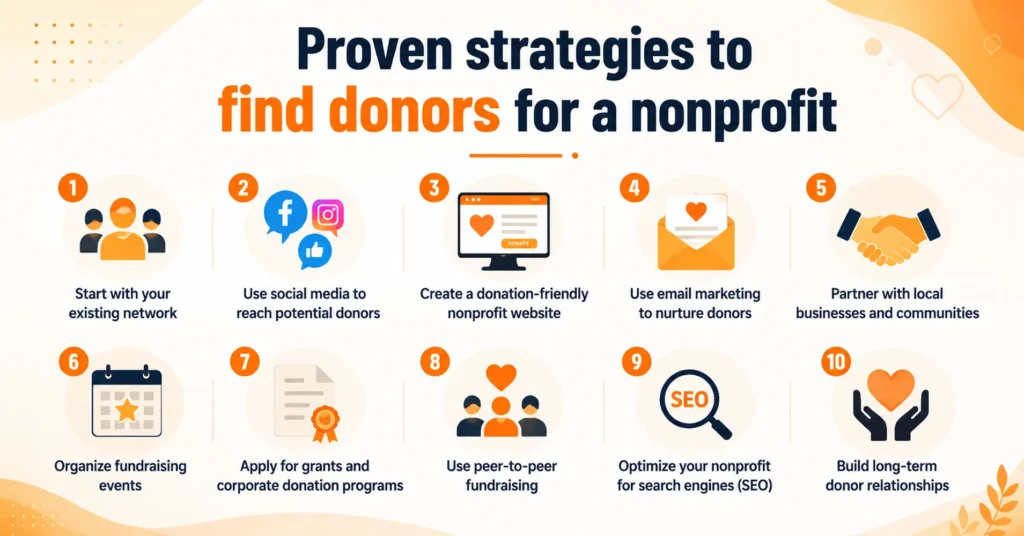
1. Start with your existing network
The fastest path to your first (or next) donor is almost always through someone you already know. Friends, family members, volunteers, board members, and past supporters represent a warm audience that already has some level of trust in you.
Don’t overlook your board. Board members should be among your most active fundraisers, not just because of their own giving capacity, but because of who they know. A personal introduction from a board member carries far more weight than a cold email.
Start by mapping your network. Who in your circle has the capacity to give? Who has connections to corporations or foundations? Who is already passionate about your cause? Warm audiences convert first, and they often bring others with them.
2. Use social media to reach potential donors
Social media is one of the most powerful and cost-effective tools available to nonprofits today, but only when used with intention. Each platform serves a different purpose:
- Facebook is ideal for reaching older demographics, running fundraisers, and building community groups.
- Instagram works well for visual storytelling, such as photos and short videos that show your work in action.
- LinkedIn is the go-to platform for connecting with corporate donors, foundations, and professional networks.
- TikTok and YouTube are increasingly effective for reaching younger audiences through short-form and long-form video.
Social media content ideas for nonprofits
The most effective nonprofit social content doesn’t lead with donation requests. Instead, it leads with stories. Show the people your organization helps. Document the work. Share behind-the-scenes glimpses of your team. Celebrate milestones. Post donor testimonials.
When you do make an ask, pair it with a clear, specific outcome: “Your $25 provides school supplies for one child for a full year.” Concrete impact statements make giving feel tangible and meaningful.
Live fundraising events on social media, whether a Facebook Live or an Instagram story series during a campaign, can drive urgency and real-time engagement in ways that static posts cannot.
3. Create a donation-friendly nonprofit website
Your website is often the first place a potential donor goes to verify your credibility and the last place they visit before deciding whether to give. If the donation experience is clunky, confusing, or slow, you will lose donors even after they’ve decided to give.
A donation-ready website should include:
- A prominent, easy-to-find donation button on your homepage and navigation
- Mobile-friendly donation forms, most users will visit from their phones
- A fast, simple checkout process with minimal required fields
- Multiple payment options, including credit/debit cards, bank transfers, and digital wallets
- Trust signals such as financial transparency pages, third-party ratings (like Charity Navigator), and clear contact information
- A recurring donation option that makes it easy for donors to commit to monthly giving
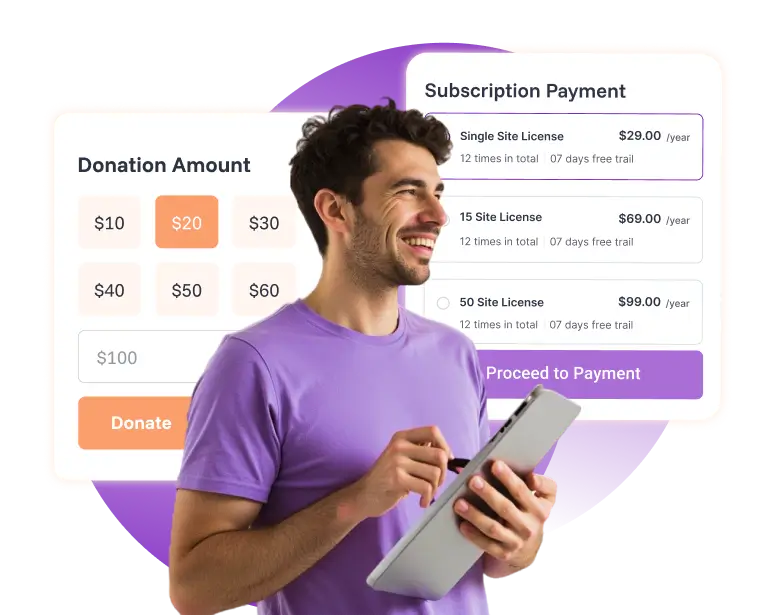
This is where a dedicated donation management tool becomes invaluable. Platforms like Paymattic allow nonprofits to set up customized donation forms, accept multiple payment methods, and manage recurring donations, all without needing technical expertise. The easier you make giving, the more donors will follow through.
Subscribe Newsletter
Subscribe to our newsletter for updates, exclusive offers, and news you won’t miss!

4. Use email marketing to nurture donors
Email remains one of the highest-ROI channels for nonprofit fundraising. Unlike social media, where algorithms control who sees your content, email lands directly in your supporter’s inbox.
The key is to use email for more than just fundraising appeals. A healthy email strategy includes:
- Welcome emails for new subscribers that introduce your mission and share an impact story
- Regular impact updates that show donors what their contributions have accomplished
- Campaign-specific appeals tied to specific goals or urgent needs
- Year-end giving appeals, which account for a significant portion of annual nonprofit revenue
- Personalized acknowledgments that make donors feel seen, not just solicited
Donation Request Letter: Free Templates & A Complete Writing Guide
Best nonprofit email ideas to engage donors
Segment your email list so long-term donors receive different messaging than new subscribers. Send birthday or anniversary emails to loyal supporters. Share stories of specific beneficiaries (with their permission). Ask for feedback, not just money.
The nonprofits with the strongest donor retention rates are the ones whose emails feel like letters from a trusted friend, not mass marketing.
5. Partner with local businesses and communities
Local businesses are often looking for ways to demonstrate their commitment to the communities they serve, and a partnership with a nonprofit is one of the most visible ways to do that.
Approach businesses with a clear value proposition: what does your nonprofit offer them in return? This might include logo placement on your materials, mentions in your newsletter, social media shoutouts, or the opportunity for their employees to volunteer with your organization.
Corporate sponsorships, community fundraising campaigns, and cause-marketing partnerships (where a percentage of sales goes to your nonprofit) are all viable models. Don’t limit yourself to large corporations; local restaurants, retailers, and professional service firms often make excellent partners and are easier to approach.
6. Organize fundraising events
Events serve a dual purpose: they raise money and raise awareness. Whether in-person, virtual, or hybrid, a well-executed fundraising event brings your community together and introduces your organization to new potential donors.
Popular formats include:
- Charity runs and walks that combine fitness with fundraising
- Gala dinners and auctions for higher-capacity donor audiences
- Online fundraising campaigns with countdown timers and milestone goals
- Webinars and panel discussions that showcase your organization’s expertise
- Community meetups that build grassroots support
Hybrid events combining an in-person gathering with a virtual livestream have grown significantly in recent years. They allow you to engage a geographically dispersed audience while still creating a meaningful local experience.
7. Apply for grants and corporate donation programs
Grants represent a significant funding opportunity for nonprofits, though they require patience and preparation. Foundation grants, government grants, and corporate giving programs can provide substantial project-specific funding.
Start by researching foundations whose focus areas align with your mission. Most foundations publish their grant guidelines and priorities publicly. Pay close attention to eligibility requirements, deadlines, and expected reporting.
Corporate matching gift programs are an often-overlooked resource. Many large employers will match charitable donations made by their employees sometimes dollar-for-dollar, sometimes at a higher ratio.
Encourage your donors to check whether their employer offers matching gifts, as this can effectively double the value of their contribution.
Corporate Social Responsibility (CSR) budgets have grown considerably in recent years. Many companies actively seek nonprofit partners to support causes aligned with their brand values. Approach these partnerships as long-term relationships, not one-time transactions.
8. Use peer-to-peer fundraising
One of the most powerful donor acquisition tools available is also one of the most underused: your existing supporters. Peer-to-peer fundraising asks your donors and volunteers to raise money on your behalf, through their own networks, with their own voice.
This might look like:
- Birthday fundraisers, where a supporter invites their friends to donate in lieu of gifts
- Team fundraising pages where groups compete to raise the most for your cause
- Ambassador programs that give your most passionate supporters tools and training to advocate for you
Peer-to-peer fundraising works because people are far more likely to give when asked by someone they know and trust. A personal appeal from a friend outperforms a cold ask from an organization every time. It also expands your reach into entirely new networks without requiring additional marketing spend.
9. Optimize your nonprofit for search engines (SEO)
When someone searches for ways to help a cause they care about, your nonprofit should appear. Search engine optimization makes that possible.
Creating educational blog content around topics related to your mission is one of the most sustainable long-term strategies for attracting new donors. Someone searching “how to help homeless families in [your city]” or “donate for animal rescue near me” is already motivated; they just need to find you.
Practical SEO steps for nonprofits include:
- Publishing regular blog posts that answer questions your target donors are searching for
- Optimizing your website’s title tags, meta descriptions, and page headings
- Claiming and updating your Google Business Profile for local visibility
- Building backlinks by getting featured in local news, partner websites, and directories
- Creating story-based content that earns shares and links naturally
SEO is a long-term investment, but it compounds over time. Articles you publish today can bring in donors for years.
10. Build long-term donor relationships
Acquiring a new donor costs significantly more than retaining an existing one. Yet many nonprofits invest far more in acquisition than in donor retention, and then wonder why their donor base isn’t growing.
Long-term donor relationships are built on four things: appreciation, transparency, communication, and impact.
- Thank donors promptly and personally after every gift
- Send impact reports that show exactly what their contributions accomplished
- Recognize your most loyal donors publicly (with their permission)
- Invite donors into your work, through volunteer opportunities, behind-the-scenes updates, or advisory roles
- Offer a recurring donation program that makes sustained giving easy and automatic
A donor who gives five times is far more valuable than five donors who give once. Focus more on donor recognition and making each supporter feel valued, not just solicited.
Common mistakes nonprofits make when trying to find donors
Even well-intentioned organizations fall into patterns that undermine their fundraising efforts. Watch out for these:
Asking for donations too early: Building trust comes before making an ask. If someone just discovered your organization, lead with your story and impact, not a donation form.
Poor website experience: A slow, confusing, or outdated website signals disorganization. Donors will leave before they give.
Lack of transparency: Donors want to know where their money goes. If you’re not publishing financial information or impact data, you’re leaving trust on the table.
Ignoring donor follow-ups: A first-time donor who never hears from you again is unlikely to give a second time. Follow-up is where retention begins.
Treating all donors the same: A major donor and a first-time $10 giver have different needs and expectations. Segment your communication accordingly.
Only fundraising during emergencies: Reactive fundraising trains donors to wait for a crisis before giving. Consistent, year-round communication builds a more stable donor base.
Simplyfies fundraising for nonprofits with Paymattic
Managing donors, fundraising campaigns, and recurring contributions manually can quickly become overwhelming for growing nonprofits.
Using a dedicated fundraising platform helps simplify the entire process, from collecting donations to building long-term donor relationships.
Nonprofits can consider Paymattic, a WordPress payment and donation plugin designed to help organizations manage donors and raise online fundraising directly from their website.
Instead of relying on multiple tools, nonprofits can manage donation forms, recurring giving, donor tracking, and payment collection from a single dashboard.
Key Paymattic features for nonprofits:
- Recurring donation support for monthly or subscription-based giving
- Custom donation forms with flexible field options
- Multiple payment gateway support, including Stripe, PayPal, Square, Razorpay, and more
- Donor management and contribution tracking
- Campaign tracking and fundraising reporting
- One-time and recurring payment collection
- Multi-currency payment support for global donations
- Offline donation and manual payment options
- Email notifications and donation confirmations
- WordPress-native setup without needing third-party platforms
Using the right fundraising platform not only saves time but also helps nonprofits create a smoother donation experience that encourages supporters to give again.
Final thoughts
Finding donors for your nonprofit is not a one-time campaign. It’s an ongoing relationship-building process that compounds over time. The organizations with the strongest donor bases didn’t build them overnight; they built them through consistent communication, genuine transparency, and an unwavering focus on impact.
Start small if you need to. Focus on your existing network first. Build your message before you scale your outreach. Invest in your website. Show up consistently on one or two social platforms. Send emails that inform and inspire, not just ask.
As you grow, layer in more strategies: events, peer-to-peer campaigns, SEO content, grant applications, and corporate partnerships. Each channel reinforces the others, and over time, your donor community builds momentum of its own.
The donors are out there. They’re looking for causes they can believe in. Your job is to make it easy for them to find you, trust you, and give, again and again.
Join the thousands already enjoying Paymattic Pro!
Frequently asked questions
Here are some frequently asked questions regarding “how to find donors for nonprofit organizations.”
1. How do nonprofits find new donors?
Nonprofits find new donors through a combination of social media outreach, email marketing, community events, SEO content, peer-to-peer fundraising, grant applications, and corporate partnerships. Starting with warm networks and expanding outward is usually the most effective approach.
2. What is the best way to attract donors?
The best way to attract donors is by building trust through transparent communication, compelling impact stories, and a simple, frictionless donation experience. Donors give to causes they emotionally connect with and organizations they believe are effective.
3. How can small nonprofits raise more donations?
Small nonprofits can raise more by focusing on community engagement, cultivating recurring donors, using low-cost digital tools like email and social media, and prioritizing donor retention alongside acquisition. Strong relationships matter more than large budgets.
4. How do nonprofits ask for donations effectively?
Effective donation asks are specific, story-driven, and tied to a clear outcome. Instead of “please donate,” say “your $50 will provide clean water to a family for one month.” Make the impact tangible and the giving process easy.
5. Why do donors stop supporting nonprofits?
The most common reasons include poor communication after the donation, lack of visible impact, too many requests without enough relationship-building, and a general sense that the organization doesn’t value them beyond their gift. Consistent, thoughtful follow-up is the antidote.

Madhobi
This is Madhobi, a content writer at WPManageNinja with expertise in technical writing and email marketing. Outside of work, she likes traveling and exploring new places.
Leave a Reply