

Top Online Payment Security Methods Businesses Should Know


Table of Content
Download Paymattic – it’s Free!
Subscribe To Get
WordPress Guides, Tips, and Tutorials
We will never spam you. We will only send you product updates and tips.
Every time someone enters their card details online, pays for a subscription, or checks out from an online store, sensitive financial information travels through the internet in seconds.
While online payments have made life easier for both businesses and customers, they’ve also opened the door to fraud, scams, and data breaches.
Customers today prioritize security before completing a transaction. A website that feels unsafe can instantly drive people away, no matter how good the product or service is.
That’s why businesses can no longer treat payment security as an optional feature. It has become a major part of building customer trust and protecting online transactions.
In this guide, we’ll break down the most important online payment security methods in simple terms, explain how they work, and share practical ways businesses can protect customer payments while creating a secure checkout experience.
TL;DR
Online payment security helps protect customer payment data from fraud, theft, and unauthorized access during online transactions. Businesses that use secure payment methods can create a safer checkout experience for customers.
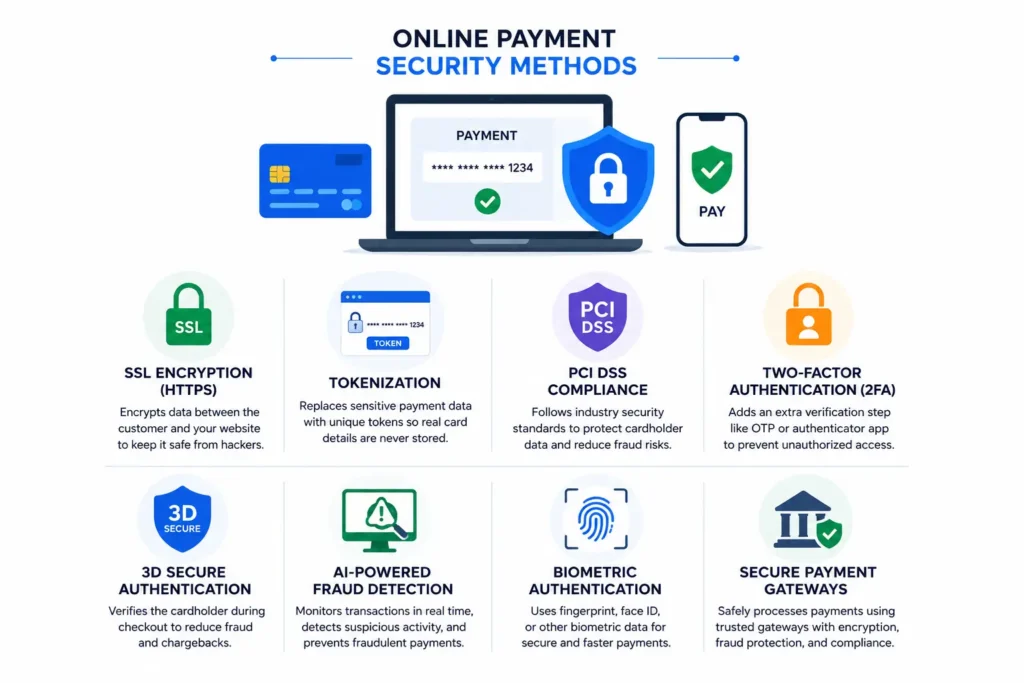
– SSL encryption protects data while it travels between the customer and your website.
– Tokenization keeps sensitive card details safe by replacing them with secure tokens.
– PCI DSS compliance helps businesses follow industry security standards for handling payment data.
– Two-factor authentication adds an extra verification step to prevent unauthorized access.
– 3D Secure authentication helps reduce fraudulent online card transactions and chargebacks.
– AI-powered fraud detection systems identify suspicious payment activity in real time.
– Biometric authentication, like fingerprint or face ID, adds stronger identity verification for digital payments.
– Secure payment gateways handle encryption, fraud protection, and safe transaction processing on behalf of businesses.
– Using trusted payment tools and keeping your website security updated can significantly reduce payment-related risks.
What is online payment security?
Online payment security refers to the technologies, security standards, and protective practices used to keep financial transactions safe on the internet. It helps protect sensitive information like credit card numbers, bank account details, passwords, and personal data from unauthorized access, fraud, or theft.
In simple terms, online payment security ensures that when customers make a payment online, their financial information remains private and protected throughout the transaction.
Think of it like a digital armored truck. Just as an armored vehicle safely transports money from one place to another, online payment security protects customer data while it travels between:
- The customer’s device or browser
- Your website or payment form
- The payment gateway and processor
- The customer’s bank
Without proper security measures, online transactions become vulnerable to cyber threats and payment fraud. Such as:
- Credit card fraud – stolen card details used for unauthorized purchases
- Data theft – hackers accessing stored payment or personal information
- Identity theft – fraudsters using stolen data to impersonate customers
- Fake transactions – chargebacks that drain revenue and damage relationships
- Business reputation damage – a single breach can cost years of customer trust
Why secure online payments matter?
Every online payment involves sensitive financial data. If that data falls into the wrong hands, it can lead to serious consequences for both businesses and customers.
Strong payment security helps:
- Customer trust: Shoppers are more likely to complete a purchase when they see security indicators like HTTPS and trusted payment logos.
- Reduced fraud losses: Fewer chargebacks, disputed transactions, and refund requests drain your revenue.
- Regulatory compliance: Meeting security standards like PCI DSS keeps you legally protected.
- Better retention: Customers who feel safe return and refer others.
- Business credibility: A secure checkout signals professionalism and reliability.
Online Payment Security Handbook
A SAFETY CHECKLIST TO PROTECT YOUR ONLINE PAYMENT
A single security breach can be devastating. This e-book outlines the essential practices that businesses should apply to safeguard online transactions and build a trusted environment.
Safest online payment security methods for business
Here are the core online payment security methods that help protect transactions from fraud, data breaches, unauthorized access, and other online threats while building customer trust.
SSL encryption (HTTPS)
SSL (Secure Sockets Layer), now commonly secured through TLS encryption, is one of the most important layers of online payment security. It protects the connection between a customer’s browser and your website by encrypting sensitive information during transmission.
When customers enter their card details, login credentials, or personal information, SSL converts that data into encrypted code. Even if hackers intercept the transmission, they cannot read or use the information without the proper decryption key.
You can usually identify SSL-protected websites by:
- The HTTPS prefix in the URL
- A padlock icon in the browser address bar
Without SSL encryption, customer payment data can become vulnerable to:
- Data interception
- Man-in-the-middle attacks
- Information theft
- Browser security warnings
Today, HTTPS is not optional for businesses that accept online payments. Modern browsers actively label websites without SSL as “Not Secure,” which can instantly reduce customer trust and increase cart abandonment.
Why SSL matters for businesses:
- Protects sensitive customer data
- Builds trust during checkout
- Helps secure login and payment forms
- Supports compliance requirements
- Improves website credibility
Practical tip: Always install and maintain an active SSL certificate on your website. Most hosting providers now offer free SSL certificates through their services.
Subscribe Newsletter
Subscribe to our newsletter for updates, exclusive offers, and news you won’t miss!
Tokenization
Tokenization is an online payment security method that protects sensitive card information by replacing it with a randomly generated identifier called a token.
Instead of storing an actual credit card number, the system stores a meaningless string of characters that cannot be reverse-engineered or used outside the payment environment.
For example:
- Original card number → 4532 XXXX XXXX 7821
- Tokenized version → TKN_84HJ29KLX
The real payment data stays securely stored with the payment processor or gateway, while your system only interacts with the token.
This dramatically reduces the risk of exposing sensitive payment data during:
- Recurring billing
- Saved payment methods
- Subscription renewals
- Future purchases
Even if hackers gain access to the token, it has no usable value outside the authorized payment system.
Why tokenization matters:
- Reduces exposure of sensitive card data
- Minimizes damage from data breaches
- Improves payment security for recurring payments
- Helps businesses reduce PCI compliance burden
Tokenization has become essential for subscription businesses, membership sites, donation platforms, and eCommerce stores that allow customers to save payment methods.
PCI DSS compliance
PCI DSS (Payment Card Industry Data Security Standard) is a global security standard designed to protect cardholder data during payment processing.
It was created by major card companies like Visa, Mastercard, American Express, and Discover to ensure businesses follow secure practices when handling payment information.
PCI DSS covers areas such as:
- Secure storage of payment data
- Safe transaction processing
- Network security
- Access control
- Security monitoring
- Vulnerability management
Any business that accepts, processes, stores, or transmits card information is expected to follow PCI compliance standards.
Why PCI compliance matters:
Without proper security standards, payment systems become easy targets for cyberattacks and data theft. PCI compliance helps businesses:
- Reduce payment fraud risks
- Protect customer data
- Avoid penalties and legal issues
- Build customer confidence
- Maintain secure payment environments
The good news for businesses, you usually do not have to manage PCI compliance entirely on your own.
Using trusted payment gateways like Stripe or PayPal helps offload much of the security responsibility because they already maintain high compliance standards and secure infrastructure.
This is one reason businesses should avoid manually storing customer card information whenever possible.
Two-factor authentication (2FA)
Two-factor authentication adds an extra layer of security beyond passwords. Instead of relying only on a username and password, users must complete a second verification step before gaining access.
This second verification can include:
- A one-time passcode (OTP)
- An authenticator app
- A fingerprint or facial scan
- A hardware security key
Even if a password gets stolen, attackers still cannot access the account without the second verification factor.
Why 2FA is important for businesses:
Many cyberattacks happen because of weak or compromised passwords. Enabling 2FA significantly reduces the risk of:
- Unauthorized admin access
- Account takeovers
- Payment dashboard breaches
- Customer data exposure
Businesses should especially enable 2FA for:
- WordPress admin accounts
- Payment dashboards
- Team member logins
- Financial management systems
It’s one of the simplest but most effective security improvements a business can implement.
3D secure authentication
3D Secure (3DS) is an additional verification layer used specifically for online card payments. You may recognize it through services like Verified by Visa, Mastercard Identity Check, and American Express SafeKey.
During checkout, customers may be asked to:
- Enter an OTP
- Approve the payment in a banking app
- Complete biometric verification
- Confirm their identity through their bank
This extra step helps confirm that the actual cardholder is making the purchase.
Why 3D Secure matters:
Online payments are considered “card-not-present” transactions because the physical card is not used during checkout. These transactions naturally carry higher fraud risks.
3DS helps reduce:
- Stolen card fraud
- Unauthorized transactions
- Chargebacks
- Payment disputes
Another major benefit is liability protection. In many cases, properly authenticated 3DS transactions shift fraud liability away from the merchant.
AI-powered fraud detection
Modern payment systems increasingly rely on artificial intelligence and machine learning to identify suspicious transactions in real time.
Instead of using only fixed security rules, AI analyzes patterns and behaviors across thousands of transactions to detect unusual activity.
These systems can flag transactions based on signals like:
- Unusual purchase amounts
- Multiple failed payment attempts
- Suspicious device behavior
- Rapid transactions from different locations
- High-risk IP addresses
- Mismatched billing information
Why AI fraud detection is effective:
Traditional fraud prevention methods often block legitimate customers or miss advanced fraud attempts. AI systems continuously learn from new transaction data, helping improve accuracy over time.
This creates a better balance between:
- Strong fraud prevention
- Smooth customer checkout experiences
AI-based fraud monitoring is especially important for:
- eCommerce stores
- Subscription businesses
- Donation platforms
- International transactions
Biometric authentication
Biometric authentication verifies identity using unique physical characteristics like:
- Fingerprints
- Facial recognition
- Voice recognition
Instead of typing passwords, users confirm payments using their own biological features. This method is widely used in mobile banking apps, Apple Pay, Google Pay, and digital wallets.
Why biometrics improve payment security: Biometric data is significantly harder to steal or replicate compared to passwords or PINs.
Benefits include:
- Faster checkout experiences
- Reduced password-related risks
- Better mobile payment security
- Stronger identity verification
As mobile payments continue growing, biometric authentication is becoming one of the most trusted and convenient payment security methods.
Secure payment gateways
A payment gateway is the technology that securely transfers payment information between your website, the payment processor, and the customer’s bank.
It acts as the bridge that authorizes and processes online transactions safely. Trusted payment solutions handle critical security tasks such as:
- SSL encryption
- Tokenization
- Fraud detection
- PCI compliance
- Secure transaction processing
Popular secure payment gateways include: Stripe, PayPal, Square, Authorize.net, and more.
Choosing the right payment gateway matters because it directly affects:
- Customer trust
- Payment security
- Checkout experience
- Fraud protection
- Transaction reliability
A secure gateway reduces the burden of handling sensitive payment data yourself while helping customers feel confident during checkout.
For WordPress businesses, using secure payment tools that integrate with trusted gateways can simplify payment collection while maintaining strong security standards.
Most secure online payment methods for your customers
Not all payment methods offer the same level of protection. Here’s what’s available and how secure each one is:
- Credit/Debit cards with 3D secure: The combination of card networks and 3DS authentication provides strong fraud protection. Cardholders also benefit from chargeback rights if something goes wrong.
- Digital wallets (Apple Pay, Google Pay): Wallets use tokenization and biometrics, meaning merchants never see the actual card number. Very secure for both customers and businesses.
- Bank transfers / ACH: Direct bank-to-bank transfers are low-fraud but slower. Great for high-value B2B transactions.
- Mobile payments: Leveraging device-level security and biometrics, mobile payments are increasingly the preferred secure option for everyday purchases.
- Buy Now Pay Later (BNPL): Convenient but varies in security by provider. Customers should use BNPL from reputable, regulated providers only.
Future trends in online payment security
The payments landscape is evolving fast. Here are developments worth keeping an eye on:
- AI and machine learning fraud prevention: Fraud detection is becoming faster, smarter, and more personalized, flagging suspicious behavior in milliseconds with fewer false positives.
- Passwordless authentication: Passkeys and biometrics are replacing passwords, reducing the risk of credential-based attacks.
- Blockchain-based payments: Decentralized ledgers offer tamper-resistant transaction records, though mainstream adoption for everyday payments is still developing.
- Real-time fraud monitoring: Banks and payment providers are investing in instant fraud alerts and transaction freezes, giving both businesses and customers faster protection.
- Biometric payment cards: Physical cards embedded with fingerprint sensors are entering the market, bringing biometric security to in-store purchases.
Common online payment security mistakes to avoid
Even well-intentioned businesses make avoidable errors. Watch out for these:
- Using outdated plugins: Unpatched plugins are one of the most exploited vulnerabilities in WordPress sites. Always keep everything updated.
- Accepting payments without SSL: Any page with a payment form must be on HTTPS full stop.
- Weak admin passwords: Brute-force attacks are common. Use a password manager to generate and store strong, unique credentials.
- Ignoring PCI compliance: Even small businesses are required to meet basic PCI DSS requirements if they handle card data.
- Using unverified payment tools: Free or unknown payment plugins for WordPress may lack proper security. Stick to tools with a strong track record and clear compliance documentation.
- Storing sensitive data unnecessarily: If you don’t need to store it, don’t. The less sensitive data you hold, the smaller your risk exposure.
Securing payments on WordPress
If your business runs on WordPress, your payment setup is only as secure as the tools you use. WordPress powers over 40% of the internet, making it a frequent target for attacks and a common source of payment security gaps when the wrong plugins are in play.
When evaluating a payment plugin for your WordPress site, look for:
- Integration with trusted, PCI-compliant gateways like Stripe and PayPal
- Support for secure form handling and data encryption
- Regular updates and active security maintenance
- Flexibility for different payment types: one-time, & recurring payments
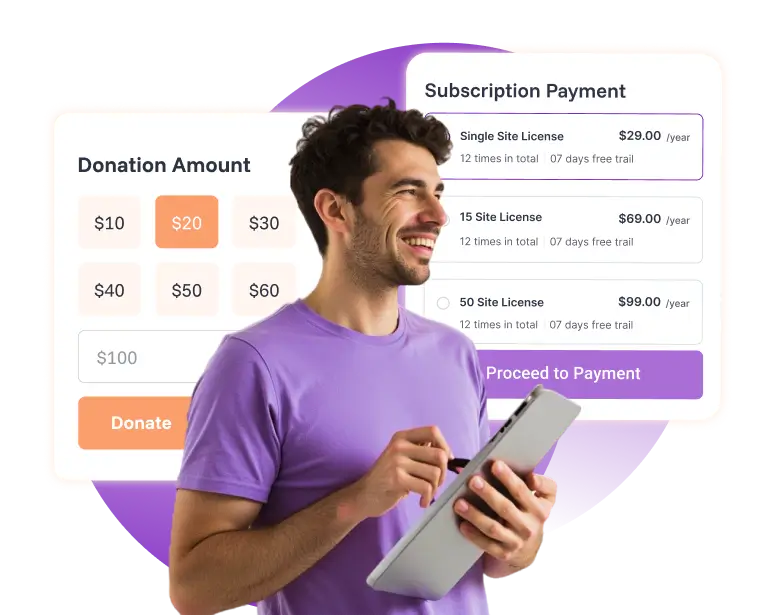
Tools like Paymattic are designed specifically for this. Paymattic allows WordPress website owners to create secure payment forms, collect donations, manage subscriptions, and integrate with trusted payment processors, all from one place, without needing to handle the underlying security complexity yourself.
With built-in support for Stripe and PayPal, form-level security, and recurring payment management, it’s a practical solution for businesses of all sizes, from freelancers and nonprofits to growing eCommerce stores. Key features of Paymattic include:
- 13+ global payment gateways covering customers worldwide
- Supports 157+ currencies
- Accept both one-time and recurring payments
- Detailed customer dashboard to manage subscriptions
- Advanced reporting dashboard for tracking transactions
- Integrates with 15+ major tools
- Smooth payment and donation form builder with 35+ custom input fields
- Automatic email notifications for confirmations, receipts, and updates
- Generate and send PDF invoices or receipts for every transaction
- PCI-DSS compliant and built with security best practices
- Advanced fraud protection with Honeypot, reCAPTCHA v2 & v3, and Cloudflare Turnstile
- Developer-friendly with webhooks, filters, and REST API support
Ready to get started?
Experience payments and donations for WordPress like never before. Try Paymattic now!
Final thoughts
Online payment security method isn’t a one-time checkbox; it’s an ongoing commitment to your customers’ safety and your business’s integrity. The good news is that most of the heavy lifting is handled by reputable payment processors and compliant tools. Your job is to choose the right ones, keep them updated, and stay informed.
Start with the basics: SSL on your site, a trusted payment gateway, 2FA on your admin accounts, and a no-raw-card-storage policy. Build from there as your business grows.
Secure payment systems help businesses build customer trust and reduce fraud risks. If you manage payments on WordPress, using a secure payment solution like Paymattic can help simplify and secure the entire payment collection process, from donation forms to subscription billing.
Join the thousands already enjoying Paymattic Pro!
Frequently asked questions
Here are some commonly asked questions regarding “Online payment security methods”.
1. What is the safest online payment method?
Digital wallets and credit cards are considered the safest online payment methods because they use encryption, tokenization, fraud monitoring, and additional verification steps to protect customer payment data.
2. Why is SSL important for online payments?
SSL encryption protects payment information while it travels between the customer and the website. It prevents hackers from intercepting sensitive data like card numbers, passwords, and personal details during transactions.
3. What is tokenization in payment security?
Tokenization replaces sensitive card information with a secure random token. Businesses store the token instead of the actual card details, reducing the risk of payment data exposure during breaches or cyberattacks.
4. How do businesses protect online payments from fraud?
Businesses use methods like 3D Secure authentication, AI fraud detection, SSL encryption, secure payment gateways, and two-factor authentication to monitor suspicious activity and reduce unauthorized transactions.
5. How can I tell if a payment website is secure?
Check if the website uses HTTPS and shows a padlock icon in the browser address bar. Secure websites also use trusted payment gateways and avoid asking for unnecessary payment information.

Madhobi
This is Madhobi, a content writer at WPManageNinja with expertise in technical writing and email marketing. Outside of work, she likes traveling and exploring new places.
Leave a Reply