

Donor Segmentation: A Complete Guide for Smarter Fundraising


Table of Content
Download Paymattic – it’s Free!
Subscribe To Get
WordPress Guides, Tips, and Tutorials
We will never spam you. We will only send you product updates and tips.
Imagine sending a heartfelt “thank you for your first gift” email to someone who has been donating monthly for three years.
That’s what happens when you treat your entire donor list as one group. Everyone gets the same message, the same ask, the same appeal, regardless of their history with you, how much they give, or why they care about your mission.
The result is lower open rates, disengaged donors, and fundraising campaigns that never quite hit their potential.
Donor segmentation is how you fix that.
In this guide, you’ll learn exactly what donor segmentation is, why it works, and most importantly, strategies that help drive real fundraising results.
TL;DR
This guide explains how donor segmentation helps nonprofits send more relevant messages and improve fundraising results. It focuses on practical ways to group donors and use that insight to increase engagement and retention.
– Donor segmentation means grouping supporters based on behavior, giving patterns, and engagement
– Sending the same message to everyone leads to low engagement and missed opportunities
– Segmentation helps you communicate in a way that feels more personal and relevant
– Better targeting leads to higher open rates, more responses, and stronger donor relationships
– Using data, such as giving history and engagement, helps identify valuable donor patterns
– Basic segments like first-time, recurring, and lapsed donors are enough to get started
– Avoid over-segmentation and keep your data clean and updated for better results
– Segmentation works best when tied directly to real fundraising campaigns
– The goal is not more outreach, but smarter communication that leads to better outcomes
What is donor segmentation?
Donor segmentation is the practice of dividing your donor base into smaller, meaningful groups based on shared characteristics like how much they give, how often they give, or how they first connected with your organization.
Instead of sending the same message to everyone on your list, you tailor your outreach to each group. For example, a donor who gives $10 a month deserves a different message than someone who gave once three years ago and hasn’t been heard from since.
That’s donor segmentation in its simplest form. And once you start doing it, the difference in results is hard to ignore. This isn’t a tactic reserved for large nonprofits with full-time data analysts. It’s something any organization can start doing, at any size, with the data you already have.
Why donor segmentation matters in fundraising?
Many nonprofits send the same appeal to their entire donor list and then wonder why engagement is low or donations stop growing. The issue usually isn’t the email itself; it’s that the message isn’t relevant to everyone receiving it.
Different donors have different motivations. A first-time supporter, a recurring donor, and a long-time major donor should not be spoken to in the same way.
Donor segmentation solves this by helping you group supporters based on their behavior, giving history, and level of engagement, so your communication becomes more targeted and meaningful.
Here’s what improves when segmentation is done well:
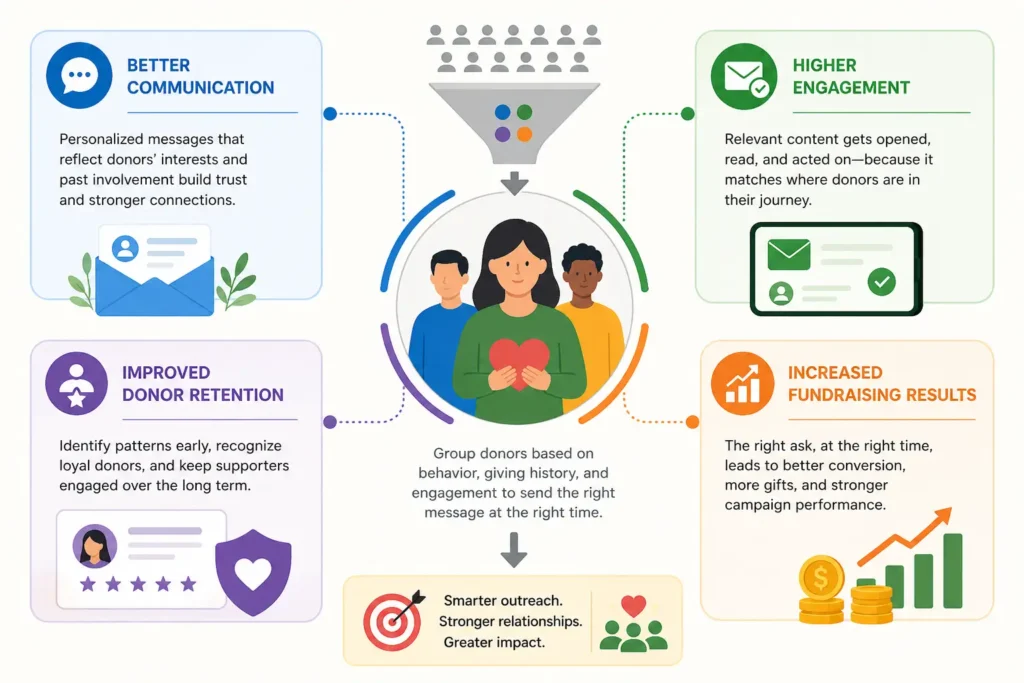
Better communication
When donors receive messages that reflect their past giving, interests, or involvement, the communication feels intentional, not generic.
Instead of a mass appeal, it feels like a message written for them, which naturally builds stronger trust and connection.
Higher engagement
Relevant messaging directly impacts performance. Donors are far more likely to open, read, and respond when the content matches where they are in their journey.
For example, a recent donor may respond better to impact updates, while a lapsed donor may need a re-engagement-focused message.
Improved donor retention
Retention is one of the biggest challenges in fundraising. Many donors stop giving not because they lose interest in the cause, but because of the lack of donor recognition.
Segmentation helps you identify donor patterns early and engage supporters in ways that keep them connected over time.
Increased fundraising results
When your ask aligns with a donor’s behavior and giving capacity, conversion rates improve.
Instead of sending more emails, you start sending smarter ones, leading to higher donation frequency and stronger campaign performance without increasing outreach volume.
In short, donor segmentation turns broad, generic communication into focused, meaningful engagement that benefits both your donors and your fundraising goals.
Types of donor segmentation
There’s many ways to segment your donors. The best approach depends on your data, your goals, and how sophisticated your team is with outreach.
Here’s a breakdown from simple to advanced.
Basic segments
These are the most common starting points and work well even with limited data:
- First-time donors are new to your organization and still forming an impression. They need a strong onboarding experience, such as a warm welcome, a mission reminder, and maybe a quick story showing their impact.
- Recurring donors are your most committed supporters. They deserve VIP treatment: early campaign updates, exclusive impact reports, and recognition that makes them feel like insiders.
- Lapsed donors gave in the past but have gone quiet. They already believe in your mission; they just need a re-engagement nudge, often with a specific reason to reconnect (“We’re so close to our goal and thought of you”).
- Major donors give significantly more than the average. They often respond better to personal phone calls or handwritten notes than email campaigns. These relationships should be stewarded intentionally.
Behavioral segments
Once you have a bit more data, you can segment based on how donors actually behave:
- Donation frequency tells you how often someone gives. Occasional donors are different from monthly givers and deserve different asks.
- Engagement level goes beyond donations. Does this person open your emails? Attend your events? Share your social posts? High-engagement, low-donation donors are often upgradeable; they just need the right ask.
- Event participation is a great segment for nonprofits that run galas, runs, or community events. People who attend are demonstrably invested and more likely to respond to event-linked campaigns.
Advanced segments
These require more data and sometimes a CRM or automation tool, but the payoff is significant:
- Donor lifecycle stage tracks where someone is in their journey from new prospect to long-term advocate. Different stages call for different messages, asks, and goals.
- Predictive donors are identified based on patterns. If someone engages heavily with your content, gives occasionally, and has a giving pattern similar to your best major donors, they may be ready for a larger ask. Some CRMs can surface these automatically.
- Interest-based segmentation groups donors by what they care about most: animal welfare, youth programs, or emergency relief. This is particularly powerful for organizations with multiple program areas.
Subscribe Newsletter
Subscribe to our newsletter for updates, exclusive offers, and news you won’t miss!
What data do you need for donor segmentation?
Donor segmentation is only as effective as the data behind it. You don’t need a massive database to get started, but you do need the right data.
Strong segmentation comes from understanding how donors give, how they interact with your organization, and what motivates them to stay involved.
When you combine donation history with engagement and behavioral insights, you start to see clear patterns: who gives regularly, who is losing interest, and who has the potential to give more.
This is what allows you to move from generic outreach to targeted, meaningful communication.
At its core, segmentation relies on a few key types of data that help you group donors accurately and make smarter decisions.
Key data you need:
- Giving history and donation data
- Recency, frequency, and monetary value (RFM)
- Demographic information (age, location, occupation, etc.)
- Engagement history (emails, events, volunteer activity)
- Interest and motivation data
- Acquisition source (how the donor found you)
Your CRM plays a central role in making all of this work. It acts as the single place where donor data is stored, organized, and analyzed, helping you identify patterns and build segments with confidence.
Even if you’re starting small, having a system that tracks and updates this data consistently will make your segmentation more accurate and far more effective over time.
How donor segmentation impact donor retention?
Retention is one of the biggest challenges in nonprofit fundraising. Many organizations invest heavily in acquiring new donors, only to see most of them disappear after their first contribution.
On average, new donor retention hovers around 20%, meaning four out of five first-time donors may never give again.
In contrast, repeat donors show retention rates closer to 60%, and acquiring a new donor can cost up to 10 times more than retaining an existing one. This gap highlights why donor segmentation plays such a critical role in long-term fundraising success.
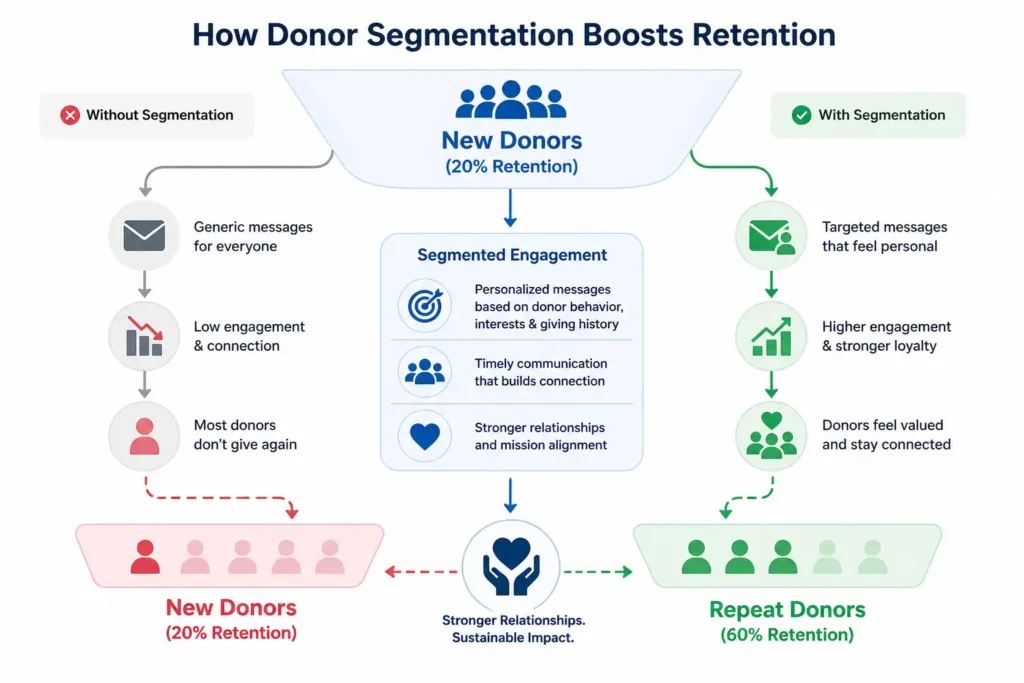
Donor segmentation helps turn one-time supporters into long-term contributors by creating a more intentional onboarding experience.
Instead of sending the same generic message to everyone, nonprofits can place new donors into a dedicated segment and guide them through a structured journey, sharing impact stories, appreciation messages, and clear next steps.
It also helps maintain relationships with existing supporters before they slowly disengage. Loyal donors rarely stop giving all at once; their engagement declines over time, with fewer email opens, less interaction, and eventually no response.
At the same time, segmentation makes it easier to identify donors who are at risk of lapsing. By analyzing behavior like donation frequency, email engagement, or event participation, nonprofits can spot early warning signs and act before the connection is lost.
Reaching out during this window with a targeted message is far more effective than trying to re-engage donors after they’ve already disengaged for a long period.
“Cilck Here to Learn Donor Engagement Strategies To Boost Recurring Giving”
Proven donor segmentation strategies for nonprofits
There’s no single “right” way to slice your donor list. The best segmentation approach depends on what you know about your donors and what you’re trying to accomplish.
Here are seven of the most effective ways to do it, each one serving a different purpose.
Affinity for a cause, topic, or event
Donors are more likely to give when the cause matches their personal values. Segmenting by affinity allows you to speak directly to what they care about most.
For organizations with multiple programs, such as youth education, emergency relief, and community development, not every donor cares equally about all three. Someone who first gave because of your school feeding program doesn’t necessarily want to read about your housing initiative.
Segmenting donors by their interests and hobbies provides a deeper understanding of what drives their engagement, enabling you to connect with donors on a more personal level.
You can capture affinity data through donation form selections, survey responses, event attendance, or simply what content they click on in your emails.
Demographics
Age, location, gender, and life stage all shape how people prefer to engage with your organization. Baby Boomers often respond well to direct mail or personal calls, while Millennials tend to prefer digital outreach like emails or social media.
Sending a text-heavy newsletter to an older donor who responds best to handwritten notes is a missed connection, not a failed campaign.
Location matters too. Donors in the same city as your programs may want invitations to events, volunteer days, or in-person impact tours.
Remote donors may prefer digital impact reports and video updates. Demographics won’t tell you everything, but they give you a starting framework for tone, format, and channel.
Actions and behaviors
What a donor does is often more revealing than who they are. Segmenting by engagement level is a more holistic way to track donors’ involvement with your nonprofit.
Factors like volunteer hours can be overlooked when focusing solely on financial contributions, but these can be strong indicators of a supporter’s affinity for your cause.
Think beyond donations. Does someone open every email you send? Do they share your campaigns on social media? Have they attended multiple events? These behaviors signal a highly engaged supporter who may be ready for a deeper ask or a more personal relationship, even if their dollar amount looks modest on paper.
Contribution amount
This is one of the most fundamental ways to segment, and for good reason. A donor who gives $25 once a year has different expectations, motivations, and upgrade potential than someone who gives $2,500 annually.
Segmenting by donation amount allows you to tailor your outreach; major donors might appreciate more personal engagement, while smaller donors can be encouraged through community-building initiatives.
A practical approach: divide donors into tiers like entry-level, mid-level, and major, and define what stewardship looks like for each. Major donors warrant personal calls and handwritten notes.
Mid-level donors might receive a special impact report. Entry-level donors need a strong onboarding experience and a path toward recurring giving.
Giving frequency
How often someone gives tells you a lot about their commitment level. A one-time donor who gave during a disaster appeal is very different from someone who has set up a $20 monthly contribution. Both matter, but they need completely different communication strategies.
Recurring donors are your most loyal and predictable supporters; they deserve recognition and exclusive updates that reinforce why their consistency matters. One-time donors, on the other hand, need nurturing.
The goal with them is to show enough impact and build enough trust that they want to give again. Focus on converting one-time small gifts to monthly recurring donations; it dramatically improves both retention and lifetime donor value.
Channel preference
Knowing how donors prefer to be contacted, whether by email, phone, or direct mail, ensures your messages reach them most effectively.
A perfectly written email campaign means nothing if it lands in the inbox of someone who only responds to a phone call or a letter in the post.
Collect channel preference data early during the first donation, in a welcome survey, or through a simple “how would you like to hear from us?” checkbox. Then honor it. When donors feel respected in how you communicate, they stay longer and give more consistently.
Length of the donor relationship
A donor who has been with your organization for eight years is not the same as someone who gave for the first time last month.
Long-term donors have built trust and emotional investment; they deserve acknowledgment of their loyalty, not the same generic appeal a brand-new donor receives.
Use relationship length to shape your tone and recognition strategy. Long-tenured donors respond well to “you’ve been with us since the beginning” messaging, anniversary acknowledgments, and invitations to leadership-level events.
New donors need orientation; they’re still deciding whether your organization is worth their long-term commitment. Treating them accordingly makes a real difference in whether they stick around.
Final thoughts
Donor segmentation isn’t a luxury for large nonprofits with dedicated data teams. It’s something any organization can start doing, even with three groups and a spreadsheet.
The reason it matters is simple: your donors are different from each other. They came to you in different ways, they give at different levels, and they care about different things. When you treat them differently, they respond better.
Start small, pick your three most important segments based on your current goals; write one tailored message for each. Track what happens, then build from there.
That’s the whole thing. You don’t need to get it perfect on day one; you just need to start.
Join the thousands already enjoying Paymattic Pro!
Frequently asked questions
Here are some frequently asked questions regarding “donor segmentation”.
1. How many donor segments should a nonprofit start with?
Most nonprofits should begin with 3–5 core segments. Starting small makes it easier to manage campaigns and ensures each segment receives meaningful, targeted communication without overwhelming your team.
2. How often should donor segments be updated?
Donor segments should be reviewed and updated regularly, ideally every few months. Donor behavior changes over time, and outdated segments can lead to irrelevant messaging and missed engagement opportunities.
3. Can small nonprofits use donor segmentation effectively?
Yes, even small nonprofits can benefit from donor segmentation. With just basic data like donation history and engagement, you can create simple segments that significantly improve communication and fundraising results.
4. What is the biggest mistake nonprofits make with donor segmentation?
One common mistake is creating segments but not using them effectively. Segmentation only works when it’s actively used to tailor messaging, campaigns, and donor experiences.
5. How do you measure the success of donor segmentation?
You can measure success by tracking metrics like email open rates, click-through rates, donor retention, and overall donation growth. Improved performance in these areas usually indicates effective segmentation.

Madhobi
This is Madhobi, a content writer at WPManageNinja with expertise in technical writing and email marketing. Outside of work, she likes traveling and exploring new places.
Leave a Reply