

PayPal Fees for Business and Nonprofits in 2026


Table of Content
Download Paymattic – it’s Free!
Subscribe To Get
WordPress Guides, Tips, and Tutorials
We will never spam you. We will only send you product updates and tips.
Ask ten small business owners what PayPal actually charges, and you’ll get ten different answers. Someone will say 3%. Someone else swears it’s 2.9%. A nonprofit manager will mention “around $2 per donation,” and a course creator will just shrug and say “whatever shows up when I check the payout.”
They’re all a little right, and that’s exactly the problem. PayPal doesn’t run on a single fee. It runs on a menu of them, and which one applies to you depends on how the payment came in, where your customer or donor is sitting, and what kind of account you’re operating.
If you’re selling products, running an online store, taking course payments, or collecting donations, that gap between “expected amount” and “amount that actually landed” isn’t random. It’s calculable, and once you know the formula behind each fee type, the surprise disappears.
This guide walks through every PayPal fees for businesses and nonprofits in 2026, with the real math behind each one, so you can price your products, set your donation asks, and forecast your payouts without guessing.
Key Takeaways:
- PayPal business account fees change based on payment method (Checkout, card, invoice, QR code), not just transaction size.
- Standard PayPal Checkout runs 3.49% + $0.49 domestically; standard card payments run 2.99% + $0.49.
- International fees stack on top of domestic ones. A cross-border sale can carry two or three separate charges before it even hits your bank.
- Nonprofits get a better deal (2.89% + $0.49, or 1.99% + $0.49 once approved for charity rates), but international donations still carry the same cross-border markup.
- Micropayment pricing (4.99% + $0.09) beats standard pricing only below roughly $10 per sale.
What are PayPal business fees, exactly?
PayPal business fees are what PayPal keeps from every dollar that moves through your account, whether that’s a customer paying for a product, a donor giving to your cause, or you moving your balance to your bank.
There’s no single “PayPal fee.” There’s a menu of them, and which one applies depends on the payment type you used to receive the money.
For most people asking “what are PayPal fees,” the honest answer is: it depends on four things.
- How the money arrived. The checkout button, direct card entry, invoice, QR code, and donation each carry their own rate.
- Where the payer is. Domestic transactions cost less than international ones.
- What currency is involved. Any conversion adds a separate markup on top of the transaction fee.
- What kind of account you’re running. A standard business account, an approved nonprofit, and a Payments Pro setup all sit on different pricing tables.
That’s the whole picture. Every fee below is a variation on those four levers.
PayPal business account fees for domestic transactions
A domestic PayPal transaction is a payment sent and received within the same country and currency setup. For example, if a customer in the United States pays a US business in USD, that is usually a domestic transaction.
This is the part most guides oversimplify. PayPal doesn’t charge one rate for “goods and services.” It charges different rates depending on exactly how the buyer paid you.
Here’s the current PayPal merchant fee schedule for US accounts, last updated in June 2026.
| Payment type | Domestic rate |
| PayPal Checkout / Guest Checkout / Pay with Venmo | 3.49% + $0.49 |
| Standard credit and debit card payment | 2.99% + $0.49 |
| QR code transaction | 2.29% + $0.49 |
| QR code Transactions through a third-party integrator | 2.29% + $0.09 |
| PayPal Pay Later | 4.99% + $0.49 |
Here is the formula for PayPal business fees in domestic transactions:
PayPal Fee = (Transaction amount x Rate) + Fixed fee
Here is a real example of a standard card payment:
Let’s say you sell a $100 course, and the buyer pays with a credit card through the standard card flow (2.99% + $0.49).
- The PayPal credit card fees would be, (100 x 2.99%) + $0.49 = $3.48
- As a marchent you’ll receive ($100 – $3.48) = $96.52
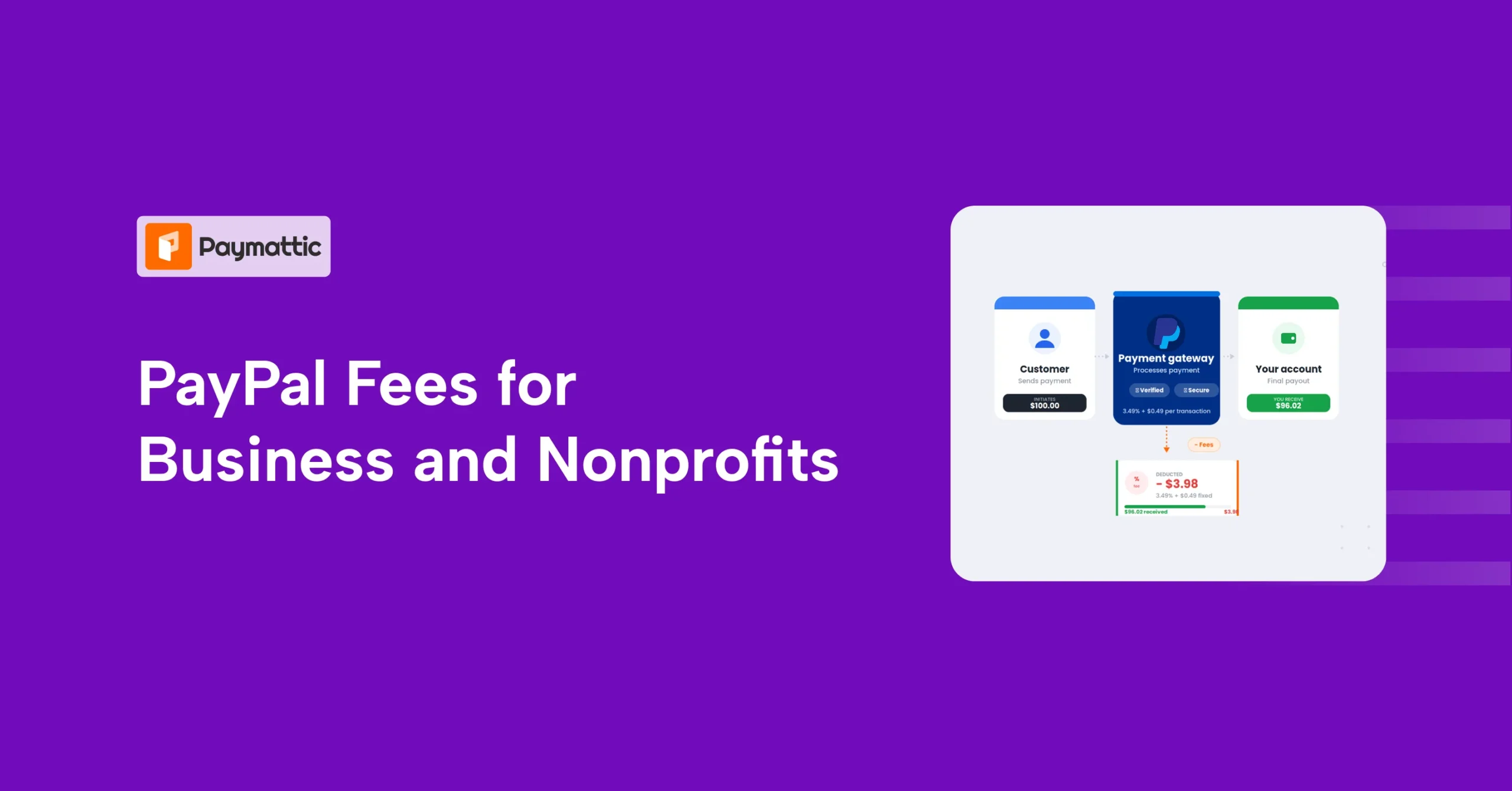
If the same buyer purchases the course through the PayPal Checkout button instead of entering card details directly, the PayPal fees would be (3.49% + $0.49).
- PayPal paymet processing fee = (100 x 3.49%) + 0.49 = $3.98
- You receive = 100 − 5.72 = $96.02
That $0.50 gap matters if you’re running volume. If your storefront defaults to the Checkout button for every buyer, you’re quietly paying half a percentage point more than a store that routes card payments directly.
This is one of the more overlooked PayPal merchant fees because most sellers assume “PayPal fee” means one number.
PayPal fees for goods and services payments
If a customer pays for a product, service, digital download, or course through PayPal, that’s classified as a Goods and Services transaction, and it always carries a fee. This is separate from Friends and Family, and it’s the category almost every ecommerce and course-selling business lives in.
The goods and services payment charges 2.99% of your transaction amount.
PayPal international fees and cross-border charges
International transactions cost more, and the reason is straightforward. When the sender and receiver are in different countries, PayPal often adds a cross-border fee of 1.5% on top of the standard transaction fee.
The PayPal merchant fees for international transactions may vary based on the following factors:
- The sender’s country
- The receiver’s country
- The currency used
- Whether conversion is required
This is why two businesses using PayPal from different countries can see different deductions even for the same payment amount.
Formula:
PayPal international fees = (Transaction amount x 2.99%) + $0.49 + (Transaction amount x 1.5%)
Real example: A UK customer buys a $100 online course from a US-based creator through PayPal Checkout. Let’s calculate the charges:
- PayPal international fees = (100x 3.49%) + $0.49 + (100 x 1.5%) = $5.48
- The merchant will receive = $(100 − 5.48) = $94.52
That’s almost double the domestic-only fee on the same sale amount.
The key takeaway is simple: when a payment crosses borders, always assume the final fee will be higher than the domestic rate unless you have confirmed otherwise for your region.
PayPal currency conversion fees
This is separate from the international surcharge above, and it only applies when a currency conversion actually happens, meaning the buyer pays in a currency different from what you have listed or are set up to receive.
How the fee is calculated:
PayPal international fees = (Transaction amount x 2.99%) + $0.49 + (Transaction amount x 1.5%)
PayPal doesn’t use the plain market exchange rate. It applies a markup to the exchange rate on top of the mid-market rate, typically ranging from ~3% to 4%.
Imagine a payment of €100 is converted into USD.
If the market rate would normally give you $116, but PayPal applies a less favorable exchange rate, you may end up with slightly less than that.
It’s an international payment, plus it has a conversion fee as well, so after all the calculations, you may end up receiving $106 – $108.
If you deal with cross-border or SEPA payments often, this is one of the first places to check when your payout looks off.
How to reduce it: Price and settle in the same currency where possible. Every unnecessary conversion is a chance to lose margin that you never see itemized.
Other PayPal business account fees to know
PayPal micropayment fees
If you sell low-cost digital products, templates, or anything under roughly $10, standard pricing eats a disproportionate chunk of the sale because of the fixed $0.49. PayPal’s micropayment rate trades a higher percentage for a much smaller fixed fee of $0.09.
It is designed for very small transactions where the fixed fee would otherwise eat too much of the sale.
PayPal micropayment fees: (Transaction amount x 4.99%) + $0.09
Chargebacks and disputes
These are the fees nobody plans for, and everybody eventually pays.
Chargeback fee: $20 USD, charged when a cardholder disputes a charge through their bank rather than through PayPal directly. This stacks on top of losing the original payment if the dispute goes against you.
Dispute fee: $15 for standard accounts, $30 for high-volume accounts, when a buyer opens a dispute through PayPal’s own resolution center.
Withdrawal fees
Getting money out of PayPal and into your bank account has its own fee structure, separate from receiving the payment in the first place.
Standard transfer: Free, but takes one to three business days.
Instant transfer: Costs 1.5% of the amount transferred, with a $0.50 minimum fee.
PayPal fees for nonprofits
PayPal for Nonprofits sits on a different pricing table than standard businesses, but the discount isn’t automatic. There are two tiers.
Standard PayPal fees for nonprofits: Applicable to any organization using the Donate button or PayPal Checkout for Donations, with no application required.
The standard rate of PayPal fees for nonprofits is 2.89% + $0.49 per donation.
Approved charity rate: Once PayPal confirms your organization’s charity status, the rate drops to 1.99% + $0.49.
This requires applying and being approved under PayPal’s Confirmed Charity terms; it’s not applied by default just because you’re a registered 501(c)(3).
What nonprofits should watch for
- Donations from international supporters may still trigger cross-border or conversion costs
- Recurring donations can add up over time
- Small donations can be hit hard by fixed fees
If your organization relies on small donations, the fee structure matters almost as much as fundraising volume.
PayPal fees calculator
Before you receive a payment, ask these questions:
- Is this domestic or international?
- Will currency conversion happen?
- Is the payment for goods and services?
- Is it under micropayments?
If you answer these first, you will stop being surprised by the payout amount.
However, there are many tools available to help you to calculate your PayPal payment processing fees. You can use this PayPal fees calculator to calculate the charges for your business.
PayPal fees calculator:
Stripe vs PayPal fees: a quick comparison
Since this question comes up in almost every “which processor should I use” conversation, here’s the current side-by-side for a standard US domestic card payment.
| Feature / Scenario | Stripe Fee | PayPal Fee |
| Domestic transaction (card) | 2.9% + $0.30 | 2.9% + $0.49 |
| International transaction | +1% cross-border fee | +1.5% cross-border fee + conversion |
| Currency conversion | 2% markup | 3–4% markup |
| Micropayments | 5% + $0.05 | 4.99% + $0.09 |
| Recurring payments/subscription | No extra fee for setup; standard processing applies | Same |
| Chargeback | $15 per dispute | $20 per dispute |
| Payouts/withdrawals | Free to bank; instant +1% | Free to bank; instant +1% |
| Nonprofit discount | Not built-in | 1.99%–2.2% domestic |
How to avoid PayPal fees (or at least reduce them)
You can’t eliminate PayPal processing fees for businesses or nonprofits, but you can reduce their bite.
Price with fees baked in. Don’t treat the fee as a surprise deduction. Build the expected percentage into your price from the start.
Match currencies where you can. Settling in the same currency your buyer pays in avoids the conversion spread entirely.
Bundle small sales. The fixed $0.49 hurts a $5 sale far more than a $500 one. Raising your minimum order value reduces the relative fee burden.
Apply for micropayment pricing if you sell low-ticket items. As shown above, it’s a meaningful difference under roughly $10 per sale.
Apply for confirmed charity status if you’re a nonprofit. The jump from 2.89% to 1.99% is worth the paperwork.
Skip instant transfers unless you need the cash today. Standard transfers are free.
Reduce refunds and disputes. The cheapest fee is the one you never have to pay twice. Clear product descriptions, strong support, and effective billing communication reduce chargebacks and refund headaches.
Don’t use Friends and Family for business income. It might dodge the fee on paper, but it strips your protection and violates PayPal’s terms, and getting flagged for it is a higher cost than the fee you saved.
FAQs
How much are PayPal fees?
Most domestic card payments run 2.99% + $0.49, and standard PayPal Checkout runs 3.49% + $0.49. International payments add another 1.5%, and currency conversion adds 3% to 4% on top of that when it applies.
What are PayPal fees for nonprofits specifically?
2.89% + $0.49 for standard donation processing, or 1.99% + $0.49 once approved for PayPal’s confirmed charity rate.
How do I calculate PayPal fees for a specific sale?
Multiply the sale amount by the applicable rate, then add the fixed fee. To find out what to charge for a specific net amount, use Charge = (Net + fixed fee) / (1 − rate).
Do PayPal fees differ for debit cards vs credit cards?
No. PayPal’s merchant rate is set by payment type (Checkout, standard card, invoice, QR code), not by whether the card is debit or credit.
Is there a way to avoid PayPal fees entirely?
Not for legitimate business or nonprofit transactions. Friends and Family transfers are fee-free in some cases, but aren’t meant for commercial use.
Wrapping up
PayPal merchant fees for businesses or nonprofits look complicated because they’re not actually one fee; they’re a stack of small decisions: which button the buyer clicked, which country they’re in, which currency they paid with, and what kind of account you’re running.
Once you separate those, the math stops being a mystery and starts being something you can plan around.
If there’s one habit worth taking away from this guide, it’s pricing with the fee already factored in rather than treating it as a deduction you discover after the fact.
Whether that’s building a small buffer into your course price, applying for confirmed charity status, or simply choosing standard transfers over instant ones, small adjustments compound the same way the fees do.
Join the thousands already enjoying Paymattic Pro!

Tipu Deb
Hey! Tipu here, working as a Marketing Strategist at WPManageNinja & Paymattic. A nature lover and a person who is addicted to exploring historical events. In my leisure, you’ll find me playing with different musical instruments.
Leave a Reply