

Can You Accept Donations Without Being a Nonprofit?


Table of Content
Download Paymattic – it’s Free!

Subscribe To Get
WordPress Guides, Tips, and Tutorials
We will never spam you. We will only send you product updates and tips.
TL;DR:
You don’t need 501(c)(3) nonprofit status to legally accept donations for a meaningful cause! Whether you’re an individual, a for-profit business, a startup, or an unregistered nonprofit, you can still raise funds if you follow the right methods. Sure, donors can’t write off taxes, but a compelling cause still motivates people to give, especially when 77% prefer supporting socially responsible businesses anyway.
This guide breaks down the top 5 strategies to help you fundraise ethically.
Nonprofit organizations registered under 501(c)(3) can raise donations and apply for grants with relative ease. But what if you’re an individual raising money for a personal cause, or a nonprofit without 501c3 status, trying to fund your mission? Can you accept donations without 501(c)(3) status at all?
In simple terms, yes. You can.
Typically, a nonprofit without 501c3 status can’t apply for grants, and individuals can’t offer their supporters a tax deduction. But neither of those facts stops you from legally accepting donations.
Donors may not get a write-off, but a compelling cause still draws support. In fact, most consumers say they’re motivated to give to causes and businesses committed to social responsibility, so the absence of tax-exempt status is rarely the deciding factor for everyday donors.
This guide walks through what the tax rules actually say, how fiscal sponsorship works as an alternative to forming your own nonprofit, and seven practical ways to legally accept donations as an individual or an organization.
Can individuals legally accept donations?
Yes. If you want to legally accept donations as an individual, you don’t need to register any kind of organization first. People raise money for medical bills, emergencies, education, creative projects, and all sorts of personal causes every day, and it’s perfectly legal to ask for and receive that support directly.
The keyword here is usually “gift.” When someone gives you money out of genuine generosity, without expecting a product or service in return, the IRS treats that as a gift rather than income, and gifts aren’t taxed to the person receiving them.
What you can’t do as an individual is offer your supporters a tax deduction. Tax-deductible giving is reserved for donations to registered 501(c)(3) organizations. That’s a real trade-off, but it’s rarely a dealbreaker. People who care about your cause will usually still give.
Can organizations accept donations without 501(c)(3) status?
Yes, an organization or group can accept donations without 501(c)(3) status, too. This applies to grassroots groups, informal community organizations, startups, and any nonprofit without 501(c)(3) registration yet in place.
What changes for organizations is grant eligibility. Most foundations and government grant programs require 501(c)(3) status before they’ll consider an application, so a nonprofit without 501c3 status is generally locked out of that funding stream.
Direct donations, on the other hand, remain completely open to you.
If you’re a for-profit business wondering whether you can accept donations, the short answer is also yes, though the considerations are a little different since for-profits are never eligible for 501(c)(3) status in the first place.
We’ve covered that situation in more depth here: Can a For-Profit Business Accept Donations?
Are donations tax-deductible without nonprofit status?
No. Without 501(c)(3) status, the donations you receive are not tax-deductible for your donors. This is true whether you’re an individual or an unregistered organization.
To be eligible for 501(c)(3) status, an organization has to be organized and operated exclusively for charitable, educational, religious, scientific, literary, or similarly recognized purposes, as defined by the IRS.
Once that status is granted, donors can generally deduct their contributions on their own tax returns, which is a real incentive for giving.
If you’re not ready to pursue 501(c)(3) status yourself, there’s a middle path worth knowing about: nonprofit fiscal sponsorship.
We’ll explain exactly how that works in the methods section below, since it’s genuinely one of the best ways to offer your donors tax-deductibility without filing for your own exemption.
Gifts vs. taxable income, explained
This is the part that decides what you actually owe the IRS, and it’s worth understanding properly before you start collecting any money.
What makes something a gift
Under federal law, gross income does not include the value of property acquired by gift.
The Supreme Court sharpened this definition in a well-known case, ruling that a true gift comes from what it called “detached and disinterested generosity,” meaning the giver acts out of sympathy or goodwill and expects nothing of equal value back.
In practice, this means money people give you to help cover a medical bill, rebuild after a disaster, or support a cause you care about is generally treated as a gift. You don’t owe income tax on it, and you don’t need to report it on your tax return.
Money crosses into taxable income the moment there’s an exchange involved. If you’re running a crowdfunding campaign and promising every contributor a product, a copy of an album, or some other reward in return, the IRS treats those payments as income, not gifts, regardless of what you call the transaction on your fundraising page.
The 1099-K and why it sometimes confuses things
If you collect donations through a payment app or platform, you might receive a Form 1099-K at tax time.
As of 2025 and into 2026, platforms are only required to issue one when a single recipient’s gross payments exceed $20,000 and 200 transactions in a calendar year, though some platforms choose to send one below that threshold anyway.
Here’s the part that trips people up: platforms aren’t always able to tell a personal gift apart from a business payment, so you may receive a 1099-K that includes money you actually received as gifts.
If that happens, don’t ignore it. Contact the platform first and ask for a corrected form. If you can’t get one in time, file your return on schedule anyway and report the amount with an offsetting adjustment so you’re not taxed on money that was never income to begin with.
Keep your records (screenshots of your campaign page, a log of who gave what and when, and notes on how you explained the cause) since that documentation is what supports the gift characterization if the IRS ever asks.
A note on the gift tax (and why it rarely applies to you)
Donors, not recipients, are the ones who could theoretically owe gift tax, and only in unusual circumstances. For 2026, a donor can give up to $19,000 to any one person without needing to file a gift tax return at all.
Even above that, it just counts against the donor’s lifetime exemption, which sits at $15 million. In other words, the people contributing $25, $50, or even a few thousand dollars to your cause are nowhere near triggering anything.
As the recipient, you never owe gift tax, regardless of how much you receive in total.
None of this is a substitute for professional advice, especially if you expect to raise a significant amount or you’re not sure how a specific situation applies to you. A quick conversation with a tax professional is worth it if you’re collecting anything beyond modest, occasional support.
7 ways to legally accept donations without being a nonprofit
Whether you want to legally accept donations as an individual or you’re running a nonprofit without 501c3 status, these are the methods that actually work.
- Crowdfunding
- Fiscal sponsorship
- Donation drive
- Direct donation buttons and payment apps
- Affiliates with local
- Donor-advised funds
- Social entrepreneurship
Let’s break down each of these sections in depth.
1. Crowdfunding
Crowdfunding is the most universal way to raise funds, and you don’t need 501(c)(3) status to do it. Anyone can start or contribute to a campaign, and it works whether you’re an individual, a for-profit business, or an unregistered nonprofit.
Crowdfunding means collecting smaller donations from a larger number of people, rather than relying on a few big gifts. It’s most commonly associated with charitable causes, creative projects, and early-stage startups, though it’s rarely the primary funding source for a for-profit business.
Think of it as a strong additional channel rather than your whole strategy if you’re running a company.
People generally want some reason to give, even a small one. A shoutout on social media, early access to something you’re building, or simply a clear, honest explanation of where the money goes can go a long way.
To run an online crowdfunding campaign, you just need to pick a platform, build a donation page, choose a title that actually grabs attention, and launch.
You can easily set up a crowdfunding campaign using the Paymattic donation plugin, which offers tons of donation features along with 14 payment gateways worldwide.
“Pro Tip – Want to reduce the workload? Paymattic offers excellent-looking ready-to-use donation forms for you.”
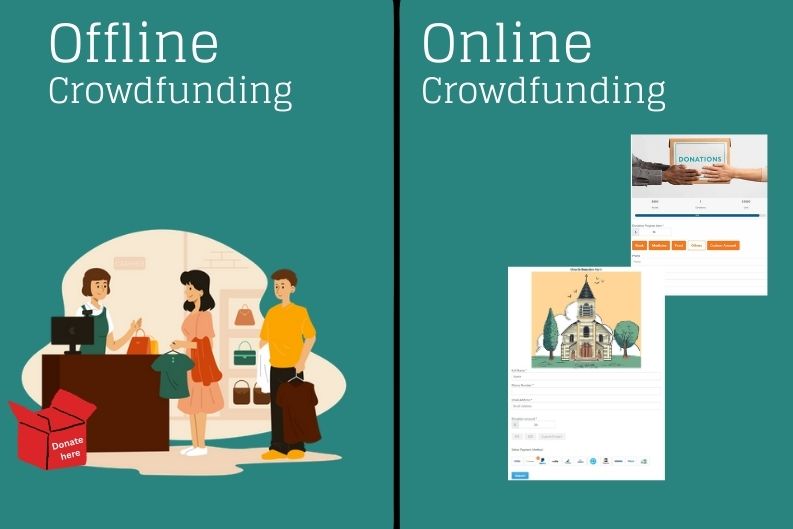
If you’re running a brick-and-mortar location, a simple donation box at the checkout counter works the same way offline.
2. Fiscal sponsorship
If you want to legally accept donations as an individual or as a nonprofit without 501(c)(3) status, while still offering your donors a tax deduction, nonprofit fiscal sponsorship is probably your best option.
So, how do fiscal sponsorship organizations actually work?
Imagine you’ve got a real cause and want to accept donations without a 501c3 status. A nonprofit organization registered as 501(c)(3) steps in and says, “We’ll handle the donations for you.” Donors donate to them, but the money goes toward your project.
And yes, those donors still get their tax deductions.
In short, “Fiscal sponsorship organizations are tax-exempt groups that receive funds on behalf of a nonprofit or project that doesn’t have a tax-exempt status yet.”
The two most common models of Fiscal sponsorship are: 1. Comprehensive sponsorship, and 2. Pre-approved grants.
Both are good choices for legally accepting donations as an individual or for a nonprofit without 501(c)(3) status.
Comprehensive Sponsorship, where the sponsor takes full control. They collect the money, they decide how it gets spent, and they handle everything. You’re more like a program under their umbrella.
This is a solid choice if you’re new to running a nonprofit and want guidance from people who’ve done it before.
Pre-Approved Grants, where the sponsor still legally holds the funds, but once your plan is approved, you execute it with much more independence. This one’s better if you’ve already applied for 501(c)(3) status or you’re running with a small team and know what you’re doing.
So, which one should you pick?
If you’re a complete beginner, go comprehensive. You’ll learn a lot from people who’ve been there.
If you’ve already got experience and just need the tax-exempt umbrella while your own paperwork is in motion, a pre-approved grant arrangement gives you more room to operate independently.
Either way, think of fiscal sponsorship as a bridge, not a permanent structure. It gets your fundraising moving now instead of stalling while you wait on IRS approval, which can take several months to come through.
3. Donation Drive
A donation drive is a collective effort to gather essential items, financial contributions, or assistance to benefit a specific cause or community in need.
Consider a physical donation drive if you feel uncomfortable asking for monetary donations because of your nonprofit status. There are a lot of people around us suffering from a lack of clothing, shoes, food, or other things.
A donation drive can be a great alternative to raising monetary donations. You can ask your consumers to donate their unused clothes or shoes that they no longer wear.
People are often more willing to clear out a closet for a good cause than to write a check, and it still moves real resources toward your mission.

“No one has ever become poor from giving.”
– Anne Frank
If your cause is animal welfare, you can run the same kind of drive: a donation box for pet food, leashes, or shelter supplies, paired with a clear explanation of where it’s going.
Donation drives have also become a common response to natural disasters and humanitarian crises, where in-kind giving fills gaps that cash alone sometimes can’t.
This is an excellent way of accepting grants for nonprofits without 501(c)(3) registration.

4. Direct donation button
A donate button is one of the simplest ways to accept donations without being a nonprofit, and you’ve got more options here than just PayPal.
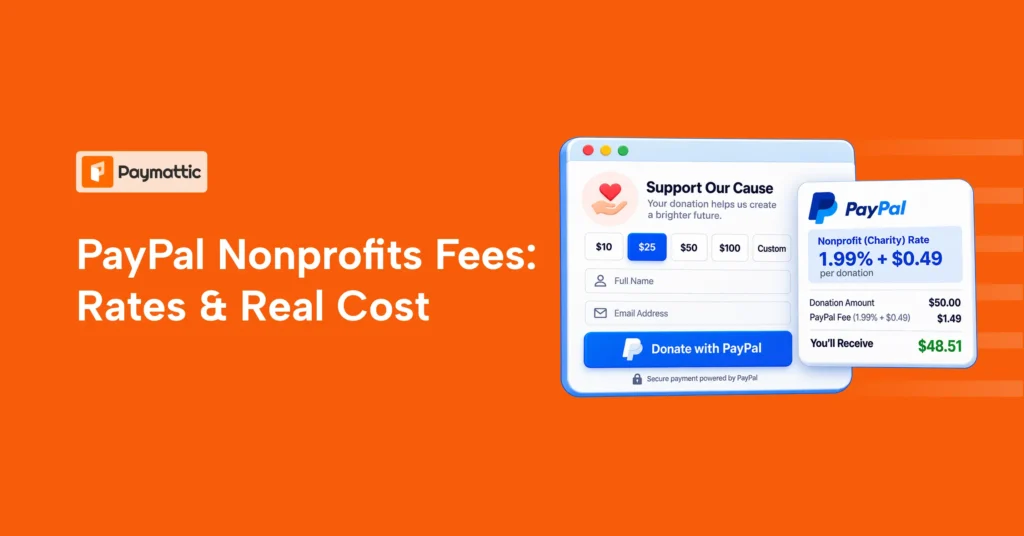
PayPal for nonprofits offers a straightforward donate button you can place anywhere on your site. Visitors who came to browse or buy something can chip in extra if they’re moved to.
It’s simple, it’s trusted, and there’s no setup beyond connecting your account, though customization is fairly limited.
Stripe is a strong option if you want more flexibility. It supports custom donation forms, recurring giving, and a wider range of payment methods, which makes it a better fit if you plan to scale your fundraising beyond occasional one-off gifts.
If your site runs on WordPress, Paymattic is built specifically for this. It connects to Stripe, PayPal, and a dozen other gateways, and lets you build a fully custom donation form (recurring donations, donor leaderboards, currency switching) without writing code.
For donation-specific use cases, our Stripe donation form guide walks through the setup step by step.
Whichever tool you choose, make sure you clearly explain why you’re raising funds. A donate button with no context rarely converts well.
Subscribe Newsletter
Subscribe to our newsletter for updates, exclusive offers, and news you won’t miss!

5. Affiliates with local
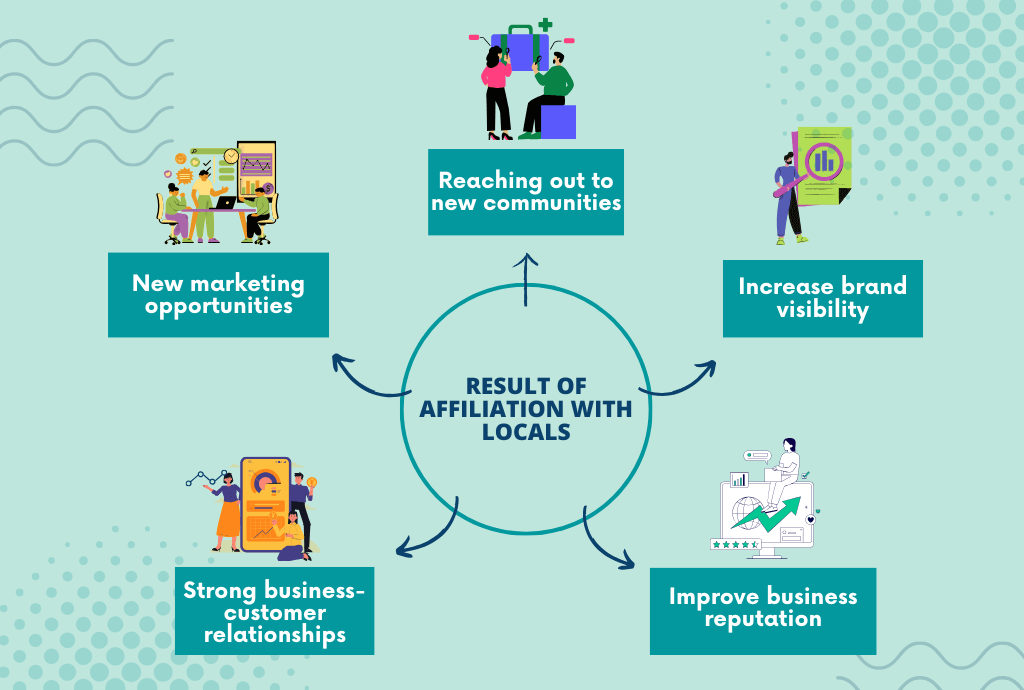
Affiliation with locals is a powerful strategy for you to accept donations without being a nonprofit, and also for nonprofits without a 501(c)(3) registration. When you affiliate with another business, organization, or any influencer, you tap into their community.
By gaining their trust and engagement, you’re more likely to raise easy donations because you get recommended by someone they know or a business they trust.
Local affiliation often comes with shared values. By partnering with a local charitable organization, you demonstrate that you care for society despite not being a nonprofit.
It’ll differentiate you from others, and people definitely appreciate your participation in the greater good. As a result, the relationship between you and your consumers becomes stronger. It’ll take you to gain some repeat contributors and help you to gain sustainability.
It’s considered one of the best donor retention strategies as well.
“In fact, 77% of individuals prefer buying from companies with social responsibilities.”
Source – HAVARD Business School report
Partnering with local organizations also opens new windows of marketing opportunities.
6. Donor-advised funds
A donor-advised fund, or DAF, is a charitable giving account managed by a sponsoring organization, usually a community foundation, public charity, or financial institution. It’s not a method you set up yourself so much as a channel donors already use that you can become eligible to receive from.
Here’s how it works in practice. A donor contributes to their DAF and gets an immediate tax benefit for doing so. Over time, they recommend grants from that fund to causes they want to support, and the sponsoring organization reviews and distributes those grants.
If your project or organization qualifies to receive DAF grants, even without 501(c)(3) status of your own (often through a fiscal sponsorship arrangement), you gain access to a pool of donors who are already primed to give.
DAFs tend to be a slower-moving channel than crowdfunding or a donate button, but they’re worth knowing about, especially if you’re working with a fiscal sponsor who can help you become DAF-eligible.
7. Social entrepreneurship
Social entrepreneurship is the practice of building a business model around solving a social, cultural, or environmental problem.
It blends commerce and cause in a way that can simplify how you accept donations without being a nonprofit, since the “ask” becomes part of a broader value exchange rather than a pure donation request.
If there are social entrepreneurs whose mission overlaps with yours, reaching out for partnership or funding can be worth the effort.
These relationships often come with built-in audiences who already care about causes like yours, and a structured partnership can be more sustainable than one-off donation drives.
Best practices for compliance and transparency
No matter which method you choose, a few habits will keep you on solid ground and keep your donors confident in you.
Be upfront about tax-deductibility. If you’re not operating under 501(c)(3) status or a fiscal sponsor, tell your donors plainly that their contribution isn’t tax-deductible. Most people will still give to a cause they believe in, but nobody likes finding this out after the fact.
Explain exactly where the money is going. Vague appeals raise less than specific ones. “Help us reach our goal” converts worse than “this covers three months of physical therapy” or “this funds 50 meals.”
Keep records from day one. Save your campaign page, your messaging to donors, and a running log of contributions. This protects you if a platform ever sends a 1099-K that needs correcting, and it protects your credibility if anyone ever asks how funds were used.
Follow through on what you promised. If you raise more than you need, or your plans change, tell your donors. Transparency here isn’t just good practice, it’s what keeps people willing to support you again.
Common mistakes to avoid
A few avoidable missteps come up again and again with individuals and small organizations accepting donations without nonprofit status.
Implying tax-deductibility without 501(c)(3) status or a fiscal sponsor
This is the most common and most damaging mistake. Even an unintentional implication, like using language that sounds like a registered charity, can create real problems with donors and with the IRS.
Spending funds differently than promised without telling anyone
Soliciting money for one stated purpose and using it for something else can expose you to real legal risk, including potential fraud claims, beyond just upsetting your supporters. If your plans genuinely change, communicate that to donors rather than quietly redirecting funds.
Treating every platform payout as automatically tax-free
Just because money came through a personal fundraiser doesn’t mean it’s automatically a gift in the IRS’s eyes, especially if you offered anything in return. When in doubt, refer back to the gift-versus-income distinction above, or ask a tax professional.
Ignoring a 1099-K instead of addressing it
As covered earlier, getting a 1099-K doesn’t mean the money is taxable. Ignoring the form entirely, instead of correcting or properly offsetting it, is what creates problems down the line.
Wrapping up
To perform a fundraising campaign for a charitable cause, you don’t always need to be registered as a 501(c)(3). Even if you can accept donations without being a nonprofit, all you need is a valid reason.
There are additional ways to legally accept donations as an individual, aside from the tax exemption.
But remember, you’re following the rules of fundraising as per the IRS and complying with all tax requirements.
Join the thousands already enjoying Paymattic Pro!

Tipu Deb
Hey! Tipu here, working as a Marketing Strategist at WPManageNinja & Paymattic. A nature lover and a person who is addicted to exploring historical events. In my leisure, you’ll find me playing with different musical instruments.
Leave a Reply