

Donation Request Letter: Free Templates & A Complete Writing Guide


Table of Content
Download Paymattic – it’s Free!
Subscribe To Get
WordPress Guides, Tips, and Tutorials
We will never spam you. We will only send you product updates and tips.
Most donation request letters never get read.
Not because the cause isn’t good. Not because the writer didn’t care. But because the letter sounds exactly like every other donation letter the reader has seen.
A formal opening, a list of accomplishments, a vague ask somewhere near the bottom, and a sign-off that feels copy-pasted from a template someone found ten years ago.
If you have ever stared at a blank page, wondering how to write a donation request letter that actually moves people to give, this guide is for you.
It walks you through everything: what a donation request letter is, the types, what to include, a step-by-step writing guide, and ready-to-use donation request letter templates covering nonprofits, schools, churches, sports teams, corporate donors, and more.
TL;DR
A donation request letter is a written appeal asking individuals, businesses, or organizations to contribute financially or in kind to your cause. Most donation letters underperform not because the cause is weak, but because the letter uses the wrong format, buries the ask, or sends donors to a donation page that kills the momentum the letter built.
Here is what actually works:
- Match your letter type to your audience; a corporate donation letter, a school fundraising letter, a church donation request letter, and a sports team appeal all follow different logic and need different tones.
- Lead with one story, not a statistic; donors give to people, not numbers.
- State the ask in the first or second paragraph, never at the end.
- Tie giving levels to real outcomes (“$50 covers one student’s supplies for a month”).
- Add trust signals in the letter itself, not buried on your website.
- Send one clear CTA that links to a campaign-specific donation form, not your homepage.
- Plan the thank-you and follow-up sequence before the letter even goes out.
This guide includes 10 donation request letter templates covering nonprofits, schools, churches, sports teams, corporate donors, in-kind requests, matching gifts, recurring giving, lapsed donors, and event auctions with a timing calendar and a donation page to embed directly.
What is a donation request letter?
A donation request letter is a written appeal asking individuals, businesses, or organizations to contribute financially or in kind to a cause, campaign, or project.
It is one of the oldest and most effective tools in fundraising, and it works just as well in an email as it does in a physical envelope.
Nonprofits, schools, churches, sports teams, and individual fundraisers all use donation letters to communicate their mission, share the impact of their work, and invite supporters to be part of something meaningful.
A well-written letter for donation request does not just ask for money. It tells a story, builds trust, and gives the reader a clear, simple way to help.
The format can vary; a letter asking for donations might be a formal printed appeal sent by mail, a short email campaign, or a personalized note to a major donor. But the purpose is always the same: to connect with a real person and inspire them to give.
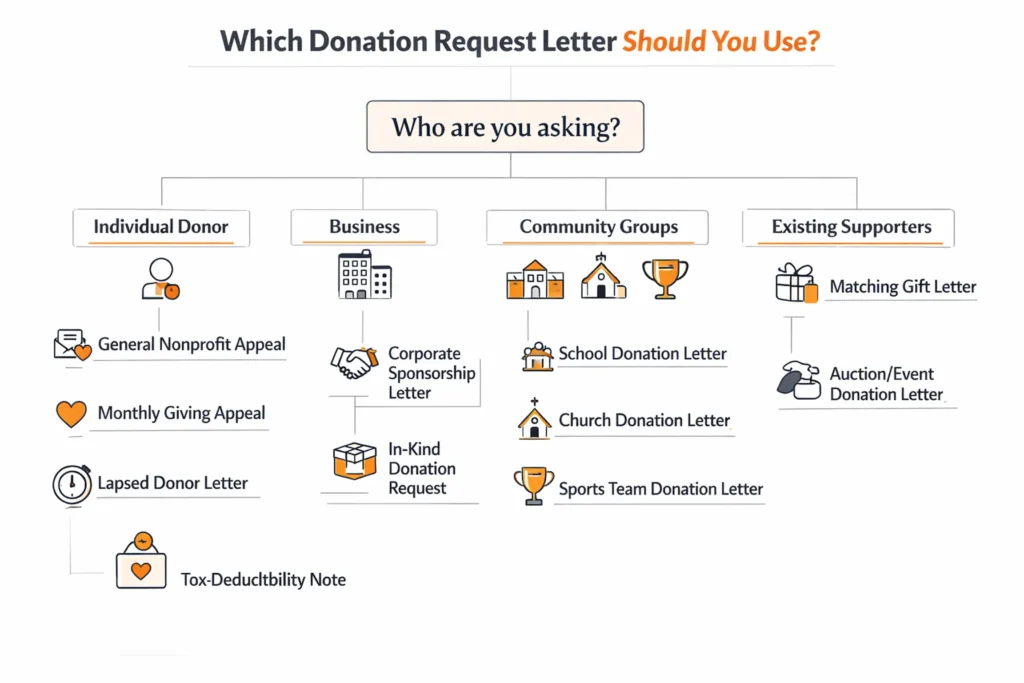
Types of donation request letters (how to pick the right one)
Here is the thing most guides do not tell you: the most common reason a fundraising donation letter underperforms is not bad writing. It is using the wrong type of letter for the wrong audience.
A corporate sponsorship letter sent to an individual donor reads as tone-deaf. A general nonprofit appeal sent to a lapsed donor who gave three years ago misses a real opportunity to acknowledge the relationship.
The type of letter you send should match the person you are sending it to and the specific thing you are asking them to do.
Here is a quick breakdown of the main types, along with when to use each one.
General nonprofit appeal
The most common type. Used for annual fund campaigns, seasonal giving pushes, and broad donor outreach. Works best when paired with a strong story and suggested giving levels tied to real outcomes.
Corporate donation letter
Sent to local businesses or brands. These letters usually offer something in return, visibility at an event, logo placement, and recognition in communications.
The tone is more formal, and the ask is typically larger. A well-written nonprofit letter asking for donations from businesses will lead with the mutual benefit, not just the need.
In-kind donation request
Asks for goods or services rather than cash. Common for food drives, auction events, and organizations that need equipment or supplies. An in-kind donation letter should be specific; list exactly what you need, how it will be used, and by when.
School donation request letter
Written for parent communities, alumni, or local businesses. These letters tend to be warmer and more community-focused. A strong school donation request letter connects the ask to a specific program, event, or student need.
Church donation request letter
Used for building funds, mission trips, outreach programs, or general congregation giving. A church donation letter speaks to shared values and community responsibility. The tone is personal and relational.
Matching gift letter
Sent after a donation has already been made to remind the donor that their employer may match the gift. Short, action-focused, and time-sensitive.
Recurring or monthly giving appeal
Converts one-time donors into monthly sustainers. The key is connecting a small recurring amount to a concrete, ongoing outcome.
Sports team donation request letter
Sent by coaches, parents, or team administrators to local businesses and community members. A sample donation request letter for sports team campaigns works best when it highlights community pride, player development, and specific funding needs like equipment or travel costs.
Lapsed donor re-engagement letter
Sent to donors who have not given in 12 months or more. Acknowledge the gap, share what has changed or been accomplished, and make a warm, low-pressure ask.
Event or auction donation request
Asks for in-kind items for a fundraising event. Should be specific about what is needed, the event details, and what the donor receives in return.
A useful rule of thumb: the larger the gift and the more specific the ask, the more personal and tailored your letter should be. A $25 annual fund appeal can go to a broad list. A $10,000 corporate sponsorship request should read as if it were written for one person.
What every nonprofit donation request letter must include
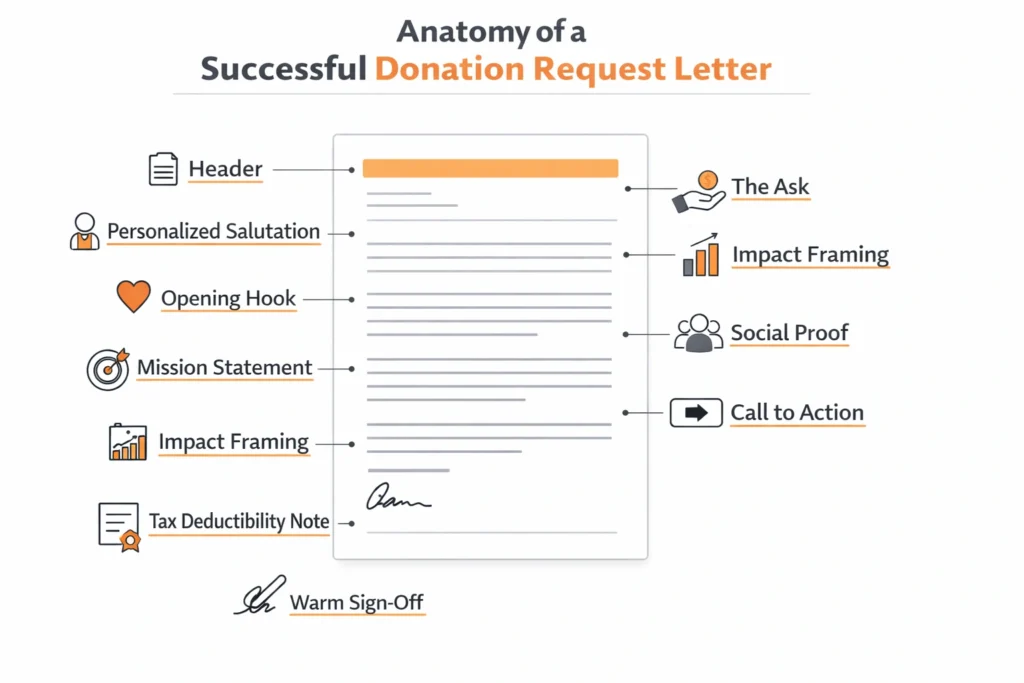
Whether you are writing a simple donation letter for a small school fundraiser or a formal nonprofit letter asking for donations for a capital campaign, the core elements stay consistent. Think of this as your pre-send checklist.
Header: Your organization name, logo, contact information, and date. For physical letters, use official letterhead. For email, make sure your branding is visible at the top.
Personalized salutation: Use the donor’s first name. Always. “Dear Friend” is the single clearest signal that this is a mass mailing, and it costs you the connection before the first sentence lands.
Opening hook: One story. One person. One moment. Not a statistic. “Last winter, a family of four showed up at our shelter with nothing but the clothes on their backs” will outperform “we served 847 families last year” every single time. Donors give to people, not numbers.
Mission statement: Two to three sentences explaining what you do, who you serve, and why it matters. Keep it plain. Avoid jargon.
The ask: State clearly what you need, how much, and why. This should appear in the first or second paragraph, not buried at the end. Most readers scan before they commit to reading fully. If they do not see the ask within the first few seconds, many will move on.
Impact framing: What does a donation actually do? Tie specific amounts to specific outcomes. “$50 covers school supplies for one child for a full semester” is far more compelling than “your generous contribution makes a difference.”
Social proof: Share a past accomplishment, a milestone reached, or a number that shows your work is working. This is not bragging; it is evidence that their donation will not disappear into a void.
Call to action: One link. One action. Send them directly to a campaign-specific donation form, not your homepage. This is where most organizations lose donations, more on that in a later section.
Tax deductibility note: A brief mention of your 501(c)(3) status (or local equivalent) removes a common hesitation for potential donors.
Warm sign-off: Thank the reader for their time and consideration. Sign with a real name and title. If the letter is going to a major donor, a handwritten note in the margin or a personal PS line can make a real difference.
Format and design basics: Keep physical letters to one page. Email appeals should run 200 to 350 words for the body, long enough to make the case, short enough to respect the reader’s time.
Use one readable font and generous line spacing. Include your logo and branded letterhead. For email, optimize for mobile; most donation appeals are opened on a phone, and a form that does not load cleanly on mobile is a direct route to an abandoned donation.
How to write a donation letter step-by-step
Knowing what to include is one thing. Knowing how to put it together so it actually reads well and moves people to act is another. Here is the step-by-step process of writing a donation request letter for a nonprofit.
Step 1: Define your goal before you write a single word
What is this letter raising money for? How much do you need? By when? A letter without a clear goal produces a vague ask, and a vague ask produces vague results.
Before you open a blank document, write down one sentence that completes this: “This letter is asking [audience] for [specific amount or item] to [specific outcome] by [date].“
Everything in the letter flows from that sentence.
Step 2: Know who you are writing to
Segmenting your donor list before you write is not extra work; it is the work. A first-time donor letter reads differently from a letter to someone who has given every year for five years. A corporate donation letter reads differently from a letter to a parent in your school community.
You do not need a different letter for every person, but you do need a different letter for every meaningful segment.
The most important segments to think about: new or first-time donors, recurring or loyal donors, lapsed donors (12 months or more without a gift), and corporate or business contacts.
Donor Segmentation: A Complete Guide for Smarter Fundraising
Step 3: Lead with a story, not a statistic
This is the single biggest difference between a donation letter that works and one that gets deleted. Open with one person, one program, or one moment that brings your mission to life. Then connect that story directly to the funding need.
“Last spring, Marcus was six weeks from dropping out of school. He couldn’t afford the equipment for the robotics team he had worked two years to join. Because of a donor like you, he didn’t drop out. He went on to win the regional championship. We have twelve students in the same position this year, and this letter is the reason we’re reaching out.”
That is a fundraising letter. A list of program statistics is a report.
Step 4: Make the ask early and clearly
State what you need in the first or second paragraph. Not at the end. Readers scan before they commit to reading linearly, and if your ask is buried in paragraph six, most people will never see it.
Leading with the ask also creates a frame for everything that follows. The reader understands why they are reading the story, the impact framing, and the social proof.
Step 5: Suggest giving levels tied to outcomes
This is one of the highest-impact adjustments you can make to a donation request letter template. Instead of leaving donors to invent a number, give them options, and attach each one to something real.
“$25 provides art supplies for one student for a month. $75 covers a full after-school session. $150 sponsors a student’s participation in our year-end showcase.”
Suggested giving levels reduces decision friction. They also shift the donor’s mental frame from “should I give?” to “which level makes sense for me?” which is a much better conversation to be having.
Step 6: Add trust signals
Research consistently shows that donor trust is one of the top reasons people do not give to a charity they otherwise support. Trust signals belong in the letter itself, not buried in the FAQ page on your website.
Include a sentence on how funds will be used, mention your tax-exempt status, and if possible, include a short quote from a beneficiary or a board member who can vouch for the organization’s credibility.
Step 7: Close with one clear call to action
One link. One action. Make it obvious and make it easy. The CTA should go directly to a donation form that is tied to this specific campaign, not your general website, not a contact page, not a PDF.
The fewer clicks between your CTA and a completed donation, the better your conversion rate will be.
Step 8: Plan the follow-up before you send
The letter is the opening move, not the complete campaign. Before you hit send, decide: when does the thank-you go out for anyone who gives?
When does the follow-up go out for non-responders? What does the post-donation experience look like? Having these answers in place before the letter goes out is what separates a one-and-done campaign from a real fundraising system.
10 Donation request letter templates for nonprofit
A good donation request letter template gives you a structure to work from, not a script to copy blindly.
Each template below is copy-paste ready. Before you send, personalize the opening two sentences, swap every bracket for your real details, and make sure the giving levels match your actual funding needs.
Template 1: General nonprofit fundraising letter
Best for: Annual fund campaigns, seasonal giving appeals, broad donor outreach.
When to use it: Year-round, with the strongest results from October through December.
Nonprofit fundraising letter template
[Organization Letterhead]
[Date]
Dear [Donor First Name],
Three years ago, [Name] walked into our center with nowhere to go and no idea what came next. Today, she runs her own small business and volunteers with us every Saturday morning. She is not unusual. She is what happens when people like you decide to give.
[Organization Name] has been [brief description of mission] for [number] years. In that time, we have [specific accomplishment; e.g., served 4,200 individuals, placed 300 people in stable housing, provided 18,000 meals].
This year, we are raising [goal amount] to [specific campaign purpose]. We are reaching out to [number] supporters who have made our work possible, and we are hoping you will be one of them.
Would you consider making a gift today?
- $35 [specific outcome]
- $75 [specific outcome]
- $150 [specific outcome]
- $500 [specific outcome]
You can give securely online at [donation page URL] or return the enclosed reply card by [date].
[Organization Name] is a registered 501(c)(3) nonprofit. Your gift is fully tax-deductible to the extent allowed by law.
Thank you for everything you have already done for this community. We would not still be here without you.
With gratitude,
[Signature]
[Name], [Title]
[Organization Name]
[Phone] | [Email]
Template 2: Corporate donation letter
Best for: Local businesses, regional brands, corporate CSR programs.
When to use it: Before a specific event or campaign; at fiscal year-end for businesses.
Corporate donation letter template
[Organization Letterhead]
[Date]
Dear [Contact First Name],
[Organization Name] is reaching out to a select group of businesses that share our commitment to [shared value; e.g., education, community wellbeing, youth development] in [City/Region]. We believe [Company Name] is one of them.
We are currently seeking sponsors for [Campaign or Event Name], taking place on [Date] at [Location]. This event will bring together [expected audience size] attendees from across [region], and it is our largest fundraising effort of the year.
As a [Sponsorship Tier; e.g., Gold] sponsor at [dollar amount], [Company Name] would receive:
- [Benefit 1 – e.g., Logo placement on all event materials]
- [Benefit 2 – e.g., Verbal recognition at the event]
- [Benefit 3 – e.g., Table for 8 at the event dinner]
- [Benefit 4 – e.g., Feature in our post-event donor communications]
Beyond the visibility, your support directly funds [specific program outcome]. That is the kind of community investment that [Company Name]’s customers and employees notice.
We would love the opportunity to discuss this with you. I will follow up by [date], or you can reach me directly at [phone/email].
Thank you for considering this partnership.
Sincerely,
[Signature]
[Name], [Title]
[Organization Name]
Template 3: In-kind donation request letter
Best for: Goods, services, equipment, food, or auction items
When to use it: Before a fundraising event, food drive, or equipment campaign
In-kind donation request letter template
[Organization Letterhead]
[Date]
Dear [Donor or Business Contact Name],
We are writing to ask for your help, not with a check, but with something you may already have.
[Organization Name] is hosting [Event Name] on [Date] to raise funds for [specific purpose]. To make this event possible, we are reaching out to local businesses and community members for in-kind donations of [specific items, e.g., restaurant gift cards, auction items, food, supplies].
If you can contribute [specific item or category], here is how it will be used: [one sentence on direct impact; e.g., “auction items will be sold to raise funds for after-school tutoring programs serving 200 students”].
All in-kind donors will be recognized [recognition method; e.g., in our event program, on our website, and in our social media campaign leading up to the event].
Donations can be dropped off at [address] by [date], or we are happy to arrange a pickup. Please contact [name] at [phone/email] to confirm your contribution or ask any questions.
Thank you so much for considering this request. Your generosity makes the work possible.
Warm regards,
[Signature]
[Name], [Title]
[Organization Name]
Template 4: School donation request letter
Best for: Parent communities, local businesses, alumni
When to use it: Back-to-school season, spring fundraisers, event-specific campaigns
School donation request letter template
[School Letterhead]
[Date]
Dear [Name],
Every year, [School Name]’s students show up ready to learn. And every year, we work hard to make sure they have what they need to do exactly that.
This year, we are raising funds for [specific need; e.g., new library books, updated science lab equipment, our annual arts program]. We are hoping to raise [goal amount] by [date], and we are reaching out to families and friends who have supported us before.
Would you consider making a gift?
- $25 [specific outcome for students]
- $50 [specific outcome for students]
- $100 [specific outcome for students]
You can give online at [Donation form URL] or return the enclosed envelope with a check made out to [School Name PTA/Foundation].
[School Name] is a [501(c)(3) / tax-exempt organization]. All donations are tax-deductible to the extent allowed by law.
We are grateful for this community and for parents and supporters like you who make [School Name] more than just a building. Thank you for everything you do.
Sincerely,
[Signature]
[Name], [Title, e.g., PTA President]
[School Name]
Template 5: Donation letter for Church
Best for: Congregation giving, building funds, mission trips, outreach programs.
When to use it: Before a specific campaign, seasonal giving push, or major community need.
Donation letter template for Church
[Church Letterhead]
[Date]
Dear [Name],
Our congregation has always believed that we are called to care for one another and for those beyond our walls. That belief is what drives everything we do at [Church Name], from [Program 1] to [Program 2] to [Program 3].
This [season/year], we are asking our church family to come together in support of [specific campaign; e.g., our building renovation fund, our mission trip to Guatemala, our community food pantry].
Our goal is to raise [amount] by [date]. With [number] families in our congregation, reaching this goal would require an average gift of [amount per family], though every contribution, of any size, makes a real difference.
To give, you can [online link / return the enclosed envelope / speak with [Name] after service]. All gifts to [Church Name] are tax-deductible.
Thank you for your faithfulness to this community and to the work we do together. We are grateful to every one of you.
In faith and gratitude,
[Signature]
[Name], [Title; e.g., Pastor, Deacon, Campaign Chair]
[Church Name]
Template 6: Matching gift follow-up letter
Best for: Donors who have already given and may have employer matching available.
When to use it: Within 48–72 hours of receiving a donation.
Matching gift follow-up letter template
[Organization Letterhead]
[Date]
Dear [Donor First Name],
Thank you so much for your recent gift of [amount] to [Organization Name]. Your generosity is what keeps our work moving forward.
We wanted to make sure you know about one more opportunity to multiply your impact, at no additional cost to you.
Many employers offer matching gift programs that can double or even triple a charitable donation. If [Company Name], or your current employer, participates in a matching gift program, your gift of [amount] could become [matched amount], which would [specific outcome of the matched gift].
To check if your employer matches donations, you can [link to employer search tool or instructions]. It typically takes just a few minutes to submit a matching request.
If you have any questions, please do not hesitate to reach out to [contact name] at [email/phone]. We are happy to help.
Thank you again for everything. Your gift makes a real difference.
With gratitude,
[Signature]
[Name], [Title]
[Organization Name]
Template 7: Monthly or recurring giving appeal
Best for: Existing one-time donors; people who have engaged but not yet made a recurring commitment.
When to use it: After a first gift; at the start of a new campaign year.
Recurring fundraising letter template
[Organization Letterhead]
[Date]
Dear [Donor First Name],
Your gift last [year/season] made [specific outcome; e.g., 14 students could complete our summer program]. That is not a small thing. That is a real result because of you.
We are writing today to ask if you would consider taking your support one step further by becoming a monthly donor.
A recurring gift of just [amount] per month means [concrete ongoing outcome]. It also means we can plan ahead. Monthly donors allow us to say yes to [specific opportunity; e.g., taking on new families, launching a new program, purchasing supplies in advance] instead of waiting for funding to catch up.
To set up a monthly gift, it takes about 60 seconds at [donation page URL]. You can pause or cancel at any time.
If monthly giving is not the right fit right now, a one-time gift is always welcome and always meaningful. But if you have ever wondered how to make your support go further, this is it.
Thank you for being part of what we do.
Warmly,
[Signature]
[Name], [Title]
[Organization Name]
Template 8: Donation request letter for sports team
Best for: Local businesses, community members, and families supporting a youth or amateur sports team.
When to use it: Before a season, tournament, or equipment campaign.
Sports team donation request letter sample
[Team or Club Letterhead]
[Date]
Dear [Name],
The [Team Name] had a [great season/strong year/milestone year] last [year/season], and it would not have been possible without the support of this community.
We are reaching out today because we need your help for the upcoming [season/tournament/year]. Our team of [number] athletes is preparing for [specific event or season], and we are raising [goal amount] to cover [specific costs; e.g., new uniforms, travel to regional championships, equipment upgrades, facility fees].
These athletes, from [school or neighborhood], represent the kind of hard work and teamwork that [City/Community] takes pride in. Every practice, every game, every early Saturday morning is an investment in their development as young people, not just athletes.
Here is what your donation would make possible:
- $50 [specific outcome – e.g., covers one player’s equipment for the season]
- $150 [specific outcome – e.g., sponsors’ travel costs for one player to the championship]
- $300 [specific outcome – e.g., funds new uniforms for two players]
- $500 [specific outcome – e.g., covers facility rental for a full month of practice]
Your contribution is tax-deductible [if applicable, remove if not a 501(c)(3)]. Donors of [amount] and above will be recognized on our [website/team banner/game-day program].
To give online, visit [URL]. To make a check payable to [Team Name or Organization], please send it to [address].
Thank you for believing in these young athletes. Your support means more than you know.
With appreciation,
[Signature]
[Name], [Title; e.g., Head Coach, Team Manager, Booster Club President]
[Team Name]
[Contact Email] | [Phone]
Template 9: Lapsed donor re-engagement letter
Best for: Donors who have not given in 12 months or more.
When to use it: Year-end giving season or before a major campaign launch.
Lapsed donor re-engagement letter template
[Organization Letterhead]
[Date]
Dear [Donor First Name],
We noticed it has been a while since we last heard from you, and before we share anything else, we want to say thank you. Your past support of [Organization Name] mattered, and we have not forgotten it.
A lot has happened since your last gift. [Two to three sentences on genuine progress; e.g., “We opened our second location. We served 600 more families than we did the year you gave. We launched a youth mentorship program that didn’t exist before.”]
We are reaching out today because we are in the middle of [current campaign] and we think you might want to be part of it. No pressure, and no hard feelings if the timing is not right. But if you have been meaning to reconnect, this is a good moment.
You can give at [URL] at whatever level feels right. And if you have any questions or want to hear more about what we have been up to, please reach out directly to [name] at [email/phone]. We would genuinely love to catch up.
Thank you for reading this, and thank you for everything you have already done.
Sincerely,
[Signature]
[Name], [Title]
[Organization Name]
Template 10: Event or auction donation request
Best for: In-kind items for a fundraising event, gala, or silent auction.
When to use it: Six to eight weeks before the event date.
Auction donation request letter example
[Organization Letterhead]
[Date]
Dear [Name],
[Organization Name] is hosting [Event Name] on [Date] at [Venue], and we are hoping [Business or Individual Name] will be part of making it a success.
Every year, this event raises funds for [specific purpose], and it draws [expected attendance or demographic; e.g., 200 community members, local families, corporate leaders]. This year’s goal is [fundraising target].
We are reaching out to ask if you would consider donating [specific item; e.g., a restaurant gift card, a spa package, a signed piece of artwork, a wine basket] for our silent auction. Items like yours tend to generate significant bidding interest and are always among the highlights of the evening.
All donors will receive:
- Recognition in our printed event program
- A feature on our event page and social media channels
- A letter of acknowledgment for your tax records [if applicable]
Donated items can be dropped off at [address], or we can arrange pickup. The deadline for auction donations is [date].
If you have questions or would like to discuss other ways to be involved, please contact [name] at [email/phone]. We would love to have [Business Name] as part of this event.
Thank you so much for considering this request.
Warm regards,
[Signature]
[Name], [Title]
[Organization Name]
The step most organizations miss: your online donation page
You spent an hour on the letter. You personalized it. You told a real story. You followed every best practice in this guide. Then you linked to a donation page that loads slowly, does not match the message of the letter, asks for twelve fields of information, and looks nothing like your organization.
That is where donations go to die.
The letter is only as good as the page it points to. Most organizations pour their energy into the writing and treat the online donation form as an afterthought.
The result is a broken experience: a donor reads a compelling letter, clicks the link, and lands somewhere that kills the momentum.
Here is what a high-converting donation page actually needs.
Subscribe Newsletter
Subscribe to our newsletter for updates, exclusive offers, and news you won’t miss!
Message match
If your letter says, “help us send 30 students to science camp this summer,” your donation page should say something close to that, not “support our general programs fund.” Message match between the letter and the page is one of the fastest ways to improve conversion rates, and it is one of the most commonly ignored.
Giving levels tied to outcomes
Use the same outcome-based giving levels from your letter on the donation form. “$50 covers lab supplies for one student” on the form matches what the donor just read and confirms they are in the right place.
A short, friction-free form
Name, email, amount, and payment. That is the core of a donation form. Every additional required field reduces the likelihood of a completed donation. If you need to collect more information, do it in the thank-you flow after the gift has been made.
Mobile optimization
A large percentage of email is opened on a phone, and a donation form that does not load cleanly on mobile means losing a donation that was already emotionally committed.
Every element of your form, buttons, fields, and layout should be tested on mobile before a campaign goes live.
Trust signals above the fold
Your organization name, nonprofit status, and a secure payment badge should all be visible before the donor scrolls. These signals answer the subconscious question every donor is asking: “Is this safe? Is this real? Will my money actually go somewhere meaningful?”
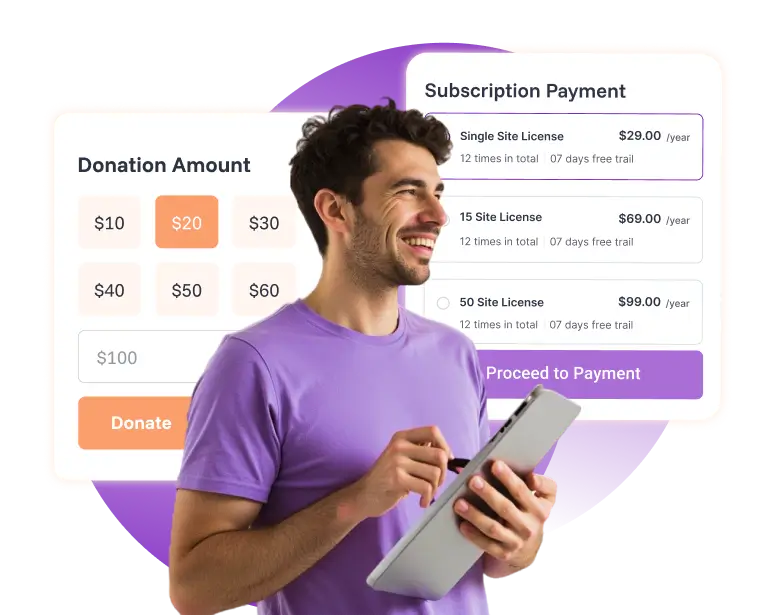
This is where Paymattic comes in. Paymattic lets you build campaign-specific donation forms that match the message and goal of each letter, with outcome-based giving levels, mobile-ready layouts, custom confirmation messages, and built-in trust signals.
Instead of linking every appeal to the same generic form, you can create a tailored page for each campaign in minutes. That continuity between letter and form is what turns a well-written appeal into a completed donation.
Here is an example of how your donation form should look:
When to send a donation request letter?
Donation request letters are particularly effective at certain times of year, but the real answer to “when should I send?” is more nuanced than “year-end.”
Letters tied to a specific event, milestone, or campaign almost always outperform general appeals, regardless of the month.
Here is a practical timing guide to build around.
Year-end giving season (October through December)
This is the highest-volume window for most nonprofits. Many organizations receive up to a third of their annual donations in the last two months of the year. Donor generosity is high, tax deadlines create urgency, and the holiday season makes people more inclined to give.
Start your sequence in October, not December. By the time you send the final year-end push in late December, donors should already know your name.
5 Fundraising Tips for Nonprofits to Supercharge The Giving Season
Giving Tuesday (first Tuesday after Thanksgiving)
A high-visibility global giving day that has become a key calendar date for nonprofits. It works especially well for matching gift appeals and peer fundraising. The window is short, so preparation should start in September or October.
Spring campaign window (March through May)
A strong window for program-specific appeals and annual fund mid-cycle asks. There is less competition than in November and December, which means your letter has a better chance of standing out.
Spring is also a natural moment for school fundraising letters and sports team donation requests tied to upcoming seasons or tournaments.
Fiscal year-end (June for many nonprofits)
A strong moment for major donor outreach and corporate donation letters. Businesses are finalizing budgets, and donors who have not yet hit their charitable giving targets for the year may be looking for opportunities.
Event-triggered timing
A letter tied to a real event, a campaign launch, a milestone, an emergency need, or a matching gift opportunity will outperform a general appeal at almost any time of year. The event creates a natural reason to reach out and a natural deadline for the donor to act.
Wrapping up
A great donation request letter gets someone to click. What they find on the other side determines whether they give and whether they come back next year.
Most organizations treat the donation letter template and the donation form as two separate things. The strongest fundraising campaigns treat them as one continuous experience: the letter sets the story, the form completes it.
Message match, friction-free giving, mobile optimization, and outcome-based giving levels are not nice-to-haves. They are the difference between a campaign that breaks even and one that builds a sustainable donor base.
If you are ready to build donation forms that match your appeals and convert at a higher rate, Paymattic is built exactly for that. From campaign-specific forms to customizable giving levels to mobile-ready layouts, it is the tool that makes the space between your fundraising letter and your completed donation as short as possible.
Join the thousands already enjoying Paymattic Pro!

Tipu Deb
Hey! Tipu here, working as a Marketing Strategist at WPManageNinja & Paymattic. A nature lover and a person who is addicted to exploring historical events. In my leisure, you’ll find me playing with different musical instruments.
Leave a Reply