

How To Start a Nonprofit Organization With No Money


Table of Content
Download Paymattic – it’s Free!

Subscribe To Get
WordPress Guides, Tips, and Tutorials
We will never spam you. We will only send you product updates and tips.
If you’ve been sitting on a powerful idea to serve your community but keep telling yourself, “I’ll start when I have the money,” this guide is your permission slip to begin right now.
The truth is, thousands of successful nonprofits started with nothing more than a clear mission, a few committed people, and free tools. The money came after because the cause was real and the foundation was solid.
This step-by-step guide will walk you through exactly how to start a nonprofit organization with no money, begin raising funds before your organization is fully registered and avoid the most common legal and financial mistakes.
What you’ll learn in this guide:
– Whether you can legally start a nonprofit by yourself
– The real cost to start a charity (and how to minimize it)
– How to get 501(c)(3) status by your own
– Free tools and grants to fund your early operation
– How to collect donations from Day one even before full registration
Can you start a nonprofit organization alone?
Obviously, you can.
Starting a nonprofit organization is not the same as starting a for-profit business. Nonprofits don’t need startup capital in the traditional sense. You don’t need investors, loans, or a big bank account. What you do need is:
- A legally recognized mission (purpose that qualifies under IRS categories)
- At least one other person to form a board (in most states)
- Time to handle paperwork and outreach
- A free or low-cost way to collect early donations
Yes, I know you have to pay government fees of $1000 alone in the starting stage. Additionally, to register your non-profit with the Internal Revenue Service in the USA, you must pay a minimum of $275. On top of that, you need to spend money on fundraising software, promotional efforts, office costs, and other things. So how is this possible with no money and alone?
Here, being alone doesn’t mean doing all the stuff by yourself. It simply means taking the first step in building a foundation on your own. In the beginning, you will need to recruit a board of directors, community support, and find ethical supporters who can help you to cover your initial expenses. But if you go with online fundraising, you can save the extra office expenses.
When your organization grows, it’s impossible to run it alone. At that time, you will need organizers, volunteers, and supporters to assist you.
10 steps to start a nonprofit organization with no money
As far as you know, it is possible to start a non-profit foundation for free. However, starting without having the capital seems daunting. Despite the challenges, many nonprofits begin their journey with no money or capital funds. Here we will show you the basic steps to start a nonprofit organization for free.
Step 1: Define your mission and vision
Clarity is the foundation of any organization. In the case of non-profits, it matters most, as this type of organization raises funds and works for others. Before you file a single form, you must be able to answer these questions in plain, simple language:
- What problem are you solving?
- Who specifically will you serve?
- How will your work create measurable change?
- Why does this cause need a formal organization, not just informal community action?
Your mission statement should be one or two sentences that any stranger can understand immediately. So before you start, set a specific mission and vision for your organization. Describe the purpose of your charity and which populations it serves. Also, outline the long-term impact that you aimed to achieve through your humanitarian work.
Mission Statement Formula (example): “Community Roots exists to provide after-school STEM education for underserved youth in rural areas so that every child has equal access to career opportunities.”
Step 2: Choose your nonprofit structure
Not all nonprofits are structured the same way. Here are your main options in the U.S.:
501(c)(3) Public Charity: The most common type. Donations are tax-deductible for donors. Required for most grants. Best for: education, religion, science, poverty relief, arts, and more.
501(c)(4) Social Welfare Organization: Allows more political activity than a (c)(3). Donations are NOT tax-deductible. Best for: civic leagues and advocacy groups.
Unincorporated Association: No formal registration needed. Great for testing your idea before committing to legal paperwork.
Fiscal Sponsorship: Partner with an existing 501(c)(3) organization that “hosts” your project legally. You can accept tax-deductible donations immediately without incorporating. Ideal for: early-stage projects with no money.
If you’re just starting with no money, consider beginning as an unincorporated association or through fiscal sponsorship. You can always formalize later once you’ve validated your mission and raised some initial funds.
Step 3: Recruit your board of directors
Most states require a minimum of 3 board members to incorporate as a nonprofit. Your board is not just a legal formality; they are co-founders of your mission.
Ideal board members bring:
- Legal or financial expertise (to reduce professional costs)
- Community connections (donors, volunteers, partner organizations)
- Diverse lived experience related to your cause
- Genuine commitment to governance (attending meetings, reviewing financials)
Some states allow a single-person board, but it’s not recommended. A solo board creates governance risk and makes it harder to get grants. Having at least 3 unrelated board members is the IRS’s strong preference for 501(c)(3) applications.
Board recruitment tips:
– Post on LinkedIn, VolunteerMatch, and local Facebook community groups
– Reach out to local university professors (they often serve on boards for experience)
– Connect with your local Chamber of Commerce or Rotary Club
– Ask retired professionals passionate about your cause
Step 4: Choose and register your organization’s name
Your nonprofit’s name needs to be unique within your state (check your Secretary of State’s website) and align with your mission for brand clarity.
Before you fall in love with a name, search:
- Your state’s Secretary of State business name database (free)
- IRS Exempt Organizations database at apps.irs.gov/app/eos (free)
- USPTO trademark database at tmsearch.uspto.gov (free)
- Available domain names at Namecheap or Google Domains
Once confirmed, register a domain name, create a simple AI logo for your nonprofit, and a free Gmail or Outlook account using your nonprofit’s name. This gives you immediate professional credibility for early donor outreach.
Step 5: Incorporate your nonprofit
Incorporating makes your organization a legal entity, separate from you personally. This protects your personal assets and is required before applying for tax-exempt status.
To incorporate, you file Articles of Incorporation with your state’s Secretary of State office. Most states have a standard template available for free on their website.
Your Articles of Incorporation must typically include:
- Organization name and address
- Statement of purpose (aligned with IRS-approved activities)
- Limitation of activities clause (nonprofit activities only)
- Dissolution clause (assets go to another 501(c)(3) if you close)
- Name and address of registered agent
- Names of initial board members
Step 6: Draft your nonprofit bylaws
Bylaws are your organization’s internal rulebook. They’re required for your 501(c)(3) application and essential for governance. The IRS will not approve your tax-exempt status without them.
Your bylaws should cover:
- Purpose of the organization
- Board size, qualifications, and terms
- How board members are elected and removed
- Meeting frequency and quorum rules
- Officer roles (President, Secretary, Treasurer)
- Conflict of interest policy
- How bylaws can be amended
Free nonprofit bylaw templates are available from:
- National Council of Nonprofits (councilofnonprofits.org)
- BoardSource (boardsource.org)
- Your state’s Secretary of State office
Do not copy bylaws from another organization without customizing them carefully for your state’s laws and your specific governance model.
Subscribe Newsletter
Subscribe to our newsletter for updates, exclusive offers, and news you won’t miss!

Step 7: Apply for an Employer Identification Number (EIN)
An EIN (also called a Federal Tax ID) is like a Social Security number for your organization. It’s required to open a bank account, hire staff, and file taxes.
The good news: Applying for an EIN is completely free and takes about 10 minutes online at IRS.gov. You’ll receive your EIN immediately upon approval.
Improtant note: Apply for your EIN AFTER you incorporate. The EIN application asks for your legal business name and state of formation information you won’t have until after incorporation.
Step 8: Open a dedicated bank account
Never mix personal and nonprofit funds. This is one of the most common mistakes new founders make and it can cost you your tax-exempt status.
To open a nonprofit bank account, you’ll typically need:
- Your EIN
- Articles of Incorporation (certified copy)
- Bylaws
- Board resolution authorizing the account
- Government-issued ID for all signatories
Many banks offer free nonprofit checking accounts. Top options for small nonprofits with no money include:
- Bank of America (Nonprofit Advantage account – no monthly fee)
- Wells Fargo (Nonprofit Organization Checking)
- Local credit unions (often most flexible for new organizations)
- Relay Financial (online business banking, highly recommended for nonprofits)
Step 9: Apply for 501(c)(3) tax-exempt status
This is the step most people are most afraid of and the most important for long-term fundraising success.
501(c)(3) status from the IRS means:
- Donations to your organization are tax-deductible for donors
- You’re exempt from federal corporate income tax
- You qualify for most private and government grants
- You get discounts on postage, software, and many services
Step 10: Register with your state for charitable solicitation
Most states require nonprofits to register before soliciting (asking for) donations within that state. This is separate from your federal 501(c)(3) application.
About 40 U.S. states have charitable solicitation registration requirements. Fees vary by state but are often $0–$50 for new organizations.
The Multi-State Filer Project (multistatefiling.org) offers a unified registration form accepted by many states, saving time if you plan to solicit nationally.
Start fundraising for free with Paymattic
People prefer online giving because of its comfort and flexibility. As a non-profit owner, you have to run a fundraising campaign to raise funds for your cause. On this point, you will need one fundraising tool that lets you start at zero cost.
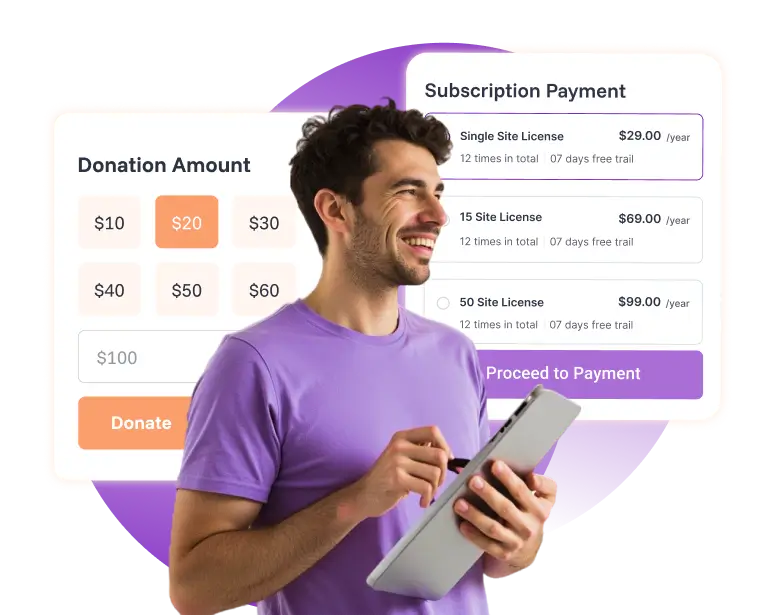
Let’s introduce Paymattic. It’s an all-in-one plugin that offers almost every feature that you need to run an online fundraising campaign. The free version of this plugin allows you to collect donations effectively without any kind of fees.
What makes it especially useful for beginners is its free version. You can start collecting donations right away without paying for extra tools or add-ons. There are no platform fees involved, just install the plugin, set up your form, and you’re ready to go.
Getting started is simple: download Paymattic from the WordPress repository, create a donation form, and begin accepting contributions through Stripe.
Paymattic free version includes:
- Stripe gateway for both payment and fundraisers (Credit Card, Apple Pay, Google Pay, and more)
- Stripe on-site checkout option
- Pre-built templates (both payment and donation)
- Horizontal payment layout
- Donation progress bar
- PDF invoice
- Form editor fields
- Multi column form fields
- Currency Settings
- 22 form fields to create and customize forms
- ReCAPTCHA V2 and V3
- Honeypot security
- Cloudflare Turnstile security
- Import and export your form entries
- Customizable confirmation message
- Free integrations: FluentCRM, Fluent Support, MailChimp, Slack, Zapier, and FluentCommunity
- Custom CSS support
The free version also lets you manage all the form entries and ensures three layers of security on your donation form.
Start Your Journey for Free!
With Paymattic free, you get a full suite of features to manage transactions from the moment you are in.
Common mistakes to avoid when starting a nonprofit with no money
1. Starting with a vague mission: If you can’t explain what you do in one sentence, donors and grantors will move on. Specificity builds trust.
2. Skipping the bylaws: Bylaws aren’t just a legal formality. They prevent internal conflicts and board disputes that destroy nonprofits in their first years.
3. Mixing personal and organizational finances: Even before you incorporate, keep a separate account or cash envelope specifically for nonprofit expenses.
4. Not registering for charitable solicitation: Raising money without registering in your state can result in fines and reputational damage.
5. Trying to do everything alone: The most resilient nonprofits start with a team. Recruit committed volunteers and board members early.
6. Waiting for 501(c)(3) status before fundraising: You can raise money as an unincorporated association or through fiscal sponsorship while your federal application is pending.
7. Ignoring donor receipts and acknowledgment: Donors need written acknowledgment of contributions over $250 for their tax records. Automate this from day one.
Start a non-profit for free today
Starting a nonprofit with no money is not only possible, it’s the story of most impactful nonprofits that exist today. They began with people who cared deeply about a problem, were willing to learn the necessary steps, and took action before they felt fully ready.
The 10 steps outlined in this guide give you everything you need to move from idea to legal organization, build the foundation for sustainable fundraising, and serve your community with integrity and effectiveness.
However, Paymattic is always there for you to make your non-profit fundraising journey simple, secure, and flawless. Explore our website to find more informative articles on receiving donations online, personal fundraising, and much more.
Best of luck with your non-profit.
Have a good day.
Ciao!
Join the thousands already enjoying Paymattic Pro!
Frequently asked questions
Here are some mostly asked questions on “How to start nonprofit organization with no money”
1. Can I start a nonprofit by myself?
Yes, you can initiate the process alone, but most states require at least 3 board members to incorporate. The IRS also looks favorably on organizations with diverse governance. You don’t need a co-founder, but you do need a board.
2. How long does it take to start a nonprofit?
Incorporating your state entity typically takes 1–4 weeks. IRS Form 1023-EZ approval takes 2–4 weeks. Form 1023 (full) can take 3–6 months. Total time from idea to fully operational: 1–6 months, depending on your state and the form you file.
3. What is the cost to start a charity?
Realistically: $300–$800 in government filing fees if you handle everything yourself. $1,500–$5,000 if you use professional legal/accounting help. $0 if you use fiscal sponsorship and qualify for all fee waivers. The biggest cost is your time.
4. How do I raise money to start a nonprofit before it’s registered?
You can raise money as an unincorporated association, through a fiscal sponsor’s 501(c)(3) umbrella, via crowdfunding platforms, or through individual contributions deposited into a dedicated bank account. Keep careful records of all early donations.
5. Do I need a lawyer to start a nonprofit?
Not necessarily. Millions of nonprofits have been started without lawyers using free templates, state resources, and online guidance. However, for complex organizations, those serving vulnerable populations, or organizations planning to grow quickly, legal guidance is worthwhile. Many law school clinics and bar associations offer free nonprofit legal assistance.

Madhobi
This is Madhobi, a content writer at WPManageNinja with expertise in technical writing and email marketing. Outside of work, she likes traveling and exploring new places.
Leave a Reply