

35 Best Fundraising Ideas for Sports Teams in 2026


Table of Content
Download Paymattic – it’s Free!

Subscribe To Get
WordPress Guides, Tips, and Tutorials
We will never spam you. We will only send you product updates and tips.
If you run a sports team, you already know the money never stops going out. Uniforms wear out, equipment needs replacing every season, travel adds up fast, and there’s always one tournament fee nobody planned for.
You can’t keep covering it out of your own pocket, and you definitely can’t keep asking the same five families every single time.
That’s where fundraising comes in, but most lists of sports team fundraising ideas give you the same fifteen things you’ve probably already tried.
This one doesn’t.
In this article, we’ve covered 35 best fundraising ideas for sports teams, split into six categories, plus a quick way to figure out which ones actually fit your team instead of just picking randomly.
Key takeaways:
You’ll find 35 creative sports fundraising ideas here, sorted into six categories: online, sports-specific, event-based, product-based, sponsorship, and game-day.
Online fundraising ideas for sports teams, like crowdfunding and peer-to-peer campaigns, work best for travel teams or anyone trying to reach supporters outside their local area.
Sponsorships and charity tournaments tend to be the most profitable fundraising ideas for sports clubs relative to the time you put in.
If you need quick fundraising ideas for sports teams, a social media donation drive or a text-to-give campaign at your next game can bring in money the same week.
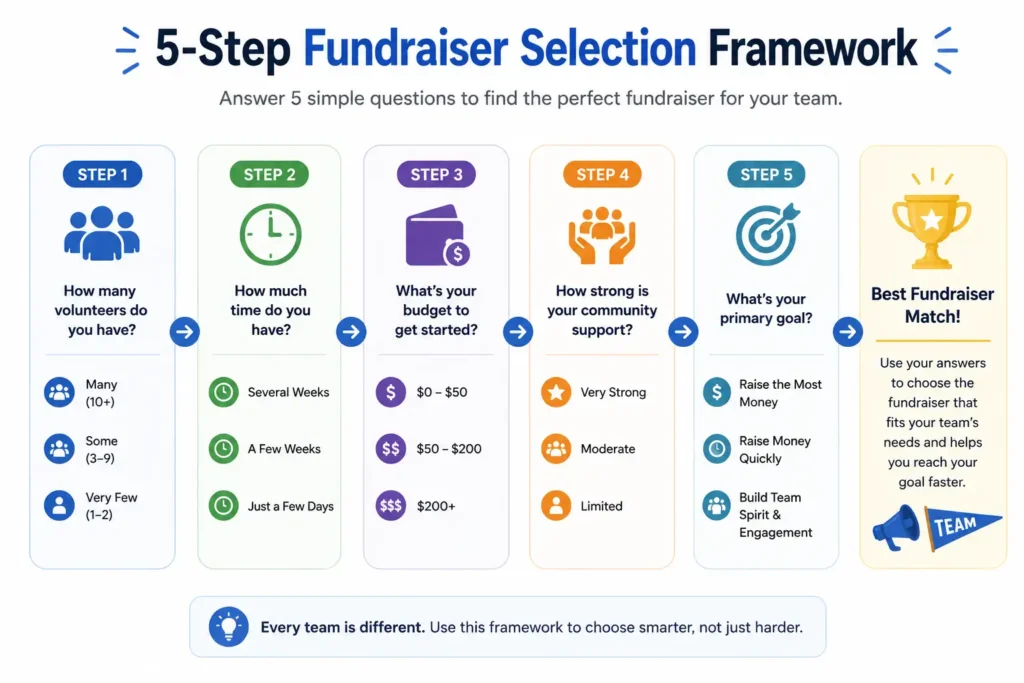
A simple five-question framework near the end helps you pick the right idea instead of guessing or copying whatever another team did last season.
Online fundraising ideas for sports teams
These are the ones to lean on if your team doesn’t have time for a big in-person event, or if you want to raise money from people who aren’t local.
You can run most of these from your phone, and if you’re after easy fundraising ideas for your team that don’t take weeks to set up, this is the category to start with.
Crowdfunding campaign
A crowdfunding campaign means setting up one central page where anyone, family, friends, alumni, and local businesses can chip in whatever they want toward your goal.
It works because people don’t need to commit a large amount; twenty small donations add up just as fast as two large ones, and you can share the link anywhere.
How to execute:
Pick a platform or set up a donation form on your own site so you’re not losing a cut to transaction fees.
Write a short, honest story about why you’re raising money, new uniforms, a tournament trip, equipment, whatever it is.
Set a specific dollar goal instead of a vague one. Share the link across team group chats, parent email lists, and social media, and post an update once you hit milestones so people see their donation actually mattered.
Peer-to-peer fundraising
Instead of one team page asking for donations, every player gets their own personal fundraising page tied back to the team goal. This usually outperforms a single crowdfunding page because you’ve now got fifteen or twenty people sharing with their own networks instead of just one.
How to execute:
Set up individual pages for each player within the main team campaign so that progress rolls up to a single shared goal. Give players a simple script or template for asking.
Most kids and parents freeze up when asked to “just ask people for money” with no guidance.
Add a bit of friendly competition, like recognizing whoever raises the most each week, since that alone tends to push numbers up. Check in weekly so it doesn’t quietly die after the first few days.
Peer-to-peer vs Crowdfunding | Which One is Best for Fundraising?
Virtual challenge
A virtual challenge is a pledge-based fundraiser where supporters donate based on something your team does, miles run, free throws made, push-ups completed, tracked over a set period, instead of at a single event. It’s a flexible option if your team is spread across different schedules or locations.
How to execute:
Pick something measurable that fits your sport, like total miles biked for a swim team’s dryland training or total reps for a strength challenge.
Set a timeframe, usually one to four weeks works best. Let supporters either pledge a flat amount or pledge per unit (a dollar per mile, for example).
Post regular progress updates with photos or short videos, since that’s what keeps people checking in and donating more as the challenge goes on.
Online auction
An online auction is an easy sports team fundraiser that lets people bid on donated items or experiences without anyone needing to show up in person.
You can run it stand-alone or as a boost alongside another event, and it works especially well if your community has businesses willing to donate products or services.
How to execute:
Reach out to local businesses, alumni, and team families for donated items, gift cards, signed memorabilia, and experiences like a private coaching session, all works well.
List everything with clear photos, descriptions, and a starting bid. Run the auction over several days, not just a few hours, so people have time to come back and outbid each other.
Send a friendly reminder as it’s closing, that last-day push is usually when bids jump the most.
Social media donation drive
This is one of the simplest sports fundraising ideas on this list. You use your team’s existing social media accounts to make a direct ask, post a story, tag people, and link straight to your donation page.
No new platform, no setup time, just a clear ask in front of people who already follow your team.
How to execute:
Pick one platform where your team already has the most engaged followers. Post consistently, not just once, a single post gets buried fast. Use real photos and short videos of the team instead of stock graphics, since that’s what people actually stop scrolling for.
Make the donation link easy to find, in your bio, pinned to the top of your page, and repeated in every post.
Text-to-give campaign
Text-to-give lets supporters donate on the spot by texting a keyword to a number, no app download, no long form to fill out. It’s especially strong at games and events where people already have their phones out and don’t want to dig for a wallet.
How to execute:
Set up a text-to-give number through your payment or donation provider ahead of time. Create a short, memorable keyword tied to your team name or campaign.
Put signage up at games, on programs, even on a banner near the concession stand, so people see it while they’re already in donating mode. Combine it with an announcer shoutout during a game for the biggest spike in donations.
Sports-specific fundraising ideas
These connect straight back to your sport, so they don’t feel like a separate task bolted onto the season.
They double as team bonding, and your community tends to show up for them because they’re genuinely fun to watch.
Shoot-a-thon
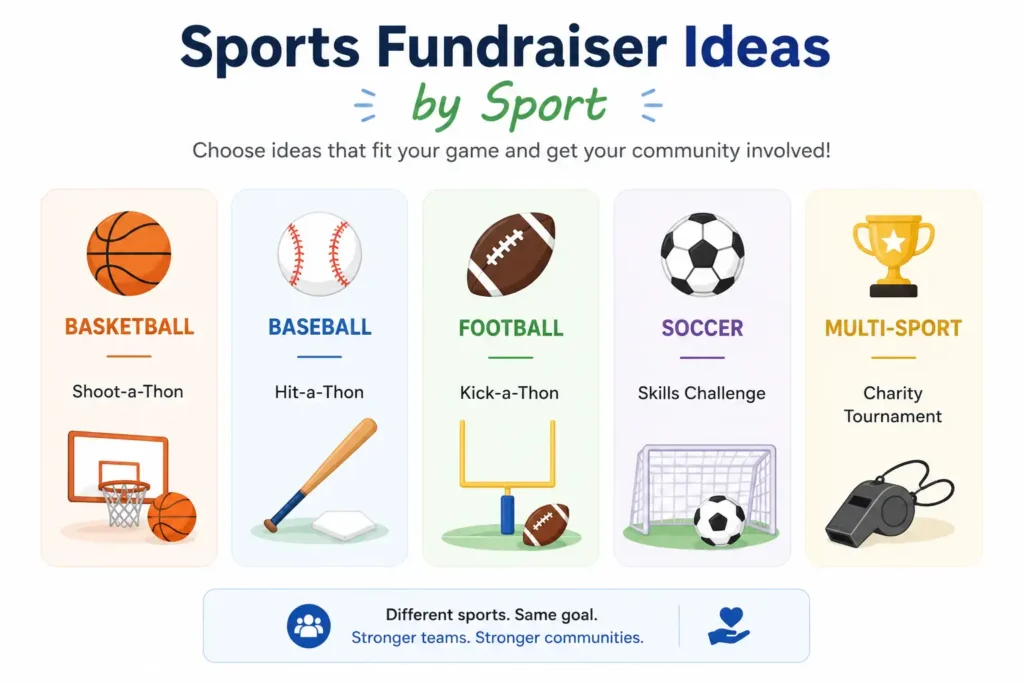
A shoot-a-thon fundraising idea works especially well for basketball teams. Each player shoots for a set amount of time, and sponsors pledge either a flat donation or a set amount per basket made.
It turns practice skills into a fundraiser without anyone having to sell a single thing.
How to execute:
Give each player a pledge sheet or a digital pledge page ahead of time so sponsors can commit before the event. Set a time limit per shooter, five minutes works well, and line up volunteers to rebound and count.
Promote the date in advance so sponsors actually show up or tune in if you’re streaming it. After the event, follow up quickly to collect what was pledged while it’s still fresh in people’s minds.
Hit-a-thon
Same idea, baseball and softball version. Players take swings for a set period, and sponsors pledge per hit instead of per basket.
How to execute:
Set the same structure as a shoot-a-thon, fixed time per player, pledge sheets collected beforehand, and a few parent volunteers to pitch and keep count. Film a few highlights to post afterward, since that’s what gets people to actually follow through on paying their pledge.
Kick-a-thon
The football equivalent. Players attempt goals or juggle the ball for a set time, with sponsors pledging per goal or per minute of control.
How to execute:
Keep it simple, one station per player, a clear scoring rule everyone agrees on beforehand, and someone tallying results in real time so there’s no dispute later.
Share results the same day so momentum doesn’t fade before you collect.
Sports skills clinic
You host a clinic where your players and coaches teach younger kids in the community. Parents pay a registration fee for their kid to learn from “the big kids,” and it works because it’s genuinely useful, not just a donation ask.
How to execute:
Pick an age group below your own team’s age; usually, a 4 to 8-year gap works well. Set a date, a fee, and a simple structure of drills and stations. Promote it through local youth leagues, elementary schools, and your own team’s social pages.
Give each kid something small at the end, a sticker, a certificate, anything that makes them want to come back next season.
Charity tournament
This is one of the most popular fundraising ideas for high school sports teams around the world. Invite other local teams to compete for an entry fee, with the proceeds going to your program. It doesn’t have to be your main sport either; a cornhole or dodgeball tournament can pull in just as many people, sometimes more.
How to execute:
Pick a format that’s easy to run; a single elimination bracket keeps things moving. Set an entry fee per team and lock down a field or venue early.
Line up a couple of local sponsors to cover prizes so the entry fees go straight to your team. Run a concession stand on the side, since a captive audience at a tournament almost always means extra food and drink sales too.
Coach challenge
Set a fundraising goal, and if your team hits it, the coach has to face a fun, slightly embarrassing challenge. Shaving their head, a dunk tank, dressing up for a week, whatever fits their personality.
How to execute:
Pick a challenge your coach is actually willing to do, and one that your supporters will find genuinely funny. Set a clear dollar goal and a deadline. Promote it everywhere.
This is the kind of sports fundraiser that spreads fast because people want to see if the goal gets hit. Follow through publicly once it does, since that’s half the fun and it builds trust for next time.
Pie the coach
A lighter, faster version of the same idea. Supporters pay for the chance to throw a pie at a coach (or vote on which coach gets it), usually stacked onto an existing event like a game day or banquet.
How to execute:
Set a price per throw or per vote. Pick a designated spot so it doesn’t turn into a mess everywhere. Pair it with a bigger event so there’s already a crowd, and get someone filming it.
This is exactly the kind of content that does well on social media afterward, which means more eyes on your next fundraiser, too.
Obstacle course challenge
Set up a course people pay to attempt, built around agility and a bit of friendly competition. It works for all ages, which makes it one of the more unique fundraising ideas for sports teams looking to involve the whole community, not just athletes.
How to execute:
Use equipment you already have, cones, hurdles, ropes, whatever’s lying around. Charge an entry fee per attempt and offer a small prize for the fastest time.
Promote it with photos beforehand to build buzz, and post the best runs afterward since people love watching others struggle through an obstacle course almost as much as running it themselves.
Event-based fundraising ideas for sports teams
These are the classics, the sports fundraising ideas that bring your whole community together in one place at one time.
Whether you call them youth sports fundraising events or just team fundraisers, they take more coordination than the online options, but they tend to raise more per event when you pull them off well.
Car wash
Still one of the easiest fundraising ideas for sports teams to pull off with almost no budget. All you need is a location, some soap and sponges, and a team willing to spend a Saturday getting wet.
How to execute:
Pick a high-traffic spot with permission to use it; a parking lot near a busy road works best. Schedule it for a sunny day if you can; attendance drops fast in bad weather.
Advertise it for at least a week beforehand through social media and local community boards. Have a sign visible from the road so people driving by actually know what’s happening and can pull in.
Trivia night
A trivia night brings in people who might not otherwise show up to a high school sports fundraiser, since it’s social, low-pressure, and genuinely fun. Charge an entry fee per team and offer a prize for the winners.
How to execute:
Book a venue, a community center, a restaurant, or even your school gym works fine. Find someone with energy to host; this matters more than the questions themselves.
Set team sizes and an entry fee per team rather than per person, since that usually gets you more total attendees. Sell snacks or drinks on the side for extra revenue.
Karaoke night
A karaoke night is cheap to run and surprisingly effective, since people will pay just to watch their friends attempt a song badly. It’s also one of those creative youth sports fundraising ideas that gets shared on social media without you even trying.
How to execute:
Rent or borrow karaoke equipment; plenty of community centers already have it. Charge a small entry fee at the door and a small fee per song if you want to add a bit more revenue.
Get a few confident singers lined up early so the night doesn’t start awkward and quiet. Sell concessions throughout the night since people stick around longer than you’d expect.
Fun run
A fun run or walkathon works for almost any team, any age group, and any budget. Charge an entry fee, and layer in pledges based on laps or distance for extra revenue.
How to execute:
Pick a route on public land, or school grounds work fine if you don’t need roads closed. Set an entry fee and offer pledge sheets for people who want to raise more based on the distance completed.
Promote it through team channels and the wider community, since fun runs tend to pull in people outside your usual donor base. Hand out something simple at the finish, even a popsicle, keeps people smiling and more likely to come back next year.
Community field day
A full day of games and activities for families, built around things you already have access to. It’s one of the common fundraising ideas for youth sports teams specifically, since it’s built for families with younger kids.
How to execute:
Pick a sunny day and a field you can reserve for free or cheaply. Set up simple stations, tug of war, relay races, water balloon tosses, nothing that needs special equipment.
Charge per activity or a flat entry fee for the whole day. Sell food and drinks on site, since a full day outside means people get hungry and don’t want to leave to go find something.
Restaurant partnership night
Partner with a local restaurant for a night where a percentage of sales goes back to your team. It’s a profitable fundraising idea as it costs you nothing to set up and gives the restaurant a reason to want repeat business from your community.
How to execute:
Reach out to a restaurant your team already frequents; owners are usually more receptive when there’s an existing relationship. Pick a slower weeknight so it’s a genuine boost for them, not a hassle.
Promote it heavily through your team channels so the turnout actually justifies their generosity. Add a small extra, a raffle or a quick trivia round, to keep people there longer and spending more.

Bingo night
Bingo nights work because they’re easy to understand, cheap to run, and appeal to a wide age range, parents and grandparents included. Charge per card and offer a mix of small and larger prizes.
How to execute:
Get bingo cards and a caller, ideally someone with a bit of personality, since that’s what keeps the room engaged. Line up prizes from local businesses willing to donate in exchange for a shoutout.
Run several rounds throughout the night rather than just one or two, since each round is really its own mini fundraiser. Sell snacks on the side to add a bit more to the total.
Product-based fundraising ideas
These sports fundraising ideas rely on selling something rather than asking for a straight donation, which tends to work well with people who want something in return for their money. If you’re looking for ideas that double as something people actually want to keep, this category is where to look.
Team merchandise
Selling team merchandise is a very classic idea to raise money for a high school sports organization. You can sell branded gear, shirts, hoodies, water bottles, hats, and raise money while also turning your supporters into walking advertisements for your team.
It’s one of the most profitable fundraising ideas for sports teams when priced right.
How to execute:
Pick two or three items instead of trying to sell everything at once; simpler is easier to manage and sell through. Use a print-on-demand service if you don’t want to deal with inventory and upfront costs.
Set up an online store so people can order and pay without you handling cash. Promote it at games, on social media, and through team newsletters so it stays visible all season, not just for one week.
While choosing the merchandise, consider some key factors, like
- Its relevance to the sport
- Geographical location
- Time of the year
- Pricing
Team calendar
A team calendar featuring players, game schedules, and maybe a few fun behind-the-scenes shots makes a great keepsake families actually want to buy and keep. It’s also a low-cost way to raise steady money for sports clubs without a big event.
How to execute:
Collect photos throughout the season so you’re not scrambling at the last minute. Keep the design simple, a basic month-by-month layout with one photo each works fine.
Print a reasonable batch based on team size and presale interest; you don’t want a garage full of unsold calendars. Sell at games, through team channels, and to extended family who might not see your team play in person otherwise.
Bake sale
Still a reliable classic. Low cost to run, and people genuinely enjoy buying baked goods to support a cause they care about.
How to execute:
Get parents and players to contribute baked goods instead of buying everything yourself; it keeps costs near zero. Set up at a game, school event, or busy community spot.
Price things simply; round numbers move faster than odd pricing. Keep a steady rotation of new items if you’re running it more than once, since the same exact spread every time tends to slow down sales.
Discount cards
Partner with local businesses to create a discount card that supporters buy once and use all year. It gives buyers ongoing value instead of a one-time transaction, which makes the ask easier.
How to execute:
Reach out to local businesses your community already shops at and ask if they’ll offer a discount in exchange for being featured. Decide whether to design your own card or use an established discount card company to handle the printing and logistics.
Price the card so the value is obvious; if one uses it back, it sells itself. Sell through players and parents rather than relying only on a table at an event.
Shoe drive
A shoe drive lets people donate something they’re not using instead of cash, which makes it one of the easier asks on this list. You collect gently used or new shoes and partner with a facilitator who pays your team based on what’s collected.
How to execute:
Partner with an organization like Funds2org that runs shoe drive fundraisers; they’ll usually provide bins, promotional material, and pickup logistics. Recruit volunteers to spread the word and collect donations from your community, school, and local businesses.
Set a clear collection window so it doesn’t drag on indefinitely. Promote the bigger picture too, shoes going to people who need them, since that gives this fundraiser a meaning beyond just your team’s budget.
Subscribe Newsletter
Subscribe to our newsletter for updates, exclusive offers, and news you won’t miss!

Sponsorship fundraising ideas for youth sports teams
Sponsorships bring in bigger amounts per relationship than most one-off events, and they tend to come back year after year once you’ve built a connection with the right businesses.
Most lists of sports team fundraising ideas treat sponsorships as an afterthought, buried near the bottom or skipped entirely. That’s a mistake. Done right, sponsorships often bring in more than every other category on this list combined.
Local business sponsorship
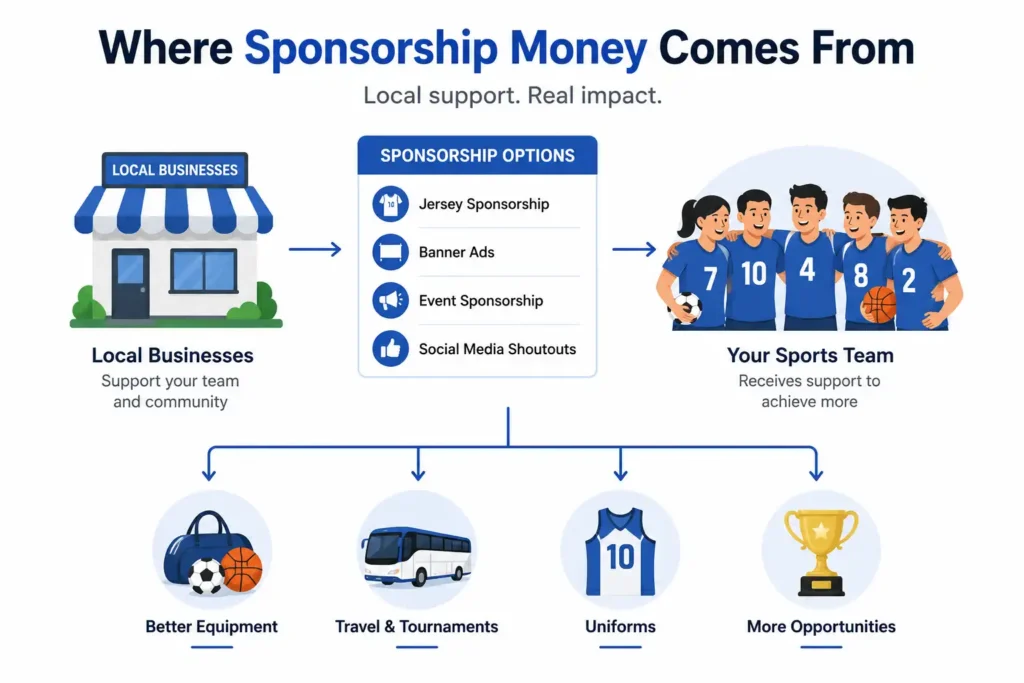
Local businesses sponsor your team in exchange for visibility on banners, social media, programs, wherever your team has an audience.
How to execute:
Build a simple sponsorship packet showing what businesses get at each giving level. Reach out to businesses your players’ families already use, plumbers, restaurants, dentists, anyone with a reason to want local goodwill.
Offer a few tiers so smaller businesses can still participate without feeling priced out. Follow through visibly on what you promised, a logo that actually shows up where you said it would, matters more than people think.
Jersey sponsorship
A business pays to have its name or logo featured on your team’s jerseys, which gives them ongoing visibility every single game. It’s a great fundraising idea for high school sports.
How to execute:
Decide on placement options ahead of time, front, sleeve, and back, and price each differently based on visibility. Pitch it as advertising, not charity; businesses respond better to that framing.
Bundle in extras like a social media mention or a banner at games to sweeten bigger sponsorships. Lock in the agreement before the jerseys go to print so there’s no scrambling later.
Event sponsorship
Instead of sponsoring the whole season, a business sponsors a single event, your tournament, your banquet, your fun run, in exchange for recognition at that event specifically.
How to execute:
Pick events that naturally draw a crowd, since that’s the appeal for the sponsor. Offer clear, simple recognition, a banner, an announcement, or a mention in event materials.
Keep the ask specific and time-bound; businesses often say yes faster to a single event than to an open-ended season commitment. Send a quick thank you and a photo afterward; it makes them far more likely to say yes again next time.
Sponsor-a-player campaign
Individual players get sponsored directly, either by a business or a family friend, to help cover their personal costs, registration, gear, and travel.
How to execute:
Let each player build a short profile explaining what they need sponsorship for. Set a target amount per player based on real costs, not a vague round number. Encourage players to reach out personally rather than relying only on a general team post; personal asks convert better.
Recognize sponsors publicly once a player’s goal is hit, since that recognition is often the main reason people say yes in the first place.
Game-day fundraising ideas for sports clubs
You already have a captive audience on game day. These are some of the simplest sports fundraising strategies out there, because the crowd’s already there, you’re just capturing a bit of that energy as actual funds.
50/50 raffle
This fundraising strategy for a sports team is very simple. Half the money raised goes to the team, half goes to one lucky winner. It’s simple, fast, and works at almost any game with decent attendance.
How to execute:
Check your local rules on raffles before running one; this varies by area. Sell tickets before and during the game, with a couple of volunteers walking the stands.
Draw the winner at a set point, halftime, or the end of the game; both work. Announce it publicly; the excitement of the draw is part of what makes people buy in the first place.
Concession stand
Running your own concession stand at games turns an existing crowd into steady, repeatable income all season long.
How to execute:
Stick to simple, low prep items, hot dogs, chips, drinks, and baked goods. Get a rotation of parent volunteers so it’s not the same few people every single game.
Price for convenience, people at a game want something fast, not a complicated menu. Keep a simple cash box or accept digital payments so you’re not turning away people who don’t have cash on them.
Halftime challenge
A quick contest during halftime, a half-court shot, a target kick, and a putting challenge give fans something fun to watch and a reason to donate or pay an entry fee for a shot at a prize.
How to execute:
Pick a challenge that’s quick to run and easy for a crowd to understand instantly. Charge a small entry fee per attempt, or let people donate to vote on who gets to try.
Offer a prize sponsored by a local business, so it costs your team nothing extra. Get the announcer involved; hype matters more than the actual difficulty of the challenge.
Fan donation booth
A simple table or booth at games where fans can donate on the spot, whether that’s cash in a jar or a quick tap-to-pay setup.
How to execute:
Set up near the entrance or concession area where foot traffic is highest. Make the ask specific, “help us get to states” works better than a generic donate sign. Use a simple QR code linked to your donation page so people without cash can still give in seconds.
This is where a tool like Paymattic’s donation form comes in handy, since it works straight from a phone with no app required. Have a friendly volunteer there to actually talk to people; a staffed booth raises more than an unattended jar every time.
Dunk tank
A classic fundraising idea for a reason. People pay for the chance to dunk a coach, a popular player, or even a rival team captain, and it draws a crowd just from the noise and splashing alone.
How to execute:
Rent a dunk tank or borrow one from another local team or organization. Schedule it for a warm day at an event that already has good attendance. Charge per throw or per set of throws, and rotate who’s in the tank to keep interest up. Promote ahead of time who’s going to be in the hot seat; that alone usually sells tickets.
Best sports fundraising ideas by situation
Not every idea on this list fits every team. Here’s a faster way to narrow things down based on your actual situation.
For youth sports teams
When you’re managing fundraising ideas for youth sports teams, simplicity matters more than scale. Parents are busy, kids can’t run a campaign on their own, and everyone involved wants something low-stress.
If you’re specifically after youth sports fundraising ideas that don’t need a big production behind them, these four are your best bet:
- Community field day, since it needs no special skills, and keeps the whole family involved.
- Bake sale, low cost, easy to run, and something parents are already comfortable organizing.
- Shoe drive, because it asks for an item instead of money, which is a much easier ask with younger kids.
- Sports skills clinic, since it gives parents something genuinely valuable in return for their money.
For high school teams
If you’re searching for fundraising ideas for high school sports teams specifically, lean into these four. High schoolers have a bigger built-in community and are old enough to help run things themselves.
- Charity tournament, since older players can help organize and run it.
- Team merchandise, because a school community tends to buy in for the long season, not just one event.
- Jersey sponsorship, local businesses respond well to a high school’s visibility.
- Trivia night, easy to staff with student volunteers and parents both.
For travel teams and college teams
Travel teams, and these fundraising ideas apply as much to college sports teams, are spread across towns, campuses, or even states, so anything that depends on everyone showing up in one place struggles.
- Crowdfunding campaign, works regardless of where your supporters live
- Peer-to-peer fundraising scales with your team instead of needing a single big crowd.
- Virtual challenge and Online auction, let supporters participate from anywhere on their own schedule.
For small teams
Small teams don’t have the manpower for big events, so the best fits are ones that don’t need a crowd to work in the first place.
- Sponsor-a-player campaign works even with a handful of athletes.
- Online auction, one or two organizers can run the whole thing.
- Social media donation drive, costs nothing and needs no setup beyond a phone.
These are easy fundraising ideas for individuals or small teams.
For fast fundraising
Looking for quick fundraising ideas instead of something that takes weeks of planning? Stick with these:
- Social media donation drive, live within minutes of posting.
- Text-to-give campaign, instant donations right at a game.
- 50/50 raffle, sells and pays out the same day.
For maximum profit
If the goal is to get some profitable fundraising ideas for sports teams and raise the most money relative to the effort put in, these consistently outperform the rest of the list.
- Local business sponsorship, one signed deal can outearn several smaller events combined.
- Jersey sponsorship, ongoing visibility means ongoing value for the sponsor, and repeat money for you.
- Charity tournament, entry fees, sponsorships, and concessions all stack within a single event.
Read more: Fundraising Ideas for Clubs: 30+ Ways to Raise Money
How to choose the right fundraising idea
If you’re still not sure where to start, run through these five questions before picking anything. This works whether you’re managing a single team or a sports organization with several programs under one roof.
Team size: Bigger teams can pull off events that need a lot of hands, smaller teams should lean toward things that don’t depend on a big crowd.
Available time: Some of these ideas take weeks of planning, others can be set up in a day. Be honest about how much time your volunteers actually have.
Budget: A few ideas need upfront money, merchandise, calendars, and equipment for a tournament. Others, like a social media donation drive, cost nothing to start.
Community support: If your local businesses are generous and well-connected, sponsorships will outperform almost anything else. If your community is smaller or more spread out, online fundraising ideas for sports teams will carry more weight.
Fundraising goal: A small goal, covering one tournament fee, might just need a single event. A bigger goal, a season’s worth of travel costs, usually needs a mix of several ideas running across the year rather than one big push.
FAQs related to sports fundraising
How do you fundraise for a sports team for the first time?
Start small and pick one idea you can actually pull off without a big team behind it, a social media donation drive or a bake sale are both good first attempts. Once you’ve run one successfully, you’ll have a better sense of what your community responds to before committing to something bigger.
How much can a sports team realistically raise from fundraising?
It depends heavily on the idea and your community size, but a well-run sponsorship deal or charity tournament can bring in several thousand dollars, while smaller events like bake sales or car washes typically raise a few hundred per event.
What’s the easiest fundraiser for a small team to start?
A social media donation drive or a simple online donation page is usually the fastest to set up, since it doesn’t need a venue, volunteers, or upfront cost. Peer-to-peer fundraising is a close second if you have even a handful of players willing to share their personal page.
How long should a sports team fundraiser run?
Most one-time events should be promoted for one to two weeks beforehand. Ongoing fundraisers like crowdfunding campaigns or merchandise sales tend to do best when capped at three to four weeks; longer than that, and momentum usually fades.
Should individual athletes fundraise separately or as part of the team?
Both work, but tying individual fundraising ideas for sports back to a shared team goal, like in a peer-to-peer campaign, tends to raise more overall than asking athletes to fundraise completely on their own.
What’s the most profitable fundraising idea for sports teams?
Sponsorships generally bring in the most relative to the effort involved, since one signed deal can cover what it would take several smaller events to match. Charity tournaments come in close behind, since entry fees, sponsorships, and concessions can all stack within a single event.
Do online fundraising ideas work as well as in-person ones?
For teams with a spread-out community, online fundraising ideas often outperform in-person events simply because they’re not limited by geography or a single date. For tightly knit local teams, in-person events tend to raise more per attendee, but online options are easier to run alongside everything else.
Wrapping up
You don’t need to run all 35 of these. Pick two or three that actually fit your team’s size, schedule, and community, and run them well instead of spreading yourself thin trying to do everything on this list at once.
A car wash and a jersey sponsorship deal will probably do more for your budget than ten different ideas done halfheartedly.
If there’s one thing worth remembering, it’s that the best fundraising ideas for sports teams aren’t always the biggest ones. Sometimes a five-minute social media donation drive brings in more than a full weekend event, and sometimes one good sponsor covers what would’ve taken six bake sales to match.
That’s exactly why the situational guide and the five-question framework are there, so you’re choosing based on your actual team instead of just copying whatever worked for someone else.
Join the thousands already enjoying Paymattic Pro!

Tipu Deb
Hey! Tipu here, working as a Marketing Strategist at WPManageNinja & Paymattic. A nature lover and a person who is addicted to exploring historical events. In my leisure, you’ll find me playing with different musical instruments.

Leave a Reply